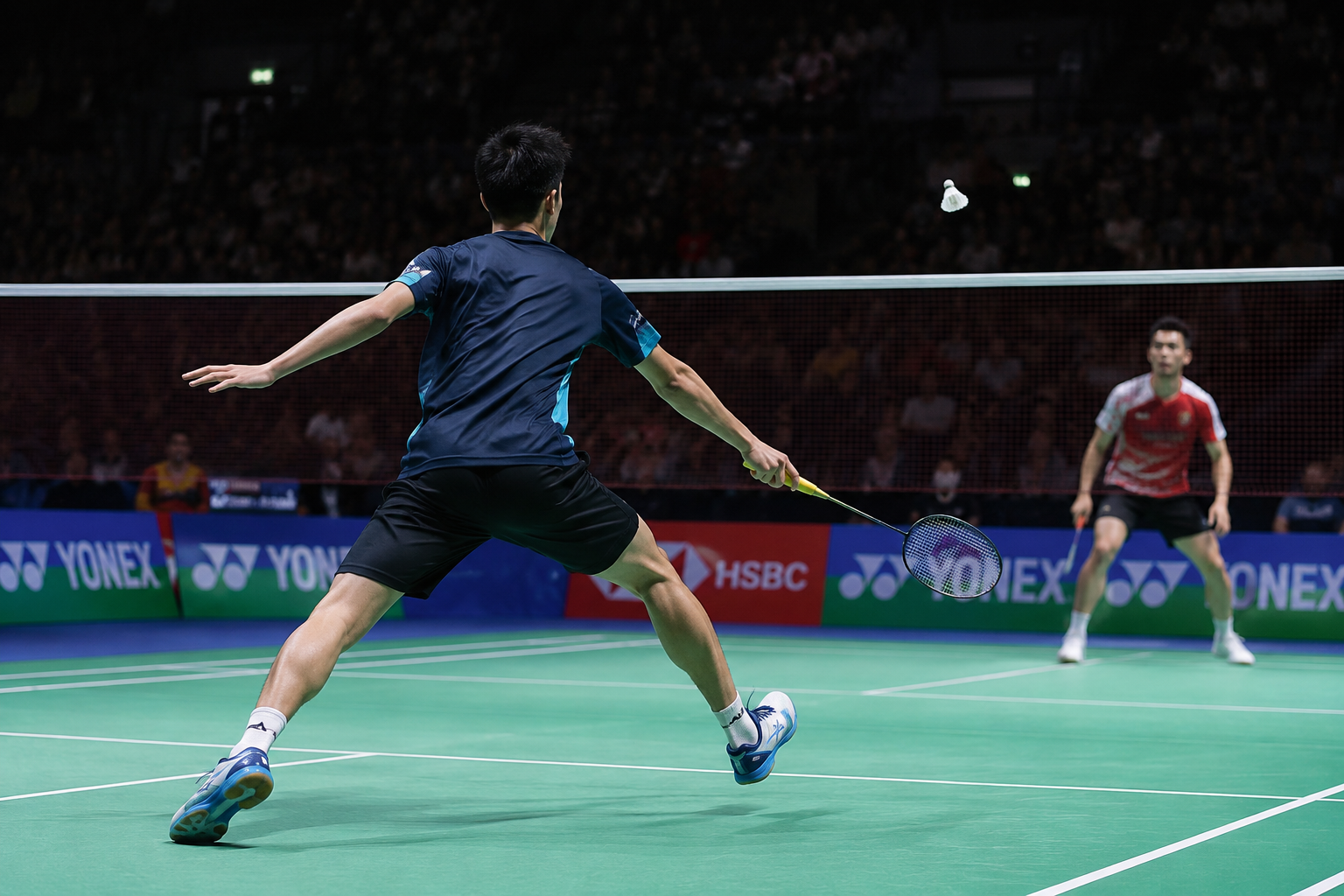
Badminton Singles Rules Explained | Court, Scoring & Service
Badminton singles may seem simple at first. There are only two players, one shuttle, and one court. However, singles is very different from doubles. Every rule, from the court dimensions to the service rules, affects how a player moves, plans rallies, and uses the court. Learning the rules of badminton singles is not only about avoiding faults. It also helps you understand the game better and improve your overall performance.
Top-level badminton singles is also one of the most physically demanding racket sports. According to the Badminton World Federation, elite singles players can cover more than four kilometres during a match through constant forward, backwards, and side-to-side movement. This highlights the importance of fitness, court coverage, and smart positioning in singles.
In this guide, you will learn all the important rules of badminton singles, including court lines, service rules, scoring, and common faults. Along with explaining each rule, we will also show how it affects gameplay and strategy. By the end, you will have a clear understanding of the rules and know how to apply them in both casual games and competitive matches.
What Makes Badminton Singles Different From Doubles?
In singles, one player is fully responsible for covering the entire court from sideline to sideline and from the net to the back boundary. There is no partner to share the load, which means every rule regarding court width, serving, and faults directly affects how a player must move and recover between shots. Consider the following factors that separate singles from doubles:
- A player has no one to cover the net while attacking from the back
- Recovery time after each shot has to account for the full width of the court
- Stamina and movement efficiency matter more than raw power
- Rallies tend to be longer because there is more open space to exploit
These differences are exactly why the rules for singles use a narrower court width than doubles, a detail covered in the next section.
Badminton Singles Court Rules and Dimensions
Court dimensions form the foundation of badminton singles rules. Understanding the court boundaries helps players know where the shuttle can legally land and how to position themselves during a rally.
A badminton singles court measures 13.41 metres in length and 5.18 metres in width. Unlike in doubles, only the inner side lines are used during singles play, while the back boundary line remains in play.
Below are the key court lines every player should know:
| Court Line | Purpose |
| Inner Side Lines | Define the width of the singles court and act as the side boundaries during rallies. |
| Outer Side Lines | Used only for doubles and counts as out of bounds in singles. |
| Back Boundary Line | Marks the deepest point where the shuttle can legally land. |
| Short Service Line | Indicates the minimum distance a serve must travel to be legal. |
| Centre Line | Divides the right and left service courts for serving. |
Since the singles court is narrower than the doubles court, players focus more on using the full length of the court. Deep clears, drop shots, and lifts are commonly used to move opponents between the front and back of the court.
Badminton Singles Service Rules
Service rules determine how every rally begins. A legal serve must follow specific court positioning and serving requirements.
Below are the main service rules in badminton singles:
- When the server’s score is even, such as 0, 2, 4, or 20, they serve from the right service court.
- When the server’s score is odd, such as 1, 3, 5, or 21, they serve from the left service court.
- The shuttle must always be served diagonally into the opponent’s correct service court.
- The shuttle must be struck below the waist, and the point of contact must not be higher than 1.15 metres from the floor.
- The racket head must point downward when making contact with the shuttle.
- Both feet must remain in contact with the court until the serve is hit.
Players usually use one of these two serves:
- High serve: Sends the shuttle deep into the opponent’s back court.
- Low serve: Lands close to the net, encouraging a quick net rally.
Failing to follow any of these rules results in a service fault, and the opponent wins the point.
Badminton Singles Scoring Rules
Badminton singles follows the rally point scoring system, which means a point is awarded after every rally, regardless of which player served.
The table below explains how matches are scored:
| Aspect | Rule |
| Points per game | First player to reach 21 points |
| Winning margin | A player must win by at least 2 points |
| Score at 20–20 | Play continues until one player leads by 2 points |
| Score at 29–29 | The first player to reach 30 points wins the game |
| Match format | Best of 3 games |
| Games needed to win | 2 out of 3 |
A player wins a point when:
- The shuttle lands inside the opponent’s court, including on the boundary lines.
- The opponent hits the shuttle out of bounds.
- The opponent fails to return the shuttle over the net.
- The opponent commits a fault.
The player who wins the rally also serves the next point. The service court depends on the server’s current score.
How Points Are Won and Lost in Singles
You win a point when your opponent fails to return the shuttle correctly or makes a mistake. A point is awarded if:
- The shuttle lands inside your opponent’s court, including on the boundary lines.
- Your opponent hits the shuttle out of bounds.
- Your opponent fails to return the shuttle over the net.
- Your opponent commits a fault.
The player who wins the rally also serves the next point. The service court they use depends on their current score, which follows the singles service rules.
Common Faults in Badminton Singles
A fault is a rule violation that immediately ends the rally and awards the point to the opponent.
Some of the most common faults in badminton singles include:
- Touching the net with your racket, body, or clothing while the shuttle is in play.
- Hitting the shuttle twice before it crosses the net.
- Striking the shuttle before it crosses into your side of the court.
- Hitting the shuttle outside the singles court boundaries.
- Serving illegally, such as serving above waist height or from the wrong service court.
- Allowing the shuttle to touch your body instead of your racket.
Avoiding these mistakes is an important part of the game. Good positioning, proper footwork, and correct serving technique help players reduce errors and stay in control during rallies.
Rest Intervals and Change of Ends
Players are allowed short breaks during a match to recover and prepare for the next phase of play.
The official rest intervals in badminton singles are:
- A 60-second interval when a player first reaches 11 points in a game.
- A 2-minute interval between games.
- In the deciding third game, players change ends when either player reaches 11 points.
These intervals are part of the official Badminton World Federation rules and apply in competitive matches.
Final Thoughts
Understanding the rules of badminton singles is the first step towards becoming a better player. From court dimensions and service rules to scoring and common faults, every rule plays an important role in ensuring fair play and helping you perform with confidence on the court. Whether you are playing for fun or preparing for competitive matches, knowing these rules will help you avoid unnecessary mistakes and make better decisions during every rally.
The best way to build confidence is through regular practice. If you want to improve your skills, compete in tournaments, or learn from experienced coaches, Khelomore offers badminton coaching, tournaments, and community events across India. Playing regularly in a structured environment will help you apply these rules naturally and take your game to the next level.
Frequently Asked Questions
What are the basic badminton singles rules?
Badminton singles is played between two players on a narrow court using the inner side lines. Players score using the rally point system, serve diagonally from the correct service court, and must avoid faults such as net touches or hitting the shuttle out of bounds.
What is the difference between badminton singles and doubles court rules?
The main difference is the court width. Singles uses the inner side lines, while doubles uses the full court width. Both formats use the same back boundary line during rallies.
How many points do you need to win a badminton singles match?
A badminton singles match is played as the best of three games. Each game is won by the first player to reach 21 points with a lead of at least two points. If the score reaches 29 all, the first player to score 30 points wins the game.
What are the rules for serving in badminton singles?
The serve must be hit below the waist with the racket pointing downward. It must be served diagonally into the correct service court, and both feet must remain on the court until the shuttle is struck.
What counts as a fault in badminton singles?
Common faults include touching the net, hitting the shuttle out of bounds, serving illegally, hitting the shuttle twice, or allowing the shuttle to touch your body. A fault immediately awards the point to your opponent.
Why is court movement important in badminton singles?
A singles player has to cover the entire court alone. Good movement and positioning help players reach the shuttle quickly, recover after each shot, and reduce unnecessary errors.
Do the same singles rules apply at the recreational and professional level?
Yes. The official rules for court dimensions, scoring, serving, and faults are the same at both recreational and professional levels. The main difference is that professional matches have officials to enforce the rules more strictly.
PakarPBN
A Private Blog Network (PBN) is a collection of websites that are controlled by a single individual or organization and used primarily to build backlinks to a “money site” in order to influence its ranking in search engines such as Google. The core idea behind a PBN is based on the importance of backlinks in Google’s ranking algorithm. Since Google views backlinks as signals of authority and trust, some website owners attempt to artificially create these signals through a controlled network of sites.
In a typical PBN setup, the owner acquires expired or aged domains that already have existing authority, backlinks, and history. These domains are rebuilt with new content and hosted separately, often using different IP addresses, hosting providers, themes, and ownership details to make them appear unrelated. Within the content published on these sites, links are strategically placed that point to the main website the owner wants to rank higher. By doing this, the owner attempts to pass link equity (also known as “link juice”) from the PBN sites to the target website.
The purpose of a PBN is to give the impression that the target website is naturally earning links from multiple independent sources. If done effectively, this can temporarily improve keyword rankings, increase organic visibility, and drive more traffic from search results.

Badminton Singles vs Doubles: Key Differences
When you walk into a badminton club in Mumbai for the first time, you might see four people are smashing away on one court. On the next one, a guy is sprinting corner to corner, solo, completely drenched. You’re watching doubles and singles formats of the game at the same time.Â
Both look like a workout. Both look like fun. But if you’re a beginner to the game, you have to pick one. Most experts suggest doubles format for beginners. There are many people who challenge to play singles directly! If you’re restarting sports in your 30s, doubles might be a good choice.
Badminton singles vs doubles, that choice shapes how you learn the game and what you prefer. At the core, it influences how fast you improve and how much you enjoy showing up again the next weekend.
Badminton Singles vs Doubles: What Changes for a Beginner?
Everything! The court dimensions, the rally style, physical demands, mental load, all of it changes depending on which format you play.
In singles, the court narrows to 5.18 metres wide but stretches the full length. You’re alone covering all four corners repeatedly, sometimes moving 6-7 metres in a single rally.Â
In doubles, the court expands to 6.1 metres wide. But you’re sharing that space with a partner and the service boxes shrink front-to-back.Â
Badminton Court Rules for Singles and Doubles
| Feature | Singles | Doubles |
| Court width | 5.18m (inner tramlines) | 6.1m (outer tramlines) |
| Service box | Long and narrow | Short and wide |
| Badminton boundaries for singles and doubles | Inner sidelines, full length | Outer sidelines, shortened length for serve |
| Players per side | 1 | 2 |
| Game pace | Measured, tactical rallies | Fast exchanges, quick reactions |
| Physical demand | Aerobic endurance, typically 4–6 km of movement | Explosive bursts, stronger upper-body power |
| Best for beginners? | Harder initially, but improves skills faster | Lower barrier to entry and easier to start with |
The Case for Doubles (Especially in Mumbai)
Mumbai’s badminton culture is packed. Walk into venues like Courts of the World in Chembur or the sports complexes in Andheri, and you’ll find doubles courts filling up faster.
Doubles lets you ease into the game. You have a fellow partner reading the shuttle with you. That psychological safety matters for beginners.
For anyone exploring sports for weight loss, doubles still burns serious calories. A 60-minute doubles session can torch 400-500 calories and the pace keeps your heart rate elevated. The rallies in doubles are actually faster at the net.
The difference between singles and doubles in badminton really shows up in court coverage. In doubles, front-back positioning is the norm. One player attacks from the back, the other defends the net. That division of labour makes the game more manageable for someone who doesn’t yet have the footwork to cover the whole court alone.
And in Mumbai specifically, with courts at a premium, doubles means you split the booking cost four ways instead of two. That’s a real consideration when you’re booking at trending badminton venues like Smash Arena or Khelomore-listed courts across Powai, Malad, and Thane.
Why Singles Might Actually Be the Better Teacher
Singles is brutal for a beginner. You will get tired and make positional errors constantly. But that suffering? It’s the fastest feedback loop in the sport.Â
When you play badminton singles, there’s nowhere to hide. Every weak return, poor serve, every time you’re caught flat-footed, it shows immediately. Your footwork either improves or you lose. That pressure accelerates learning in a way doubles rarely does.
Singles also teaches you how to play badminton in its purest form. You learn to think three shots ahead. You learn to control the shuttle’s trajectory. The badminton smash techniques you develop in singles (generating power from the back court, varying pace, disguising direction) directly transfer when you eventually move to doubles.
Several badminton academies in Mumbai actually structure beginner training around singles drills precisely because the feedback is cleaner. If you’re training rather than casually playing, singles-based drills build your foundation faster.
The Real Differentiator: What Kind of Beginner Are You?
Forget the formats for a second. Ask yourself this: are you there to get fit and have fun with friends, or are you genuinely trying to learn the game and improve?
If it’s the former: doubles, no question. Grab three friends, split a court on KheloMore, and spend an hour chasing the shuttle and laughing. It’s social, it’s energetic, it’s a great workout.
If it’s the latter: start with doubles, but push yourself into singles within the first two months. Use doubles to get comfortable with the shuttle speed and court sense. Then transition.
The players who plateau in Mumbai’s recreational badminton scene are overwhelmingly the ones who stayed in doubles-only mode for years.Â
They got better at partnership play but never developed the court coverage or shot variety that badminton singles vs doubles play demands on opposite ends of the skill spectrum. When they finally stepped onto a singles court, they realised their footwork was underdeveloped.
The players who improved fastest? They rotated. Doubles on weekends with a group. Singles practice mid-week with one opponent.
Court Rules to Know Before You Step On
A lot of beginners embarrass themselves at Mumbai clubs by mixing up the badminton boundaries for singles and doubles mid-game.
Singles
- Use the inner sidelines (narrower court).
- Service must land in the long, narrow service box diagonally.
- The full length of the court is in play after the serve.
Doubles
- Use the outer sidelines (wider court).
- Service must land in the shorter service box. The back tramlines are out during serve only.
- After the serve, the full outer boundary applies.
That shift in service box dimensions is where most beginners get confused. In doubles, your serve has to be more precise because the service area is actually smaller front-to-back.
Knowing these rules cold before you walk in? It saves you that awkward moment of arguing about whether a shuttle landed in or out while three other players stare at you.
Finding Courts in Mumbai
Mumbai has no shortage of options. From the NSCI courts in Worli to community badminton halls in Borivali, the infrastructure exists. The gap for most beginners is discovery and availability.
Khelomore lists badminton courts across Mumbai with real-time availability. You’re not calling venues or navigating group chats to confirm a booking. Pick your sport, find a court near you, and lock it in.
If you want structured coaching alongside court time, several academies operate out of Khelomore-listed venues. Book a court and explore coaching options in the same place.
The Verdict
For absolute beginners in Mumbai’s badminton clubs: start with doubles. It is more forgiving. Once you can sustain a rally and your footwork feels natural, go to singles. Let it expose your gaps for a good training.Â
You can also directly go for singles if you can handle total control over your shots and court space. Doubles is more difficult for some because it requires a lot of teamwork and communication. So, the choice is as much a matter of personal preference.
Ultimately, the debate “Badminton singles vs doubles” is not a permanent allegiance. It is a toolkit. The best recreational players in Mumbai use both. So should you.
FAQs
Badminton singles vs doubles, which is more physically demanding?
Usually, singles format is considered as more physically demanding. You have to cover the full court alone, moving 4-6km per match. Doubles demands explosive bursts and faster reactions, but the physical load per player is lower overall.
Can badminton benefit diabetics?
Yes. Badminton improves insulin sensitivity and helps regulate blood sugar through sustained aerobic activity. Regular play (even 3 sessions a week) supports glucose metabolism and cardiovascular health.
Does badminton change body shape?
It does, but over time. Badminton burns 400-550 calories per hour. It builds lean leg and core muscle, and reduces body fat through regular play. Consistent sessions do improve muscle tone and posture noticeably.
Can I play badminton instead of going to gym?
For cardio, agility, and general fitness, yes! Badminton covers endurance and lower-body strength well. It won’t replace targeted strength training. As a primary fitness activity, it holds up solidly against a standard gym routine.
PakarPBN
A Private Blog Network (PBN) is a collection of websites that are controlled by a single individual or organization and used primarily to build backlinks to a “money site” in order to influence its ranking in search engines such as Google. The core idea behind a PBN is based on the importance of backlinks in Google’s ranking algorithm. Since Google views backlinks as signals of authority and trust, some website owners attempt to artificially create these signals through a controlled network of sites.
In a typical PBN setup, the owner acquires expired or aged domains that already have existing authority, backlinks, and history. These domains are rebuilt with new content and hosted separately, often using different IP addresses, hosting providers, themes, and ownership details to make them appear unrelated. Within the content published on these sites, links are strategically placed that point to the main website the owner wants to rank higher. By doing this, the owner attempts to pass link equity (also known as “link juice”) from the PBN sites to the target website.
The purpose of a PBN is to give the impression that the target website is naturally earning links from multiple independent sources. If done effectively, this can temporarily improve keyword rankings, increase organic visibility, and drive more traffic from search results.