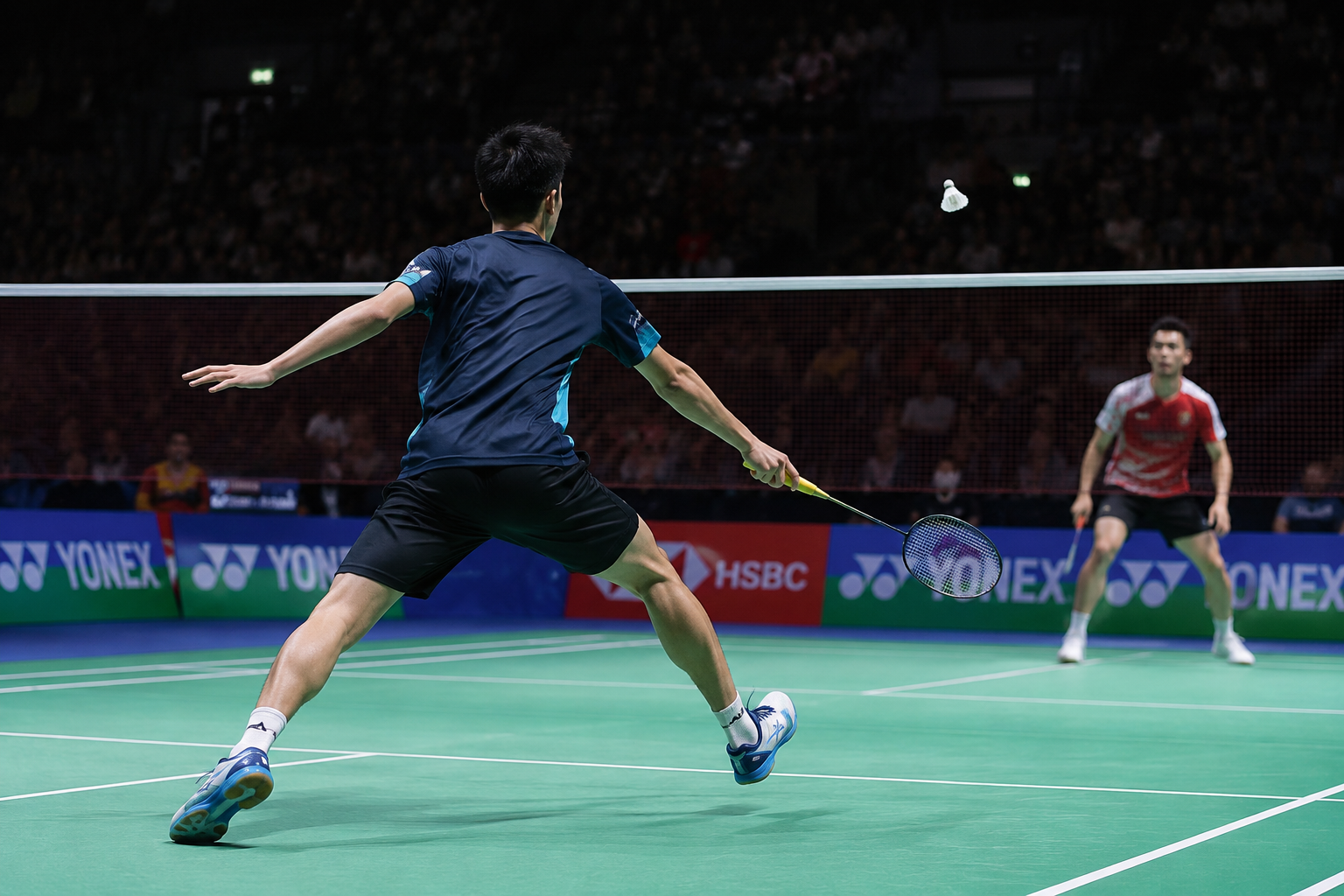
Badminton Singles Rules Explained | Court, Scoring & Service
Badminton singles may seem simple at first. There are only two players, one shuttle, and one court. However, singles is very different from doubles. Every rule, from the court dimensions to the service rules, affects how a player moves, plans rallies, and uses the court. Learning the rules of badminton singles is not only about avoiding faults. It also helps you understand the game better and improve your overall performance.
Top-level badminton singles is also one of the most physically demanding racket sports. According to the Badminton World Federation, elite singles players can cover more than four kilometres during a match through constant forward, backwards, and side-to-side movement. This highlights the importance of fitness, court coverage, and smart positioning in singles.
In this guide, you will learn all the important rules of badminton singles, including court lines, service rules, scoring, and common faults. Along with explaining each rule, we will also show how it affects gameplay and strategy. By the end, you will have a clear understanding of the rules and know how to apply them in both casual games and competitive matches.
What Makes Badminton Singles Different From Doubles?
In singles, one player is fully responsible for covering the entire court from sideline to sideline and from the net to the back boundary. There is no partner to share the load, which means every rule regarding court width, serving, and faults directly affects how a player must move and recover between shots. Consider the following factors that separate singles from doubles:
- A player has no one to cover the net while attacking from the back
- Recovery time after each shot has to account for the full width of the court
- Stamina and movement efficiency matter more than raw power
- Rallies tend to be longer because there is more open space to exploit
These differences are exactly why the rules for singles use a narrower court width than doubles, a detail covered in the next section.
Badminton Singles Court Rules and Dimensions
Court dimensions form the foundation of badminton singles rules. Understanding the court boundaries helps players know where the shuttle can legally land and how to position themselves during a rally.
A badminton singles court measures 13.41 metres in length and 5.18 metres in width. Unlike in doubles, only the inner side lines are used during singles play, while the back boundary line remains in play.
Below are the key court lines every player should know:
| Court Line | Purpose |
| Inner Side Lines | Define the width of the singles court and act as the side boundaries during rallies. |
| Outer Side Lines | Used only for doubles and counts as out of bounds in singles. |
| Back Boundary Line | Marks the deepest point where the shuttle can legally land. |
| Short Service Line | Indicates the minimum distance a serve must travel to be legal. |
| Centre Line | Divides the right and left service courts for serving. |
Since the singles court is narrower than the doubles court, players focus more on using the full length of the court. Deep clears, drop shots, and lifts are commonly used to move opponents between the front and back of the court.
Badminton Singles Service Rules
Service rules determine how every rally begins. A legal serve must follow specific court positioning and serving requirements.
Below are the main service rules in badminton singles:
- When the server’s score is even, such as 0, 2, 4, or 20, they serve from the right service court.
- When the server’s score is odd, such as 1, 3, 5, or 21, they serve from the left service court.
- The shuttle must always be served diagonally into the opponent’s correct service court.
- The shuttle must be struck below the waist, and the point of contact must not be higher than 1.15 metres from the floor.
- The racket head must point downward when making contact with the shuttle.
- Both feet must remain in contact with the court until the serve is hit.
Players usually use one of these two serves:
- High serve: Sends the shuttle deep into the opponent’s back court.
- Low serve: Lands close to the net, encouraging a quick net rally.
Failing to follow any of these rules results in a service fault, and the opponent wins the point.
Badminton Singles Scoring Rules
Badminton singles follows the rally point scoring system, which means a point is awarded after every rally, regardless of which player served.
The table below explains how matches are scored:
| Aspect | Rule |
| Points per game | First player to reach 21 points |
| Winning margin | A player must win by at least 2 points |
| Score at 20–20 | Play continues until one player leads by 2 points |
| Score at 29–29 | The first player to reach 30 points wins the game |
| Match format | Best of 3 games |
| Games needed to win | 2 out of 3 |
A player wins a point when:
- The shuttle lands inside the opponent’s court, including on the boundary lines.
- The opponent hits the shuttle out of bounds.
- The opponent fails to return the shuttle over the net.
- The opponent commits a fault.
The player who wins the rally also serves the next point. The service court depends on the server’s current score.
How Points Are Won and Lost in Singles
You win a point when your opponent fails to return the shuttle correctly or makes a mistake. A point is awarded if:
- The shuttle lands inside your opponent’s court, including on the boundary lines.
- Your opponent hits the shuttle out of bounds.
- Your opponent fails to return the shuttle over the net.
- Your opponent commits a fault.
The player who wins the rally also serves the next point. The service court they use depends on their current score, which follows the singles service rules.
Common Faults in Badminton Singles
A fault is a rule violation that immediately ends the rally and awards the point to the opponent.
Some of the most common faults in badminton singles include:
- Touching the net with your racket, body, or clothing while the shuttle is in play.
- Hitting the shuttle twice before it crosses the net.
- Striking the shuttle before it crosses into your side of the court.
- Hitting the shuttle outside the singles court boundaries.
- Serving illegally, such as serving above waist height or from the wrong service court.
- Allowing the shuttle to touch your body instead of your racket.
Avoiding these mistakes is an important part of the game. Good positioning, proper footwork, and correct serving technique help players reduce errors and stay in control during rallies.
Rest Intervals and Change of Ends
Players are allowed short breaks during a match to recover and prepare for the next phase of play.
The official rest intervals in badminton singles are:
- A 60-second interval when a player first reaches 11 points in a game.
- A 2-minute interval between games.
- In the deciding third game, players change ends when either player reaches 11 points.
These intervals are part of the official Badminton World Federation rules and apply in competitive matches.
Final Thoughts
Understanding the rules of badminton singles is the first step towards becoming a better player. From court dimensions and service rules to scoring and common faults, every rule plays an important role in ensuring fair play and helping you perform with confidence on the court. Whether you are playing for fun or preparing for competitive matches, knowing these rules will help you avoid unnecessary mistakes and make better decisions during every rally.
The best way to build confidence is through regular practice. If you want to improve your skills, compete in tournaments, or learn from experienced coaches, Khelomore offers badminton coaching, tournaments, and community events across India. Playing regularly in a structured environment will help you apply these rules naturally and take your game to the next level.
Frequently Asked Questions
What are the basic badminton singles rules?
Badminton singles is played between two players on a narrow court using the inner side lines. Players score using the rally point system, serve diagonally from the correct service court, and must avoid faults such as net touches or hitting the shuttle out of bounds.
What is the difference between badminton singles and doubles court rules?
The main difference is the court width. Singles uses the inner side lines, while doubles uses the full court width. Both formats use the same back boundary line during rallies.
How many points do you need to win a badminton singles match?
A badminton singles match is played as the best of three games. Each game is won by the first player to reach 21 points with a lead of at least two points. If the score reaches 29 all, the first player to score 30 points wins the game.
What are the rules for serving in badminton singles?
The serve must be hit below the waist with the racket pointing downward. It must be served diagonally into the correct service court, and both feet must remain on the court until the shuttle is struck.
What counts as a fault in badminton singles?
Common faults include touching the net, hitting the shuttle out of bounds, serving illegally, hitting the shuttle twice, or allowing the shuttle to touch your body. A fault immediately awards the point to your opponent.
Why is court movement important in badminton singles?
A singles player has to cover the entire court alone. Good movement and positioning help players reach the shuttle quickly, recover after each shot, and reduce unnecessary errors.
Do the same singles rules apply at the recreational and professional level?
Yes. The official rules for court dimensions, scoring, serving, and faults are the same at both recreational and professional levels. The main difference is that professional matches have officials to enforce the rules more strictly.
PakarPBN
A Private Blog Network (PBN) is a collection of websites that are controlled by a single individual or organization and used primarily to build backlinks to a “money site” in order to influence its ranking in search engines such as Google. The core idea behind a PBN is based on the importance of backlinks in Google’s ranking algorithm. Since Google views backlinks as signals of authority and trust, some website owners attempt to artificially create these signals through a controlled network of sites.
In a typical PBN setup, the owner acquires expired or aged domains that already have existing authority, backlinks, and history. These domains are rebuilt with new content and hosted separately, often using different IP addresses, hosting providers, themes, and ownership details to make them appear unrelated. Within the content published on these sites, links are strategically placed that point to the main website the owner wants to rank higher. By doing this, the owner attempts to pass link equity (also known as “link juice”) from the PBN sites to the target website.
The purpose of a PBN is to give the impression that the target website is naturally earning links from multiple independent sources. If done effectively, this can temporarily improve keyword rankings, increase organic visibility, and drive more traffic from search results.

Basic Rules of Padel Tennis
Watching padel and understanding padel are two completely different experiences. The glass walls, the underarm serves, the cage… none of it makes sense until you understand the framework holding the game together. Once you do, everything clicks. In other words, we are talking about knowing the padel rules for beginners.
Padel rules are simple for those who already play racquet sports like tennis and badminton. Here’s the kicker! Not just to players, the rules are important to casual players and even spectators to fully appreciate the game.
So if you’re looking to get on a court for the first time, or if you’re someone trying to restart sports in your 30s and padel caught your eye, this is where you begin.
What Are the Padel Rules: The Fundamentals
The padel rules revolve around a simple structure: two teams of two players compete on an enclosed court divided by a net. It as a mash-up of tennis and squash. The scoring feels familiar but the walls change everything.
- Every point begins with an underarm serve.
- Each shot must clear the net and bounce on the court floor before striking any wall or cage. If the ball hits the wall or cage without bouncing first, the shot is out and your opponents claim the point.
- You get only one bounce. If the ball bounces twice on your side, the point goes to the other team.
- After the ball bounces, it can ricochet off the glass walls, and you can still play it. The game gets creative.
- Smashes and powerful shots can sometimes bounce and fly out of the court entirely. When that happens, players can run through the side doors, chase down the ball outside, and send it back over the net to keep the rally alive.
Padel Rules for Scoring
If you’ve ever watched tennis, you already know the padel rules for scoring. Padel uses the exact same system, with matches played as a best-of-three-set format.
| Term | What It Means |
| 15 | First point won in a game |
| 30 | Second point won |
| 40 | Third point won |
| Deuce | Score is tied at 40-40 |
| Advantage | One team wins the point after deuce |
| Game | Won by the first team to reach four points with a two-point lead |
| Set | Won by the first team to reach six games with a two-game lead |
| Tie-break | Played at 6-6 in a set; first team to seven points (with a two-point lead) wins it |
If you win a point at deuce, you earn “advantage.” Win the next point and the game is yours. Lose it, and the score resets to deuce. This back-and-forth can stretch a single game into a dramatic battle.
Padel Serve Rules
The serve is where the padel rules feel most different from tennis. There are no overhead cannons here. Every serve must be hit underarm and the ball must bounce before you strike it. You also cannot hit the ball above waist height after that bounce.
- Stand behind the service line and serve diagonally into the opposite service box, just like in tennis.
- Keep at least one foot planted on the ground throughout the serve.
- If the ball lands in the service box and then bounces into the back glass wall, the serve is in and the rally is live.
- If the ball lands in the service box but bounces and strikes the cage (the metal fence), the serve is out.
- A net cord that drops the ball into the correct service box counts as a let. Retake the serve.
- You get two chances. Miss both and the point goes to your opponents.
- Each player takes turns serving for an entire game before the serve rotates.
Padel Rules for the Walls: What Counts as In and What Counts as Out
The walls are the most thrilling and confusing part of padel for newcomers. Understanding these regulations is what separates a confused beginner from someone who looks like they belong on the court.
Shots that are IN
- The ball bounces once on the floor and then hits the back glass, the point continues. This applies to serves too.
- During a rally (not on a serve), the ball bounces once and comes off the metal cage, still in play.
- The ball bounces once and then sails over the back glass or over the cage. The shot is in and your opponents can run outside to retrieve it.
Shots that are OUT
- The ball strikes the back glass or cage directly without bouncing on the court floor first: out.
- The ball bounces twice or more before reaching the wall: the point is already over (your opponents won it on the second bounce).
- On a serve specifically, the ball bounces and hits the cage: this serve is out.
The distinction between the glass wall and the cage on serves is one of the most overlooked padel rules among new players. During rallies, the cage is fair game. On serves, it is not. Memorise that and you’ll avoid a lot of confusion.
Warm Up Before Play
When discussing padel rules, the importance of physical fitness comes up again. A flexible and agile body is imperative to quickly learn and imbibe the game. Your body moves in patterns it may not encounter in everyday life. Stepping onto the court cold is how hamstring, calf, and quadriceps strains happen. A solid 10-15 minute warm-up before every session protects your joints, fires up the right muscle groups, and sharpens your first few shots.
Body warm-up (10 reps each)
| Exercise | Instructions | Repetitions/Duration |
| Light Cardio | Jog around the court or shuttle between the net and the back glass to raise your heart rate. | 2 minutes |
| Squats | Stand with feet flat and hips aligned. Bend your knees, lower down, then drive through your legs and tuck your pelvis as you rise. | 10 reps |
| Lateral Lunges | Step wide to one side, sink deep into the landing leg, then push back to standing. Alternate sides. | 10 reps each side |
| Forward Lunges | Step forward, bend the front leg to 90 degrees, hold briefly, then power back up explosively. | 10 reps each side |
| Wall Press-ups | Place hands on the wall at shoulder height, stand on the balls of your feet, and press in and out while keeping your core tight. | 10 reps |
| Short Sprints | Start from one knee on the floor, drive up hard, and sprint between the net and the back glass. Alternate the lead leg and rest well between sets. | 10 reps |
Warm-up Your RacquetÂ
Don’t skip straight from stretching to match play. Grab your paddle and rally with a partner through the major in-game scenarios, e.g., baseline rallies, volleys at the net, overheads, and a few practice serves and returns. Try ladder rallies: start with a three-shot rally, then build to four, five, six, and so on.
Mental Warm-Up
Before the first serve, set three small goals for the session. Something concrete: “I want to read wall bounces better today,” or “I want to land five successful lobs.” Framing your session around specific targets turns casual hitting into focused improvement.
Quick-Reference Cheat Sheet
- Always serve underarm, below the waist, after bouncing the ball.
- Serve diagonally into the opposite service box.
- The ball must bounce before hitting any wall, otherwise it’s out.
- On serves, a bounce into the cage is out; a bounce into the back glass is in.
- During rallies, bounces off the cage and glass are all fair game.
- One bounce maximum. Two bounces and the point is lost.
- You can leave the court through the side doors to retrieve balls that bounce and fly out.
- Scoring follows tennis rules: 15, 30, 40, deuce, advantage.
- First to six games (with a two-game lead) wins a set; best of three sets wins the match.
Wrap Up
After learning padel rules, nobody forgets their first wall return. The ball slams into the back glass, ricochets at an angle you didn’t expect, and your paddle somehow gets there in time. That single moment is the hook. Every new padel player describes it the same way.
You’ve absorbed everything you need. Text three friends tonight. Book the earliest court you can find on Khelomore near you. Bring water and shoes that grip. And when a smash sails over the back glass and you sprint through the door to chase it down, you’ll understand why millions of players worldwide can’t stop coming back.
FAQs
What is the one golden rule in padel?
The golden rule in padel is the “golden point” at 40-40. Instead of continuing with advantage and deuce, the very next rally decides the game winner, making every point at deuce crucial.
Which is harder for beginners, padel or tennis?
For most beginners, tennis is usually harder than padel. Padel courts are smaller. The rallies last longer and the underhand serve is easier to learn. Tennis demands greater power and movement, making it more physically and technically challenging at first.
Can I hit side wall first in padel?
No, in padel the ball cannot hit the side wall before crossing the net on your shot. It must first bounce on the opponent’s court. After bouncing, it may hit the side or back glass and still remain in play.
What are some unwritten rules of padel?
Some common unwritten rules in padel focus on respect, safety, and sportsmanship. Players usually avoid smashing the ball directly at opponents. They call lines honestly, keep noise and celebrations respectful, and apologise for lucky net or frame shots. Good communication with your partner and quick court rotation etiquette are also valued.
PakarPBN
A Private Blog Network (PBN) is a collection of websites that are controlled by a single individual or organization and used primarily to build backlinks to a “money site” in order to influence its ranking in search engines such as Google. The core idea behind a PBN is based on the importance of backlinks in Google’s ranking algorithm. Since Google views backlinks as signals of authority and trust, some website owners attempt to artificially create these signals through a controlled network of sites.
In a typical PBN setup, the owner acquires expired or aged domains that already have existing authority, backlinks, and history. These domains are rebuilt with new content and hosted separately, often using different IP addresses, hosting providers, themes, and ownership details to make them appear unrelated. Within the content published on these sites, links are strategically placed that point to the main website the owner wants to rank higher. By doing this, the owner attempts to pass link equity (also known as “link juice”) from the PBN sites to the target website.
The purpose of a PBN is to give the impression that the target website is naturally earning links from multiple independent sources. If done effectively, this can temporarily improve keyword rankings, increase organic visibility, and drive more traffic from search results.