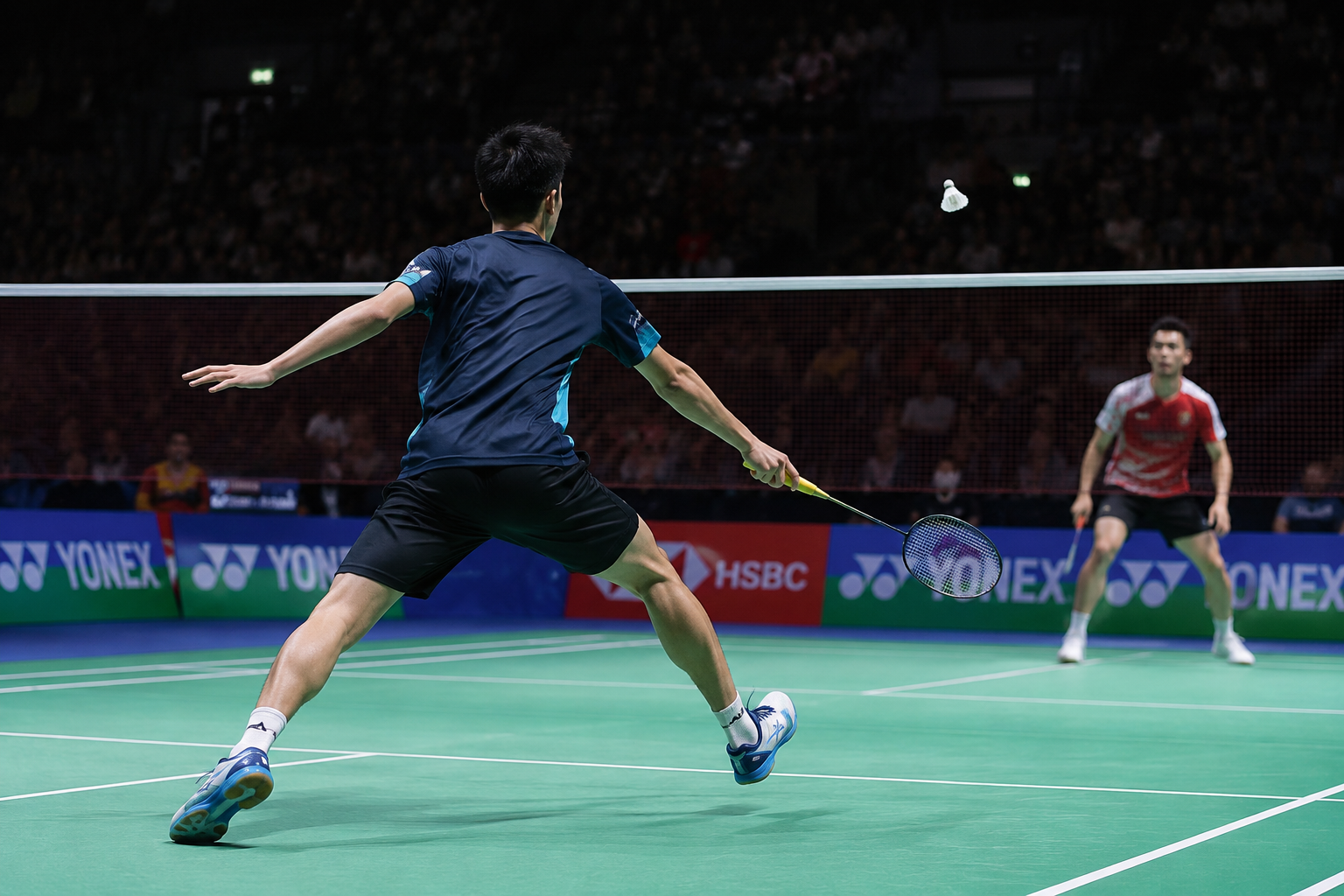
Badminton Singles Rules Explained | Court, Scoring & Service
Badminton singles may seem simple at first. There are only two players, one shuttle, and one court. However, singles is very different from doubles. Every rule, from the court dimensions to the service rules, affects how a player moves, plans rallies, and uses the court. Learning the rules of badminton singles is not only about avoiding faults. It also helps you understand the game better and improve your overall performance.
Top-level badminton singles is also one of the most physically demanding racket sports. According to the Badminton World Federation, elite singles players can cover more than four kilometres during a match through constant forward, backwards, and side-to-side movement. This highlights the importance of fitness, court coverage, and smart positioning in singles.
In this guide, you will learn all the important rules of badminton singles, including court lines, service rules, scoring, and common faults. Along with explaining each rule, we will also show how it affects gameplay and strategy. By the end, you will have a clear understanding of the rules and know how to apply them in both casual games and competitive matches.
What Makes Badminton Singles Different From Doubles?
In singles, one player is fully responsible for covering the entire court from sideline to sideline and from the net to the back boundary. There is no partner to share the load, which means every rule regarding court width, serving, and faults directly affects how a player must move and recover between shots. Consider the following factors that separate singles from doubles:
- A player has no one to cover the net while attacking from the back
- Recovery time after each shot has to account for the full width of the court
- Stamina and movement efficiency matter more than raw power
- Rallies tend to be longer because there is more open space to exploit
These differences are exactly why the rules for singles use a narrower court width than doubles, a detail covered in the next section.
Badminton Singles Court Rules and Dimensions
Court dimensions form the foundation of badminton singles rules. Understanding the court boundaries helps players know where the shuttle can legally land and how to position themselves during a rally.
A badminton singles court measures 13.41 metres in length and 5.18 metres in width. Unlike in doubles, only the inner side lines are used during singles play, while the back boundary line remains in play.
Below are the key court lines every player should know:
| Court Line | Purpose |
| Inner Side Lines | Define the width of the singles court and act as the side boundaries during rallies. |
| Outer Side Lines | Used only for doubles and counts as out of bounds in singles. |
| Back Boundary Line | Marks the deepest point where the shuttle can legally land. |
| Short Service Line | Indicates the minimum distance a serve must travel to be legal. |
| Centre Line | Divides the right and left service courts for serving. |
Since the singles court is narrower than the doubles court, players focus more on using the full length of the court. Deep clears, drop shots, and lifts are commonly used to move opponents between the front and back of the court.
Badminton Singles Service Rules
Service rules determine how every rally begins. A legal serve must follow specific court positioning and serving requirements.
Below are the main service rules in badminton singles:
- When the server’s score is even, such as 0, 2, 4, or 20, they serve from the right service court.
- When the server’s score is odd, such as 1, 3, 5, or 21, they serve from the left service court.
- The shuttle must always be served diagonally into the opponent’s correct service court.
- The shuttle must be struck below the waist, and the point of contact must not be higher than 1.15 metres from the floor.
- The racket head must point downward when making contact with the shuttle.
- Both feet must remain in contact with the court until the serve is hit.
Players usually use one of these two serves:
- High serve: Sends the shuttle deep into the opponent’s back court.
- Low serve: Lands close to the net, encouraging a quick net rally.
Failing to follow any of these rules results in a service fault, and the opponent wins the point.
Badminton Singles Scoring Rules
Badminton singles follows the rally point scoring system, which means a point is awarded after every rally, regardless of which player served.
The table below explains how matches are scored:
| Aspect | Rule |
| Points per game | First player to reach 21 points |
| Winning margin | A player must win by at least 2 points |
| Score at 20–20 | Play continues until one player leads by 2 points |
| Score at 29–29 | The first player to reach 30 points wins the game |
| Match format | Best of 3 games |
| Games needed to win | 2 out of 3 |
A player wins a point when:
- The shuttle lands inside the opponent’s court, including on the boundary lines.
- The opponent hits the shuttle out of bounds.
- The opponent fails to return the shuttle over the net.
- The opponent commits a fault.
The player who wins the rally also serves the next point. The service court depends on the server’s current score.
How Points Are Won and Lost in Singles
You win a point when your opponent fails to return the shuttle correctly or makes a mistake. A point is awarded if:
- The shuttle lands inside your opponent’s court, including on the boundary lines.
- Your opponent hits the shuttle out of bounds.
- Your opponent fails to return the shuttle over the net.
- Your opponent commits a fault.
The player who wins the rally also serves the next point. The service court they use depends on their current score, which follows the singles service rules.
Common Faults in Badminton Singles
A fault is a rule violation that immediately ends the rally and awards the point to the opponent.
Some of the most common faults in badminton singles include:
- Touching the net with your racket, body, or clothing while the shuttle is in play.
- Hitting the shuttle twice before it crosses the net.
- Striking the shuttle before it crosses into your side of the court.
- Hitting the shuttle outside the singles court boundaries.
- Serving illegally, such as serving above waist height or from the wrong service court.
- Allowing the shuttle to touch your body instead of your racket.
Avoiding these mistakes is an important part of the game. Good positioning, proper footwork, and correct serving technique help players reduce errors and stay in control during rallies.
Rest Intervals and Change of Ends
Players are allowed short breaks during a match to recover and prepare for the next phase of play.
The official rest intervals in badminton singles are:
- A 60-second interval when a player first reaches 11 points in a game.
- A 2-minute interval between games.
- In the deciding third game, players change ends when either player reaches 11 points.
These intervals are part of the official Badminton World Federation rules and apply in competitive matches.
Final Thoughts
Understanding the rules of badminton singles is the first step towards becoming a better player. From court dimensions and service rules to scoring and common faults, every rule plays an important role in ensuring fair play and helping you perform with confidence on the court. Whether you are playing for fun or preparing for competitive matches, knowing these rules will help you avoid unnecessary mistakes and make better decisions during every rally.
The best way to build confidence is through regular practice. If you want to improve your skills, compete in tournaments, or learn from experienced coaches, Khelomore offers badminton coaching, tournaments, and community events across India. Playing regularly in a structured environment will help you apply these rules naturally and take your game to the next level.
Frequently Asked Questions
What are the basic badminton singles rules?
Badminton singles is played between two players on a narrow court using the inner side lines. Players score using the rally point system, serve diagonally from the correct service court, and must avoid faults such as net touches or hitting the shuttle out of bounds.
What is the difference between badminton singles and doubles court rules?
The main difference is the court width. Singles uses the inner side lines, while doubles uses the full court width. Both formats use the same back boundary line during rallies.
How many points do you need to win a badminton singles match?
A badminton singles match is played as the best of three games. Each game is won by the first player to reach 21 points with a lead of at least two points. If the score reaches 29 all, the first player to score 30 points wins the game.
What are the rules for serving in badminton singles?
The serve must be hit below the waist with the racket pointing downward. It must be served diagonally into the correct service court, and both feet must remain on the court until the shuttle is struck.
What counts as a fault in badminton singles?
Common faults include touching the net, hitting the shuttle out of bounds, serving illegally, hitting the shuttle twice, or allowing the shuttle to touch your body. A fault immediately awards the point to your opponent.
Why is court movement important in badminton singles?
A singles player has to cover the entire court alone. Good movement and positioning help players reach the shuttle quickly, recover after each shot, and reduce unnecessary errors.
Do the same singles rules apply at the recreational and professional level?
Yes. The official rules for court dimensions, scoring, serving, and faults are the same at both recreational and professional levels. The main difference is that professional matches have officials to enforce the rules more strictly.
PakarPBN
A Private Blog Network (PBN) is a collection of websites that are controlled by a single individual or organization and used primarily to build backlinks to a “money site” in order to influence its ranking in search engines such as Google. The core idea behind a PBN is based on the importance of backlinks in Google’s ranking algorithm. Since Google views backlinks as signals of authority and trust, some website owners attempt to artificially create these signals through a controlled network of sites.
In a typical PBN setup, the owner acquires expired or aged domains that already have existing authority, backlinks, and history. These domains are rebuilt with new content and hosted separately, often using different IP addresses, hosting providers, themes, and ownership details to make them appear unrelated. Within the content published on these sites, links are strategically placed that point to the main website the owner wants to rank higher. By doing this, the owner attempts to pass link equity (also known as “link juice”) from the PBN sites to the target website.
The purpose of a PBN is to give the impression that the target website is naturally earning links from multiple independent sources. If done effectively, this can temporarily improve keyword rankings, increase organic visibility, and drive more traffic from search results.

Rackets, Bags & Shoes Explained
When playing Padel, racket shape affects your swing. The shoe sole determines whether you grip the court or slide through a volley. The foam core in your racket? It changes how every shot feels off the face. And the bag you toss everything into after a match can either preserve your gear or quietly destroy it in the Indian heat.
Padel gear decisions stack on top of each other. Get the racket wrong and your arm pays for it. Get the shoes wrong, your ankles do. Skip the small accessories, and you’ll replace expensive gear faster than you should.
Your Complete Padel Equipment
| Equipment | Purpose | Features | Typical Price |
| Padel Racket | Main playing equipment | Round, teardrop, or diamond shape; EVA or FOAM core | ₹5,000-₹40,000+ |
| Padel Shoes | Grip and movement support | Lateral stability, cushioned sole, padel-specific tread | Varies by brand |
| Padel Balls | Gameplay | Lower pressure and softer bounce than tennis balls | Sold in cans |
| Padel Bag | Carry and protect equipment | Thermal racket compartment, shoe pocket, accessory storage | Varies by size/brand |
| Accessories | Comfort and racket protection | Overgrips, wrist straps, sweatbands, racket protectors | ₹100+ |
Padel equipment falls into three tiers. The first tier is non-negotiable: your racket, your shoes, and balls. The second tier is strongly recommended: a dedicated bag, overgrips, and a wrist strap. The third tier is the nice-to-haves: racket protectors, specific apparel, and sweatbands.
Unlike tennis, padel equipment operates under a different set of physics. The racket has no strings. The court has walls you play off. The ball bounces lower. Every piece of gear is engineered around these differences, and substituting tennis gear for padel gear will affect your game in ways you’ll notice immediately.
The Racket
A padel racket looks nothing like a tennis racket. It’s solid with a foam core and a hitting surface made from carbon fibre, fibreglass, or a blend of both. The face has small holes drilled through it, reducing air resistance and allowing spin.
Three variables determine how a racket performs: shape, weight, and core material.
Shape:Racket shape is the single biggest factor in how a racket feels in your hand.
Round rackets have the largest sweet spot, positioned low and centred in the face. They’re forgiving on off-centre hits and deliver excellent control. If you’re new to padel, start here. If you’re a defensive player who wins rallies through placement and patience, stay here.
Teardrop rackets shift the sweet spot slightly higher, blending power and control. This is the best intermediate padel racket shape for players who have developed their technique and want to add punch to their smashes without losing precision. Most club-level players gravitate toward teardrops eventually.
Diamond rackets are head-heavy with a high sweet spot. They generate explosive power on overheads and volleys, but demand consistent technique. Mis-hits sting. If your timing isn’t sharp, diamond shapes will frustrate you.
Weight
Padel rackets range from 340g to 385g. Lighter rackets are easier on the wrist and faster to manoeuvre. Heavier rackets generate more power but tire your arm quicker.
Most recreational players in India do well between 355g and 370g. If you have any history of elbow or shoulder issues, go lighter.
Core Material
The two common foam cores are EVA and FOAM (polyethylene). EVA is denser and delivers a firmer feel with more control. FOAM is softer, giving a trampoline-like pop that adds power and comfort. Some manufacturers now use a blend or multi-layered core to split the difference.
What About Price?
Padel equipment price varies enormously depending on brand, materials, and where you buy.
| Category | Price Range (₹) | Materials | Who It’s For |
| Entry-Level | ₹5,000-₹9,000 | Fibreglass face, soft EVA core | Beginners, casual players |
| Mid-Range | ₹9,000-₹18,000 | Carbon/fibreglass blend, dual-core | Regular players, improvers |
| Advanced/Pro | ₹18,000-₹40,000+ | Full carbon fibre, multi-layer core | Competitive and advanced |
Padel Shoes: Why Your Regular Sneakers Won’t Cut It
Your feet take a beating in padel. The sport demands constant lateral movement, explosive first steps, sudden stops, and quick pivots. Running shoes are designed for forward motion. Tennis shoes aren’t built for padel’s specific court surfaces. You need padel shoes engineered for the way this sport actually moves your body.
What Makes Padel Shoes Different?
Sole Pattern: Padel courts use artificial grass with sand infill. Padel shoes have a herringbone or modified omni-direction tread pattern designed for grip on this surface. Running shoes will slip. Tennis shoes designed for clay or hard court will wear down unevenly.
Lateral Support: The side-to-side movement in padel puts enormous stress on ankles. Padel shoes feature reinforced sidewalls and a wider base to stabilise your foot during cuts and lunges.
Cushioning: ASICS uses GEL technology in the heel and forefoot. The goal is to absorb the shock from sudden stops and hard landings to protect your knees and joints.
Weight: Court shoes for padel tend to be lighter than standard tennis shoes. They are in the 300g-380g range.
Padel Balls: Not the Same as Tennis Balls
Padel balls look similar to tennis balls, but they are not interchangeable. Padel balls have lower internal pressure, which produces a softer, lower bounce suited to the shorter court and wall-play dynamics.
Using tennis balls on a padel court disrupts the entire flow of the game. Wall rebounds become unpredictable. Your control over shot placement drops.
The Padel Tennis Bag
Once you’ve invested in a racket and shoes, you need something to carry and protect them. A padel tennis bag is specifically designed for this gear. It’s not a gym bag with a racket shoved inside.
Good padel bags include thermal-lined compartments that shield your racket from extreme heat. India’s climate can push temperatures well above 40°C in summer. Heat damages the foam core of your racket, softening the material and altering its playing characteristics. A thermally insulated bag prevents this.
Features to look for in a padel bag.
- Dedicated racket compartment with thermal lining.
- Separate shoe pocket to keep sweaty footwear away from clean gear.
- Accessory pockets for overgrips, wristbands, a water bottle, and your phone.
- Padded straps for comfortable carrying.
The Small Stuff That Makes a Big Difference
Overgrips:The factory grip on your racket will wear out. An overgrip wraps over the base grip, restoring tackiness and absorbing moisture. They cost between ₹100 and ₹300 per piece and you should replace them every 5-10 sessions.
Racket Protectors:A padel racket’s frame takes hits during play. A protector tape applied along the frame’s edge absorbs this impact and extends your racket’s life.
Wrist Straps:Every padel racket has a hole at the bottom of the handle for a wrist strap. Use it. The strap keeps the racket tethered to your hand during aggressive swings, preventing it from flying across the court and potentially injuring another player. Some tournaments require them.
Sweatbands and Wristbands:In Indian conditions, sweat management matters. A soaked grip slips. Wristbands channel sweat away from your hand, and a headband keeps it out of your eyes. Inexpensive and effective.
Buying Used Padel Equipment: Smart or Risky?
The padel market in India is still young, but a secondary market for used padel equipment is starting to form. Outlets like PadelOutlet.in already list used rackets (graded by condition) at significant discounts, up to 30-40% off the original price.
Used padel equipment can be a smart entry point, especially for beginners who don’t want to commit ₹15,000+ before knowing whether they’ll stick with the sport. A few things to check before buying:
Frame Integrity: Run your fingers along the entire frame edge. Cracks, even hairline ones, compromise the racket’s structural strength and can worsen rapidly.
Foam Core Condition: Press the face of the racket. If it feels dead or overly soft compared to a new racket of the same model, the core has degraded. Heat exposure is the usual culprit.
Grip State: A worn-out base grip is easy and cheap to replace. Don’t let it be a dealbreaker if the frame and core are solid.
Shoes: Be cautious with used padel shoes. The outsole tread wears down, and once grip is gone, you lose traction and stability. Cushioning also compresses over time and doesn’t recover. Buy new shoes whenever possible.
How to Choose Padel Equipment Based
Your skill level should dictate your padel equipment choices. Overspending on pro-level gear as a beginner doesn’t accelerate your improvement. Underspending as a regular player limits your potential. Here’s a level-by-level breakdown:
Beginner (0-6 months): Go with a round-shaped racket in the ₹5,000-₹9,000 range. Pair it with entry-level padel shoes (₹5,000-₹7,000). Add a basic bag, some overgrips, and a can of balls. Total investment: ₹12,000-₹18,000.
Intermediate (6-18 months): Upgrade to the best intermediate padel racket you can afford in the teardrop shape, somewhere between ₹12,000 and ₹20,000. Invest in better padel shoes with advanced cushioning and lateral support (₹8,000-₹12,000). Your bag and accessories stay the same. Total investment: ₹22,000-₹35,000.
Advanced (18+ months): You know what you want by now. Pro-level rackets, premium shoes, a quality padel tennis bag, and a stocked accessory kit. Budget ₹40,000+ for the full setup.
Where Does India Stand?
The padel equipment market in India has matured quickly. Three years ago, buying a padel racket in India meant importing one or relying on a handful of online stores. Now, dedicated retailers like PadelOutlet.in, Racquets4U, and SportsJam stock full catalogues from HEAD, Babolat, Bullpadel, and Adidas. Pricing has become more competitive, and delivery infrastructure covers most major cities.
The challenge remains access to padel courts. But that’s changing fast. Platforms like Khelomore are at the centre of it. Khelomore lets you discover and book padel courts (along with 30+ other sports) across cities in India. You open the app, pick a slot, and show up ready to play.
If you’ve been assembling your padel equipment and are itching to use it, book a padel court on Khelomore and get on the court this week.
Final Thoughts
Padel equipment isn’t complicated, but it does reward thoughtful choices. A well-matched racket elevates your game. Proper shoes protect your body. The right accessories extend the life of your gear and keep you comfortable through long sessions in Indian heat.
Start with the essentials. Buy the best padel equipment you can reasonably afford at your current level. Upgrade as your skills and commitment grow.
FAQs
How long does a padel racket last?
A padel racket lasts between 6 and 18 months with regular play (two to five sessions per week). The foam core loses its elasticity over time even without visible cracks. A dull sound on ball contact and reduced power are the clearest signs you need a replacement.
Can I wear tennis shoes to play padel?
Clay court tennis shoes work as a temporary substitute, but they are not built for padel’s artificial grass and sand surface. Padel shoes have deeper herringbone treads for grip on sand, lighter construction, and more flexibility. So, switch to dedicated padel shoes as soon as you commit to the sport.
How do I store my padel racket in hot weather?
Keep it in a thermally insulated bag, away from direct sunlight and never inside a parked car. Heat above 40°C softens the EVA or FOAM core and permanently alters the racket’s playing characteristics.
Are pressureless padel balls good for practice?
Pressureless balls last significantly longer than pressurised ones because their bounce comes from a thicker rubber core, not internal air pressure. They are cost-effective for coaching drills and ball machines. For match play and technique development, though, pressurised balls provide the true feel and bounce behaviour you need to train accurately.
What is the right padel racket weight for beginners?
Beginners should start with a racket between 340g and 360g. Lighter rackets reduce fatigue during long rallies and put less strain on the wrist and elbow while you develop your technique. As your swing mechanics improve and your arm strength builds, you can move toward a heavier racket for added power.
PakarPBN
A Private Blog Network (PBN) is a collection of websites that are controlled by a single individual or organization and used primarily to build backlinks to a “money site” in order to influence its ranking in search engines such as Google. The core idea behind a PBN is based on the importance of backlinks in Google’s ranking algorithm. Since Google views backlinks as signals of authority and trust, some website owners attempt to artificially create these signals through a controlled network of sites.
In a typical PBN setup, the owner acquires expired or aged domains that already have existing authority, backlinks, and history. These domains are rebuilt with new content and hosted separately, often using different IP addresses, hosting providers, themes, and ownership details to make them appear unrelated. Within the content published on these sites, links are strategically placed that point to the main website the owner wants to rank higher. By doing this, the owner attempts to pass link equity (also known as “link juice”) from the PBN sites to the target website.
The purpose of a PBN is to give the impression that the target website is naturally earning links from multiple independent sources. If done effectively, this can temporarily improve keyword rankings, increase organic visibility, and drive more traffic from search results.