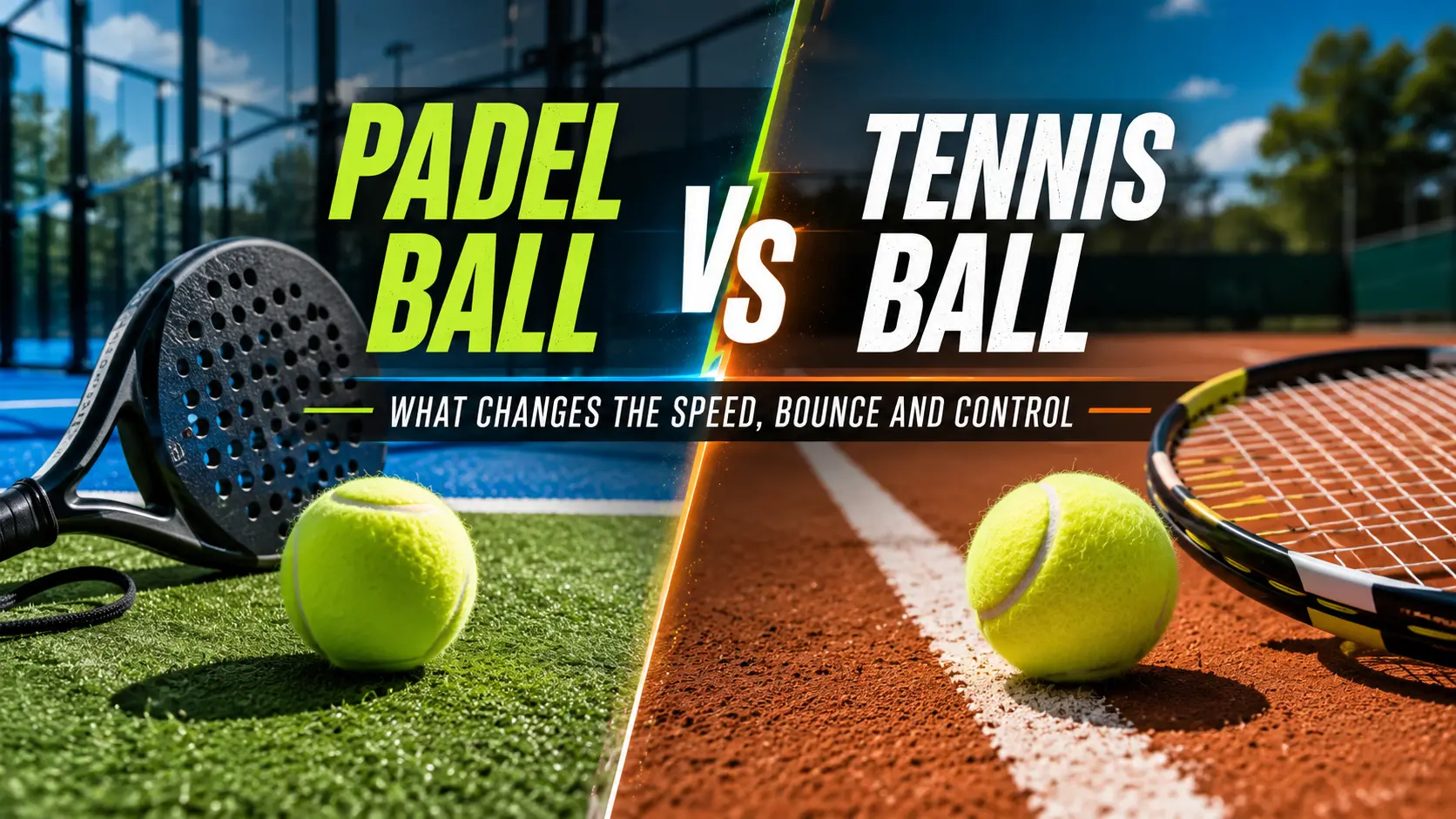
Padel Ball vs Tennis Ball: Speed, Bounce & Control
You’ve probably seen padel courts popping up across Mumbai, Bengaluru, and Delhi like they’re trying to catch up with cricket nets. And if you’ve watched anyone play, you’ve noticed something: the ball behaves differently.Â
It doesn’t bounce the same way. The rallies feel different. Even the sound is distinct. So what’s actually going on? Is it the ball, the court, the racket or all three working together?
Padel Ball vs Tennis Ball: The Core Differences
After knowing about Padel, the debate padel ball vs tennis ball starts with one deceptively simple fact: they look almost identical. Same fuzzy felt, roughly the same size. But play with the wrong one and you’ll feel the difference within five minutes.
Padel Ball Pressure: Why Lower Is Actually Smarter
Padel ball pressure is lower than that of a tennis ball. It’s a deliberate design choice that shapes the entire game.
A lower-pressure ball compresses more on contact. That extra compression gives the player a longer dwell time on the stringless padel racket face. You get more control over direction. You can redirect the ball, add spin, or kill the pace with a drop shot.
In tennis, high internal pressure means the ball launches off the racket fast. That’s great for big servers and aggressive baseliners.Â
But a high-pressure ball in a padel court would be borderline unplayable.
How Speed Changes Between the Two Balls
Ask any player who’s switched from tennis to padel: the pace is different, but not in the way you’d expect.
The padel ball travels slower off the racket. But once it hits the glass wall and comes back? That rebound can be sharp and awkward in ways a tennis baseline rally never is. You’re not dealing with unpredictable speed. The ball can die in a corner, kick up off the turf seam, or fizz back at shoulder height off the back glass.
Tennis balls with their higher internal pressure, generate more raw velocity. The professional serves clock in above 200 km/h. The ball punches through the air. On clay, the slower surface absorbs pace. On grass, it skids. The felt interacts with the surface in a way that’s central to the sport’s identity.
In padel, the felt is thinner and the pressure is lower, so the ball grips the artificial turf ever so slightly.
What Happens to Bounce
Both balls are tested for bounce from a height of 2.54 metres. The acceptable range overlaps. But padel balls are tested indoors, at room temperature, which reflects actual playing conditions. Tennis balls are tested at 20°C and the bounce requirements vary slightly across surface types.
A padel ball feels softer underfoot. Drop one on a hard surface and it doesn’t rocket back up. It bounces with a kind of muted thud. That’s by design, i.e., padel courts have turf surfaces and enclosed walls. A ball that bounces too high would constantly fly over the glass panels. A ball that bounces too low would die in the turf.
The padel ball’s bounce is calibrated for a court that’s roughly one-third the size of a tennis court. Every millimetre of bounce range matters at that scale.
Tennis balls, especially new pressurised ones fresh out of the can, bounce with authority. That pop when you open a tennis ball can is the pressurised air signalling that the ball is at peak performance. After a couple of sets, the pressure drops, the felt wears, and the bounce becomes less lively.Â
Most club players know the feeling of playing with a “dead” tennis ball. It is low and feels like hitting a lemon.
Control: Where the Real Divide Lives
If you’ve played both sports, you know that control in padel feels more immediate. Your wrist has more say. The swing is compact and the ball responds to subtle changes in angle.
That’s not just about technique, it’s the ball itself. The lower padel ball pressure allows the ball to to deform slightly more on impact. It translates directly into feedback. Mishits are obvious. Clean strikes feel satisfying in a way that’s hard to explain.
Tennis is a different contract with the ball. Control comes from footwork, swing mechanics, and racket head speed. You’re generating power through movement and technique. The high-pressure ball rewards aggression and clean mechanics. It punishes lazy swings.
Padel rewards placement and anticipation. The ball suits a game where you’re working in pairs, covering a small court, and reading your opponent’s angles off the glass. Control, in that context, means managing pace rather than generating it.
Can You Use a Tennis Ball for Padel? (Or Vice Versa?)
Technically you can. Realistically, you shouldn’t.
A tennis ball in a padel court bounces too high. It moves too fast and takes away the tactical chess match that makes padel so engaging. You’ll spend most of the time scrambling rather than constructing rallies.
A padel ball in a tennis match lacks the pace and bounce that the game demands. Serving with a padel ball is frustrating. It won’t generate spin the same way, and the lower pressure makes it feel sluggish off the strings.
Some beginners use old tennis balls for casual padel, especially when starting out. It works. But the moment you play with proper padel balls on a proper court, the difference is immediate and you won’t go back.
Tennis Ball Price vs Padel Ball Price: What to Expect in India
Tennis balls in India range widely. Entry-level balls (Cosco, Nivia) are available for ₹80-₹150 per ball, or roughly ₹300-₹600 for a can of three. Premium ITF-approved balls from Wilson or Dunlop sit between ₹600-₹900 per can. For regular club play, most players find mid-range options sufficient. Tennis ball price has stayed relatively stable, though import-dependent brands have seen marginal increases post GST adjustments.
Padel balls are slightly harder to find in India right now. Expect to pay ₹400-₹700 for a can of three from brands like Head, Bullpadel, or Wilson’s padel range. As the sport grows and more venues come up, that price will likely come down.
If you’re booking padel courts on Khelomore, some venues include balls with the court booking. Worth checking before you stock up.
The Tennis Ball vs Padel Ball Confusion: Why It Keeps Coming Up
The tennis ball vs padel ball mix-up happens because the sports share visual DNA. If you’re standing ten feet away, you can’t tell the difference.
The confusion is also marketing-driven. Padel is frequently described as a “tennis hybrid” in promotional material, which leads people to assume the equipment is interchangeable.Â
It isn’t. The ball is engineered for a specific court environment, a specific bounce range, and a specific style of play.
Understanding the difference doesn’t require a physics degree. Play both sports once with the right equipment, and your hands will explain it faster than any explanation can.
What This Means If You’re Booking Courts in India
If you’re serious about the game play with the right ball from the start. The experience of padel with proper padel ball pressure is completely different from a makeshift session with tennis balls. The rallies are longer, the tactics are clearer, and the sport starts to make sense in a way it doesn’t when you’re fighting the equipment.
Find a venue, check what’s included in the booking, and if you’re buying your own, don’t substitute one for the other. The distinction between padel ball vs tennis ball is small on paper. On court, it changes everything.
Looking to book a padel court or tennis court near you?Khelomore lists 30+ sports across courts, turfs, and play zones in your city.Â
Download the app and find your next game in one tap.
FAQs
How many balls come in a padel can?
A standard padel can contain three balls, the same as tennis. Some brands sell tubes of two for training use. Most recreational players go through one can per session before the pressure drops noticeably and the balls start feeling flat.
Do padel balls lose pressure faster than tennis balls?
Yes. Because padel balls start at lower internal pressure, the drop-off is more noticeable after heavy use. Expect usable performance for three to five hours of play. Store them in an airtight pressuriser between sessions to extend their life.
Is padel harder to learn than tennis for beginners?
Padel has a shorter learning curve. The compact court, slower ball, and solid racket face give beginners faster rally confidence. Most first-timers can sustain a proper rally within the first session.
Can altitude affect how a padel ball plays?
Absolutely. At higher altitudes, lower air density causes the ball to travel faster and bounce higher. FIP-approved balls come in pressurised variants calibrated for high-altitude play to compensate for this.
Can I use old tennis balls for padel?
Yes, but only if they still have decent bounce and feel. Old tennis balls work for casual padel practice. Padel balls are slightly less pressurised and provide better play.
PakarPBN
A Private Blog Network (PBN) is a collection of websites that are controlled by a single individual or organization and used primarily to build backlinks to a “money site” in order to influence its ranking in search engines such as Google. The core idea behind a PBN is based on the importance of backlinks in Google’s ranking algorithm. Since Google views backlinks as signals of authority and trust, some website owners attempt to artificially create these signals through a controlled network of sites.
In a typical PBN setup, the owner acquires expired or aged domains that already have existing authority, backlinks, and history. These domains are rebuilt with new content and hosted separately, often using different IP addresses, hosting providers, themes, and ownership details to make them appear unrelated. Within the content published on these sites, links are strategically placed that point to the main website the owner wants to rank higher. By doing this, the owner attempts to pass link equity (also known as “link juice”) from the PBN sites to the target website.
The purpose of a PBN is to give the impression that the target website is naturally earning links from multiple independent sources. If done effectively, this can temporarily improve keyword rankings, increase organic visibility, and drive more traffic from search results.

Basic Rules of Padel Tennis
Watching padel and understanding padel are two completely different experiences. The glass walls, the underarm serves, the cage… none of it makes sense until you understand the framework holding the game together. Once you do, everything clicks. In other words, we are talking about knowing the padel rules for beginners.
Padel rules are simple for those who already play racquet sports like tennis and badminton. Here’s the kicker! Not just to players, the rules are important to casual players and even spectators to fully appreciate the game.
So if you’re looking to get on a court for the first time, or if you’re someone trying to restart sports in your 30s and padel caught your eye, this is where you begin.
What Are the Padel Rules: The Fundamentals
The padel rules revolve around a simple structure: two teams of two players compete on an enclosed court divided by a net. It as a mash-up of tennis and squash. The scoring feels familiar but the walls change everything.
- Every point begins with an underarm serve.
- Each shot must clear the net and bounce on the court floor before striking any wall or cage. If the ball hits the wall or cage without bouncing first, the shot is out and your opponents claim the point.
- You get only one bounce. If the ball bounces twice on your side, the point goes to the other team.
- After the ball bounces, it can ricochet off the glass walls, and you can still play it. The game gets creative.
- Smashes and powerful shots can sometimes bounce and fly out of the court entirely. When that happens, players can run through the side doors, chase down the ball outside, and send it back over the net to keep the rally alive.
Padel Rules for Scoring
If you’ve ever watched tennis, you already know the padel rules for scoring. Padel uses the exact same system, with matches played as a best-of-three-set format.
| Term | What It Means |
| 15 | First point won in a game |
| 30 | Second point won |
| 40 | Third point won |
| Deuce | Score is tied at 40-40 |
| Advantage | One team wins the point after deuce |
| Game | Won by the first team to reach four points with a two-point lead |
| Set | Won by the first team to reach six games with a two-game lead |
| Tie-break | Played at 6-6 in a set; first team to seven points (with a two-point lead) wins it |
If you win a point at deuce, you earn “advantage.” Win the next point and the game is yours. Lose it, and the score resets to deuce. This back-and-forth can stretch a single game into a dramatic battle.
Padel Serve Rules
The serve is where the padel rules feel most different from tennis. There are no overhead cannons here. Every serve must be hit underarm and the ball must bounce before you strike it. You also cannot hit the ball above waist height after that bounce.
- Stand behind the service line and serve diagonally into the opposite service box, just like in tennis.
- Keep at least one foot planted on the ground throughout the serve.
- If the ball lands in the service box and then bounces into the back glass wall, the serve is in and the rally is live.
- If the ball lands in the service box but bounces and strikes the cage (the metal fence), the serve is out.
- A net cord that drops the ball into the correct service box counts as a let. Retake the serve.
- You get two chances. Miss both and the point goes to your opponents.
- Each player takes turns serving for an entire game before the serve rotates.
Padel Rules for the Walls: What Counts as In and What Counts as Out
The walls are the most thrilling and confusing part of padel for newcomers. Understanding these regulations is what separates a confused beginner from someone who looks like they belong on the court.
Shots that are IN
- The ball bounces once on the floor and then hits the back glass, the point continues. This applies to serves too.
- During a rally (not on a serve), the ball bounces once and comes off the metal cage, still in play.
- The ball bounces once and then sails over the back glass or over the cage. The shot is in and your opponents can run outside to retrieve it.
Shots that are OUT
- The ball strikes the back glass or cage directly without bouncing on the court floor first: out.
- The ball bounces twice or more before reaching the wall: the point is already over (your opponents won it on the second bounce).
- On a serve specifically, the ball bounces and hits the cage: this serve is out.
The distinction between the glass wall and the cage on serves is one of the most overlooked padel rules among new players. During rallies, the cage is fair game. On serves, it is not. Memorise that and you’ll avoid a lot of confusion.
Warm Up Before Play
When discussing padel rules, the importance of physical fitness comes up again. A flexible and agile body is imperative to quickly learn and imbibe the game. Your body moves in patterns it may not encounter in everyday life. Stepping onto the court cold is how hamstring, calf, and quadriceps strains happen. A solid 10-15 minute warm-up before every session protects your joints, fires up the right muscle groups, and sharpens your first few shots.
Body warm-up (10 reps each)
| Exercise | Instructions | Repetitions/Duration |
| Light Cardio | Jog around the court or shuttle between the net and the back glass to raise your heart rate. | 2 minutes |
| Squats | Stand with feet flat and hips aligned. Bend your knees, lower down, then drive through your legs and tuck your pelvis as you rise. | 10 reps |
| Lateral Lunges | Step wide to one side, sink deep into the landing leg, then push back to standing. Alternate sides. | 10 reps each side |
| Forward Lunges | Step forward, bend the front leg to 90 degrees, hold briefly, then power back up explosively. | 10 reps each side |
| Wall Press-ups | Place hands on the wall at shoulder height, stand on the balls of your feet, and press in and out while keeping your core tight. | 10 reps |
| Short Sprints | Start from one knee on the floor, drive up hard, and sprint between the net and the back glass. Alternate the lead leg and rest well between sets. | 10 reps |
Warm-up Your RacquetÂ
Don’t skip straight from stretching to match play. Grab your paddle and rally with a partner through the major in-game scenarios, e.g., baseline rallies, volleys at the net, overheads, and a few practice serves and returns. Try ladder rallies: start with a three-shot rally, then build to four, five, six, and so on.
Mental Warm-Up
Before the first serve, set three small goals for the session. Something concrete: “I want to read wall bounces better today,” or “I want to land five successful lobs.” Framing your session around specific targets turns casual hitting into focused improvement.
Quick-Reference Cheat Sheet
- Always serve underarm, below the waist, after bouncing the ball.
- Serve diagonally into the opposite service box.
- The ball must bounce before hitting any wall, otherwise it’s out.
- On serves, a bounce into the cage is out; a bounce into the back glass is in.
- During rallies, bounces off the cage and glass are all fair game.
- One bounce maximum. Two bounces and the point is lost.
- You can leave the court through the side doors to retrieve balls that bounce and fly out.
- Scoring follows tennis rules: 15, 30, 40, deuce, advantage.
- First to six games (with a two-game lead) wins a set; best of three sets wins the match.
Wrap Up
After learning padel rules, nobody forgets their first wall return. The ball slams into the back glass, ricochets at an angle you didn’t expect, and your paddle somehow gets there in time. That single moment is the hook. Every new padel player describes it the same way.
You’ve absorbed everything you need. Text three friends tonight. Book the earliest court you can find on Khelomore near you. Bring water and shoes that grip. And when a smash sails over the back glass and you sprint through the door to chase it down, you’ll understand why millions of players worldwide can’t stop coming back.
FAQs
What is the one golden rule in padel?
The golden rule in padel is the “golden point” at 40-40. Instead of continuing with advantage and deuce, the very next rally decides the game winner, making every point at deuce crucial.
Which is harder for beginners, padel or tennis?
For most beginners, tennis is usually harder than padel. Padel courts are smaller. The rallies last longer and the underhand serve is easier to learn. Tennis demands greater power and movement, making it more physically and technically challenging at first.
Can I hit side wall first in padel?
No, in padel the ball cannot hit the side wall before crossing the net on your shot. It must first bounce on the opponent’s court. After bouncing, it may hit the side or back glass and still remain in play.
What are some unwritten rules of padel?
Some common unwritten rules in padel focus on respect, safety, and sportsmanship. Players usually avoid smashing the ball directly at opponents. They call lines honestly, keep noise and celebrations respectful, and apologise for lucky net or frame shots. Good communication with your partner and quick court rotation etiquette are also valued.
PakarPBN
A Private Blog Network (PBN) is a collection of websites that are controlled by a single individual or organization and used primarily to build backlinks to a “money site” in order to influence its ranking in search engines such as Google. The core idea behind a PBN is based on the importance of backlinks in Google’s ranking algorithm. Since Google views backlinks as signals of authority and trust, some website owners attempt to artificially create these signals through a controlled network of sites.
In a typical PBN setup, the owner acquires expired or aged domains that already have existing authority, backlinks, and history. These domains are rebuilt with new content and hosted separately, often using different IP addresses, hosting providers, themes, and ownership details to make them appear unrelated. Within the content published on these sites, links are strategically placed that point to the main website the owner wants to rank higher. By doing this, the owner attempts to pass link equity (also known as “link juice”) from the PBN sites to the target website.
The purpose of a PBN is to give the impression that the target website is naturally earning links from multiple independent sources. If done effectively, this can temporarily improve keyword rankings, increase organic visibility, and drive more traffic from search results.
Difference Between Tennis and Badminton You Should Know
Standing at the edge of the court, racket in hand, heart pounding against your ribs. A familiar feeling, right?
Most sports fans assume if you can play one racket sport, you can play them all. Big mistake. Walking onto a badminton court with a tennis mindset is a recipe for a twisted ankle. Bringing a badminton swing to a tennis match ensures your ball lands in the parking lot.
While both sports share DNA, viz., nets, rackets, and scoring points, they evolved into completely different species. One demands raw, muscular endurance and heavy artillery. The other requires lightning reflexes, deception, and acrobatic agility.
Knowing the difference between tennis and badminton saves you from embarrassment and helps you respect the nuances of each discipline. Let’s dissect the mechanics, the physics, and the sweat equity required for both so you can choose your battlefield on Khelomore.
Difference Between Tennis and Badminton: At a Glance
| Aspect | Tennis | Badminton |
| Overall Difficulty | Requires strength, endurance, and technical skill over long periods | Requires speed, agility, and fast reflexes |
| Primary Physical Demand | Muscular strength and aerobic endurance | Raw speed, agility, and explosive movement |
| Equipment | Heavy racket (250g – 350g) and bouncy rubber ball | Lightweight racket (70g – 95g) and feather/plastic shuttlecock |
| Projectile Behavior | The ball has a high bounce and durability, suited for powerful strokes | Shuttlecock is aerodynamic, lightweight, and changes direction rapidly |
| Court Size (Singles) | 78 ft × 27 ft (23.77 m × 8.23 m) | 44 ft × 17 ft (13.4 m × 5.18 m) |
| Court Size (Doubles) | 78 ft × 36 ft (23.77 m × 10.97 m) | 44 ft × 20 ft (13.4 m × 6.1 m) |
| Fault Consequence | A double fault loses the point | Every fault immediately loses a point |
| Playing Surface | Clay, grass, or hard courts; indoor and outdoor | Mostly indoor; synthetic or wooden floors |
| Match Duration | Can last 3–5 hours (even longer in rare cases) | Typically 30–60 minutes |
The Physics of the Projectile: Heavy Ball vs. Drag
Everything starts with what you hit.
In tennis, you battle a pressurised rubber ball covered in felt. It weighs about 58 grams. When you strike it, it wants to keep moving. It carries momentum. Physics dictates that the ball bounces, retaining significant speed after contact with the court. You have time to prepare. You see the bounce, calculate the trajectory, and wind up for a heavy groundstroke.
Badminton is a fight against aerodynamics. The shuttlecock is a cone of feathers (or nylon) stuck to a cork base. It has high drag.
Smash a shuttlecock, and it leaves your racket at over 300 km/h— faster than a Formula 1 car. But here is the catch: it decelerates instantly. It doesn’t glide; it dies. You have to chase it. You cannot wait for it to come to you because it won’t.
A tennis and badminton comparison often ignores this fundamental truth: Tennis is about managing energy conservation and spin. Badminton is about managing energy explosion and drag.
The Racket: Extension of Arm vs. Flick of Wrist
Pick up a tennis racket. It feels solid. Weighing between 250 to 350 grams, it acts as a bludgeon. You need that mass to counteract the heavy ball. To swing it effectively, you lock your wrist. The power comes from your legs, travels through your core, and exits through a rigid arm. It is a full-body kinetic chain.
Now, hold a badminton racket. It feels like a toy in comparison, weighing a mere 70 to 95 grams. But do not let the weight fool you.
If you swing a badminton racket with a locked wrist like a tennis player, you will fail. Badminton relies on “snap.” You hold the grip loosely, almost gently, until the millisecond of impact. Then, you squeeze and snap your wrist.
- Tennis Swing: Long, sweeping loops. Shoulder-driven.
- Badminton Swing: Short, sharp whips. Wrist-driven.
Mixing these techniques leads to the most common injury for crossover athletes: tennis elbow for badminton players, and wrist tendinitis for tennis players.
The Court Dynamics: The Horizontal vs. The Vertical
Visualising the court reveals another layer of the difference between badminton and tennis game mechanics.
A tennis court is massive. At 78 feet long and 27 feet wide (for singles), it feels like a vast territory to defend. The net sits low— about 3 feet at the centre. This geometry encourages horizontal play. You hit drives, cross-court shots, and passing shots that barely skim the net. You run side-to-side, covering miles in a match.
Badminton courts are smaller (44 x 17 feet for singles), but the net stands high, 5 feet 1 inch.
That height changes everything.
You cannot hit “through” a badminton opponent easily. You must go over them or steeply down at them. The game becomes vertical. You clear the shuttle high to the baseline to force your opponent back, then you drop it short to bring them forward.
In tennis vs badminton, think of tennis as a 2D battle of angles and badminton as a 3D battle of height and depth.
Movement: The Glide vs. The Lunge
Watch a tennis pro like Federer or Djokovic. They glide. They take small adjustment steps, slide into position, and plant their feet before hitting. It looks rhythmic. The movement is about efficient coverage of large spaces.
Now watch a badminton legend like Lin Dan. The movement is violent. It is explosive.
Because the shuttle does not bounce, you cannot wait. You lunge, jump, and dive. A badminton player spends a huge portion of the match in the air or doing deep lunges that would make a fencer jealous.
The Cardio Reality
- Tennis: An aerobic marathon. Matches last hours. You run 3 to 5 miles. It is a test of sustained output.
- Badminton: An anaerobic series of sprints. Matches last 40 minutes, but the shuttle is in play for double the time of a tennis ball. You perform hundreds of explosive movements with zero rest.
Scoring and Psychology
Scoring systems dictate how you think.
Tennis uses a bizarre system (15, 30, 40, Game) rooted in medieval French history. But the structure allows for “coasting.” You can lose a point without losing the game. You can lose a set and still win the match. It rewards mental resilience and long-term strategy. The server holds a massive advantage, dominating the pace.
Badminton uses a rally-point system to 21. Every mistake costs you a point immediately. There is no second serve. If you mess up the serve, you lose the point. This creates immense pressure. You cannot afford a mental lapse. The server has no major advantage because the serve must be underhand.
In a badminton vs tennis psychological analysis, tennis allows for comebacks through grinding, while badminton demands perfection from the first second.
The “Cool” Factor: Culture and Vibe
We have to talk about the vibe.
Tennis carries a legacy of tradition. Think Wimbledon whites, silence during points, and polite applause. It feels grand. It feels like an occasion. When you book a tennis court, you are stepping into a world of etiquette and focus.
Badminton is the people’s champion in Asia. It is loud. It is fast. Walk into an indoor badminton hall in Bangalore or Hyderabad, and the sound is deafening—shoes squeaking, rackets cracking like whips, players shouting. It feels like a gladiatorial pit.
Which One Suits You?
Deciding depends on what you want from your hour of play.
Choose Tennis if,
- You love the outdoors and open spaces.
- You want a battle of patience and tactical construction.
- You enjoy the feeling of hitting a heavy object with power.
- You want a sport you can play casually into your 60s and 70s.
Choose Badminton if,
- You want the ultimate HIIT workout.
- You prefer indoor environments (no sun in your eyes, no wind).
- You love fast-twitch reactions and speed.
- You want to sweat buckets in under 30 minutes.
The Verdict
Comparing these two is like comparing a sniper rifle to a machine gun. Both are weapons, but they solve different problems.
Some athletes love the tennis vs badminton rivalry, claiming one is harder than the other. The truth? Tennis is harder to learn. Getting the ball over the net consistently takes months of practice. Badminton is easy to learn, but it is infinitely harder to master physically.
So, why not try both?
Your footwork from the badminton court will make you faster on the tennis baseline. The power generation from your tennis serve will add venom to your badminton smash.
Stop Thinking, Start Playing
Reading about the mechanics won’t burn calories. Only sweating will.
You don’t need a club membership or a professional coach to get started. You need a racket, a friend, and a venue.
Khelomore bridges that gap. We stripped away the hassle of calling ten different venues to find a slot.
- Open the app.
- Search for “Badminton” or “Tennis” near you.
- Check the reviews and photos.
- Book your slot instantly.
The court is empty. The lights are on. The only thing missing is you.
Book your game on Khelomore now.
FAQs
Can you play badminton outdoors effectively?
No. Even a slight breeze disrupts the lightweight shuttlecock’s flight. Competitive badminton is strictly an indoor sport to ensure precision, stability, and fairness during rallies.
Is tennis equipment more expensive than badminton gear?
Generally, yes. While entry-level costs are similar, professional tennis rackets, stringing maintenance, and court rental fees typically cost more than badminton equivalents over time.
Do I need specific shoes for each sport?
Yes. Badminton shoes use non-marking gum rubber soles for indoor grip. Tennis shoes feature durable, reinforced outsoles designed to withstand abrasion on rough, hard-court surfaces.
Why do professionals use feather shuttlecocks?
Feathers offer superior aerodynamic drag and flight stability compared to nylon. They allow for precise net shots and steeper drops, despite being less durable than plastic.
How does the doubles strategy differ in these sports?
Badminton doubles is faster, relying on rapid rotation and flat drives. Tennis doubles prioritises net dominance, serve placement, and poaching volleys to end points quickly.
PakarPBN
A Private Blog Network (PBN) is a collection of websites that are controlled by a single individual or organization and used primarily to build backlinks to a “money site” in order to influence its ranking in search engines such as Google. The core idea behind a PBN is based on the importance of backlinks in Google’s ranking algorithm. Since Google views backlinks as signals of authority and trust, some website owners attempt to artificially create these signals through a controlled network of sites.
In a typical PBN setup, the owner acquires expired or aged domains that already have existing authority, backlinks, and history. These domains are rebuilt with new content and hosted separately, often using different IP addresses, hosting providers, themes, and ownership details to make them appear unrelated. Within the content published on these sites, links are strategically placed that point to the main website the owner wants to rank higher. By doing this, the owner attempts to pass link equity (also known as “link juice”) from the PBN sites to the target website.
The purpose of a PBN is to give the impression that the target website is naturally earning links from multiple independent sources. If done effectively, this can temporarily improve keyword rankings, increase organic visibility, and drive more traffic from search results.
Best Tennis Academy in Ahmedabad for Beginners & Kids
Qq Khelomore, we have scouted the top spots so you don’t have to. Here is where you should be heading to sharpen that serve.
Finding the Best Tennis Academy in Ahmedabad
| S.No. | Tennis Academy | Google Rating |
| 1. | Lakshya Sports Academy | 4.8 |
| 2. | Navrang Tennis Academy | 4.5 |
| 3. | Ahmedabad City Tennis Foundation (ACTF) | 4.5 |
| 4. | Ageta Tennis Academy | 4.5 |
| 5. | GK Tennis Academy | 5.0 |
| 6. | Altitude Tennis Academy | 4.9 |
| 7. | Neon Sports Academy | 4.4 |
| 8. | Ahmedabad Racquet Academy (ARA) | 4.1 |
| 9. | Shaishya Tennis Academy | 4.4 |
| 10. | SRAG Tennis Academy | 4.2 |
When you are looking for the best tennis academy in Ahmedabad,
Timings: 6 am–11 pm
Simply saying, Shaishya is a favourite in Ahmedabad because of its accessibility and safe environment. It’s been a staple for learners for years.
Timings: 6:30 am–9 pm; Closed on Sunday
Explore Your Potential with Khelomore
Expert Coaching: From “Cricket Champs for Kids” to “Pro Cricket Coaching” for teens, we connect you with expert coaches who can elevate your skills.
FAQs
PakarPBN
A Private Blog Network (PBN) is a collection of websites that are controlled by a single individual or organization and used primarily to build backlinks to a “money site” in order to influence its ranking in search engines such as Google. The core idea behind a PBN is based on the importance of backlinks in Google’s ranking algorithm. Since Google views backlinks as signals of authority and trust, some website owners attempt to artificially create these signals through a controlled network of sites.
In a typical PBN setup, the owner acquires expired or aged domains that already have existing authority, backlinks, and history. These domains are rebuilt with new content and hosted separately, often using different IP addresses, hosting providers, themes, and ownership details to make them appear unrelated. Within the content published on these sites, links are strategically placed that point to the main website the owner wants to rank higher. By doing this, the owner attempts to pass link equity (also known as “link juice”) from the PBN sites to the target website.
The purpose of a PBN is to give the impression that the target website is naturally earning links from multiple independent sources. If done effectively, this can temporarily improve keyword rankings, increase organic visibility, and drive more traffic from search results.