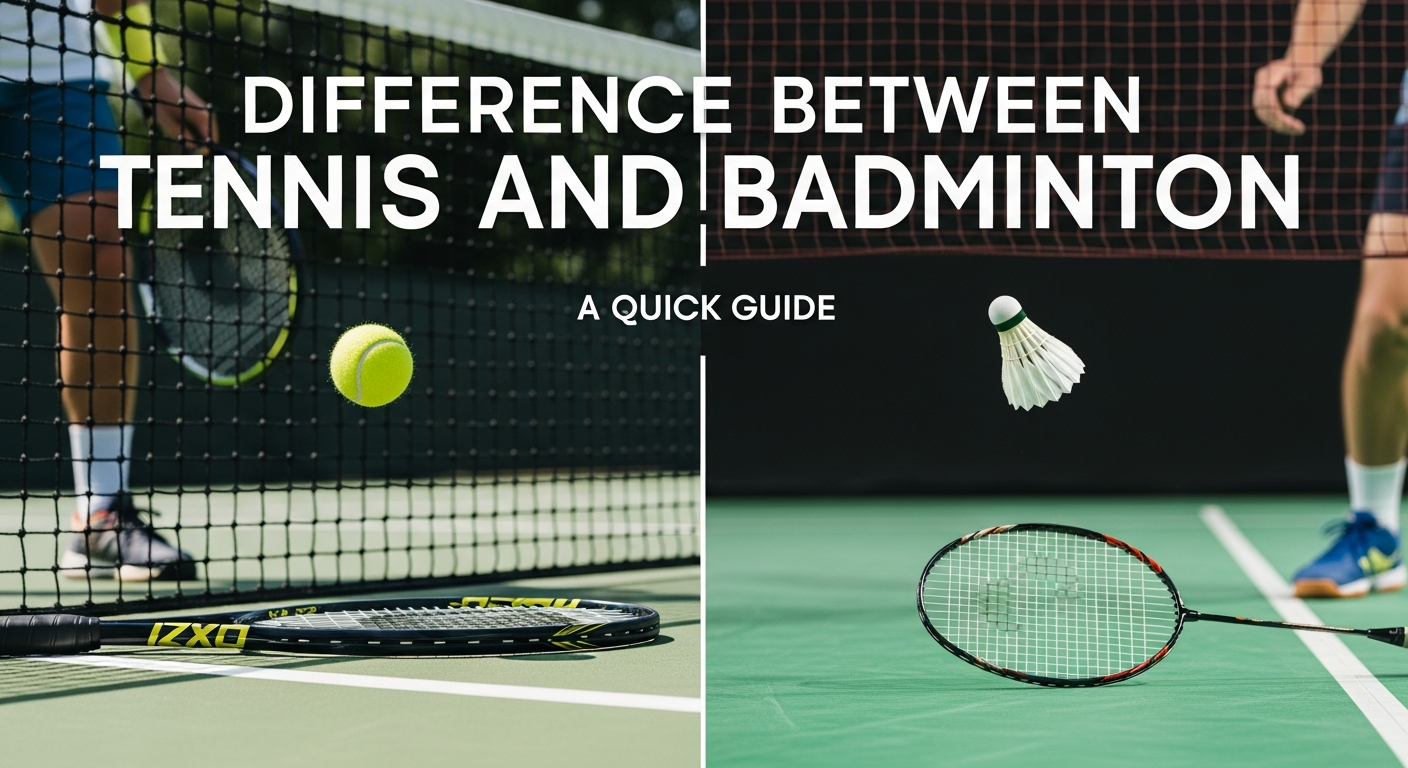
Difference Between Tennis and Badminton You Should Know
Standing at the edge of the court, racket in hand, heart pounding against your ribs. A familiar feeling, right?
Most sports fans assume if you can play one racket sport, you can play them all. Big mistake. Walking onto a badminton court with a tennis mindset is a recipe for a twisted ankle. Bringing a badminton swing to a tennis match ensures your ball lands in the parking lot.
While both sports share DNA, viz., nets, rackets, and scoring points, they evolved into completely different species. One demands raw, muscular endurance and heavy artillery. The other requires lightning reflexes, deception, and acrobatic agility.
Knowing the difference between tennis and badminton saves you from embarrassment and helps you respect the nuances of each discipline. Let’s dissect the mechanics, the physics, and the sweat equity required for both so you can choose your battlefield on Khelomore.
Difference Between Tennis and Badminton: At a Glance
| Aspect | Tennis | Badminton |
| Overall Difficulty | Requires strength, endurance, and technical skill over long periods | Requires speed, agility, and fast reflexes |
| Primary Physical Demand | Muscular strength and aerobic endurance | Raw speed, agility, and explosive movement |
| Equipment | Heavy racket (250g – 350g) and bouncy rubber ball | Lightweight racket (70g – 95g) and feather/plastic shuttlecock |
| Projectile Behavior | The ball has a high bounce and durability, suited for powerful strokes | Shuttlecock is aerodynamic, lightweight, and changes direction rapidly |
| Court Size (Singles) | 78 ft × 27 ft (23.77 m × 8.23 m) | 44 ft × 17 ft (13.4 m × 5.18 m) |
| Court Size (Doubles) | 78 ft × 36 ft (23.77 m × 10.97 m) | 44 ft × 20 ft (13.4 m × 6.1 m) |
| Fault Consequence | A double fault loses the point | Every fault immediately loses a point |
| Playing Surface | Clay, grass, or hard courts; indoor and outdoor | Mostly indoor; synthetic or wooden floors |
| Match Duration | Can last 3–5 hours (even longer in rare cases) | Typically 30–60 minutes |
The Physics of the Projectile: Heavy Ball vs. Drag
Everything starts with what you hit.
In tennis, you battle a pressurised rubber ball covered in felt. It weighs about 58 grams. When you strike it, it wants to keep moving. It carries momentum. Physics dictates that the ball bounces, retaining significant speed after contact with the court. You have time to prepare. You see the bounce, calculate the trajectory, and wind up for a heavy groundstroke.
Badminton is a fight against aerodynamics. The shuttlecock is a cone of feathers (or nylon) stuck to a cork base. It has high drag.
Smash a shuttlecock, and it leaves your racket at over 300 km/h— faster than a Formula 1 car. But here is the catch: it decelerates instantly. It doesn’t glide; it dies. You have to chase it. You cannot wait for it to come to you because it won’t.
A tennis and badminton comparison often ignores this fundamental truth: Tennis is about managing energy conservation and spin. Badminton is about managing energy explosion and drag.
The Racket: Extension of Arm vs. Flick of Wrist
Pick up a tennis racket. It feels solid. Weighing between 250 to 350 grams, it acts as a bludgeon. You need that mass to counteract the heavy ball. To swing it effectively, you lock your wrist. The power comes from your legs, travels through your core, and exits through a rigid arm. It is a full-body kinetic chain.
Now, hold a badminton racket. It feels like a toy in comparison, weighing a mere 70 to 95 grams. But do not let the weight fool you.
If you swing a badminton racket with a locked wrist like a tennis player, you will fail. Badminton relies on “snap.” You hold the grip loosely, almost gently, until the millisecond of impact. Then, you squeeze and snap your wrist.
- Tennis Swing: Long, sweeping loops. Shoulder-driven.
- Badminton Swing: Short, sharp whips. Wrist-driven.
Mixing these techniques leads to the most common injury for crossover athletes: tennis elbow for badminton players, and wrist tendinitis for tennis players.
The Court Dynamics: The Horizontal vs. The Vertical
Visualising the court reveals another layer of the difference between badminton and tennis game mechanics.
A tennis court is massive. At 78 feet long and 27 feet wide (for singles), it feels like a vast territory to defend. The net sits low— about 3 feet at the centre. This geometry encourages horizontal play. You hit drives, cross-court shots, and passing shots that barely skim the net. You run side-to-side, covering miles in a match.
Badminton courts are smaller (44 x 17 feet for singles), but the net stands high, 5 feet 1 inch.
That height changes everything.
You cannot hit “through” a badminton opponent easily. You must go over them or steeply down at them. The game becomes vertical. You clear the shuttle high to the baseline to force your opponent back, then you drop it short to bring them forward.
In tennis vs badminton, think of tennis as a 2D battle of angles and badminton as a 3D battle of height and depth.
Movement: The Glide vs. The Lunge
Watch a tennis pro like Federer or Djokovic. They glide. They take small adjustment steps, slide into position, and plant their feet before hitting. It looks rhythmic. The movement is about efficient coverage of large spaces.
Now watch a badminton legend like Lin Dan. The movement is violent. It is explosive.
Because the shuttle does not bounce, you cannot wait. You lunge, jump, and dive. A badminton player spends a huge portion of the match in the air or doing deep lunges that would make a fencer jealous.
The Cardio Reality
- Tennis: An aerobic marathon. Matches last hours. You run 3 to 5 miles. It is a test of sustained output.
- Badminton: An anaerobic series of sprints. Matches last 40 minutes, but the shuttle is in play for double the time of a tennis ball. You perform hundreds of explosive movements with zero rest.
Scoring and Psychology
Scoring systems dictate how you think.
Tennis uses a bizarre system (15, 30, 40, Game) rooted in medieval French history. But the structure allows for “coasting.” You can lose a point without losing the game. You can lose a set and still win the match. It rewards mental resilience and long-term strategy. The server holds a massive advantage, dominating the pace.
Badminton uses a rally-point system to 21. Every mistake costs you a point immediately. There is no second serve. If you mess up the serve, you lose the point. This creates immense pressure. You cannot afford a mental lapse. The server has no major advantage because the serve must be underhand.
In a badminton vs tennis psychological analysis, tennis allows for comebacks through grinding, while badminton demands perfection from the first second.
The “Cool” Factor: Culture and Vibe
We have to talk about the vibe.
Tennis carries a legacy of tradition. Think Wimbledon whites, silence during points, and polite applause. It feels grand. It feels like an occasion. When you book a tennis court, you are stepping into a world of etiquette and focus.
Badminton is the people’s champion in Asia. It is loud. It is fast. Walk into an indoor badminton hall in Bangalore or Hyderabad, and the sound is deafening—shoes squeaking, rackets cracking like whips, players shouting. It feels like a gladiatorial pit.
Which One Suits You?
Deciding depends on what you want from your hour of play.
Choose Tennis if,
- You love the outdoors and open spaces.
- You want a battle of patience and tactical construction.
- You enjoy the feeling of hitting a heavy object with power.
- You want a sport you can play casually into your 60s and 70s.
Choose Badminton if,
- You want the ultimate HIIT workout.
- You prefer indoor environments (no sun in your eyes, no wind).
- You love fast-twitch reactions and speed.
- You want to sweat buckets in under 30 minutes.
The Verdict
Comparing these two is like comparing a sniper rifle to a machine gun. Both are weapons, but they solve different problems.
Some athletes love the tennis vs badminton rivalry, claiming one is harder than the other. The truth? Tennis is harder to learn. Getting the ball over the net consistently takes months of practice. Badminton is easy to learn, but it is infinitely harder to master physically.
So, why not try both?
Your footwork from the badminton court will make you faster on the tennis baseline. The power generation from your tennis serve will add venom to your badminton smash.
Stop Thinking, Start Playing
Reading about the mechanics won’t burn calories. Only sweating will.
You don’t need a club membership or a professional coach to get started. You need a racket, a friend, and a venue.
Khelomore bridges that gap. We stripped away the hassle of calling ten different venues to find a slot.
- Open the app.
- Search for “Badminton” or “Tennis” near you.
- Check the reviews and photos.
- Book your slot instantly.
The court is empty. The lights are on. The only thing missing is you.
Book your game on Khelomore now.
FAQs
Can you play badminton outdoors effectively?
No. Even a slight breeze disrupts the lightweight shuttlecock’s flight. Competitive badminton is strictly an indoor sport to ensure precision, stability, and fairness during rallies.
Is tennis equipment more expensive than badminton gear?
Generally, yes. While entry-level costs are similar, professional tennis rackets, stringing maintenance, and court rental fees typically cost more than badminton equivalents over time.
Do I need specific shoes for each sport?
Yes. Badminton shoes use non-marking gum rubber soles for indoor grip. Tennis shoes feature durable, reinforced outsoles designed to withstand abrasion on rough, hard-court surfaces.
Why do professionals use feather shuttlecocks?
Feathers offer superior aerodynamic drag and flight stability compared to nylon. They allow for precise net shots and steeper drops, despite being less durable than plastic.
How does the doubles strategy differ in these sports?
Badminton doubles is faster, relying on rapid rotation and flat drives. Tennis doubles prioritises net dominance, serve placement, and poaching volleys to end points quickly.
PakarPBN
A Private Blog Network (PBN) is a collection of websites that are controlled by a single individual or organization and used primarily to build backlinks to a “money site” in order to influence its ranking in search engines such as Google. The core idea behind a PBN is based on the importance of backlinks in Google’s ranking algorithm. Since Google views backlinks as signals of authority and trust, some website owners attempt to artificially create these signals through a controlled network of sites.
In a typical PBN setup, the owner acquires expired or aged domains that already have existing authority, backlinks, and history. These domains are rebuilt with new content and hosted separately, often using different IP addresses, hosting providers, themes, and ownership details to make them appear unrelated. Within the content published on these sites, links are strategically placed that point to the main website the owner wants to rank higher. By doing this, the owner attempts to pass link equity (also known as “link juice”) from the PBN sites to the target website.
The purpose of a PBN is to give the impression that the target website is naturally earning links from multiple independent sources. If done effectively, this can temporarily improve keyword rankings, increase organic visibility, and drive more traffic from search results.

Dataflows Gen2 vs Data Factory Pipelines in Microsoft Fabric: What’s the Difference?
Dataflows Gen2 vs Data Factory in Microsoft Fabric: What’s the Difference? I have been asked this question several times in recent training sessions on Microsoft Fabric, so I jotted some notes down here.
Microsoft Fabric brings together the best of Microsoft’s data engineering, data integration, analytics, and AI capabilities into a single unified platform. For many teams adopting Fabric, one of the first questions that arises is:
“What’s the difference between Dataflows Gen2 and Data Factory Pipelines?”
Both can move, transform, and prepare data. Both live inside the Fabric experience. And both can be scheduled, monitored, and orchestrated. However, they serve different purposes, offer different strengths, and work best in different parts of the modern data lifecycle.
This post explains the key differences and provides practical examples to help you choose the right tool for your scenario.
What Are Dataflows Gen2?
Dataflows Gen2 are Fabric’s low-code data preparation and transformation solution. They are built on Power Query, the same engine used in Power BI and Excel, giving analysts and citizen developers a familiar, friendly interface.
Key Characteristics
- Low-code / no-code: Drag-and-drop transformation steps rather than writing SQL or Python.
- Power Query based: Ideal for data wrangling, cleansing, merging, shaping, and enrichment.
- Works well for mid-volume data: Excellent for business data preparation and M-code transformations.
- Outputs straight into Fabric: Can load data into Lakehouses, Warehouses, and KQL databases.
- Accessible to analysts: You don’t need a data engineering background to use it effectively.
When to Use Dataflows Gen2
Dataflows Gen2 shine in scenarios such as:
- Self-service data preparation for analysts building semantic models.
- Ingesting business application data (Excel files, SharePoint lists, Dataverse, SQL).
- Quick transformations such as splitting columns, merging tables, cleaning text, or deduplication.
- Prototyping datasets before handing them over to engineering teams.
If you know Power Query, you’ll feel at home immediately.
What Is Data Factory (in Fabric)?
Fabric’s version of Data Factory combines two things:
- Pipelines – orchestration and data movement.
- Dataflows (Power Query) and Notebooks (Spark) – heavy-duty transformation for engineers.
It is Microsoft’s full data integration and ETL/ELT platform, now tightly integrated into Fabric.
Key Characteristics
- Enterprise-grade orchestration with pipelines, triggers, and dependency management.
- Powerful connectors for large-scale ingestion, especially from cloud and on-premises systems.
- Supports Spark notebooks and data engineering workloads.
- Handles high-volume, complex pipelines.
- CI/CD friendly and suited for production data engineering.
When to Use Data Factory
Data Factory is designed for more complex engineering tasks, such as:
- High-volume ingestion from operational systems, APIs, or files landing in cloud storage.
- ETL/ELT using Spark notebooks, SQL scripts, and pipeline activities.
- Orchestrating multi-step workflows, including branching, loops, and conditional logic.
- Copying terabyte-scale datasets from Azure SQL Database, Synapse, ADLS, AWS S3, Oracle, and more.
- Building production-ready pipelines with monitoring, retries, and error handling.
If you are familiar with Azure Data Factory, this will feel like its next evolution within Fabric.
Dataflows Gen2 vs Data Factory: How to Choose?
Here is a simple way to think about it:
Choose Dataflows Gen2 when:
- You want low-code data shaping.
- Business analysts are preparing their own datasets.
- You need simple ingestion or transformation.
- The data volumes are small to medium.
- The source systems are Excel, SharePoint, Dataverse, or SQL.
Choose Data Factory when:
- You are building enterprise pipelines.
- You need orchestration, scheduling, and dependencies.
- You are working with large or complex datasets.
- You require Spark, notebooks, Data Engineering, or SQL pipeline logic.
- Data movement needs to be integrated into CI/CD or operated at production scale.
A Combined Approach
In many organisations the best approach is both, working together:
- Data Factory pipelines handle ingestion from source systems into the Bronze layer.
- Dataflows Gen2 then apply transformations to shape and enrich the data for the Silver layer or the semantic model.
This layered approach provides scalability, governance, and flexibility while still enabling self-service analytics.
Need help applying this in practice?
If your organisation is using Power BI or Microsoft Fabric and needs clarity around architecture, governance, or next steps,
The Data Platform Accelerator is designed to help.
It’s a focused engagement that assesses your current setup and delivers a practical roadmap you can execute.
👉
Learn more about The Data Platform Accelerator
Summary
While Dataflows Gen2 and Data Factory sit side-by-side in Microsoft Fabric, they target very different users and workloads:
- Dataflows Gen2 → Best for analysts, low-code transformations, quick data preparation.
- Data Factory → Best for engineers, enterprise data pipelines, complex ingestion, and orchestration.
Understanding these differences ensures your team uses the right tool for the right job, helping you build efficient, scalable, and well-governed data solutions in Microsoft Fabric.
If you’re teaching or adopting Fabric, this distinction is one of the most important concepts to get right early.
News
Berita Teknologi
Berita Olahraga
Sports news
sports
Motivation
football prediction
technology
Berita Technologi
Berita Terkini
Tempat Wisata
News Flash
Football
Gaming
Game News
Gamers
Jasa Artikel
Jasa Backlink
Agen234
Agen234
Agen234
Resep
Cek Ongkir Cargo
Download Film