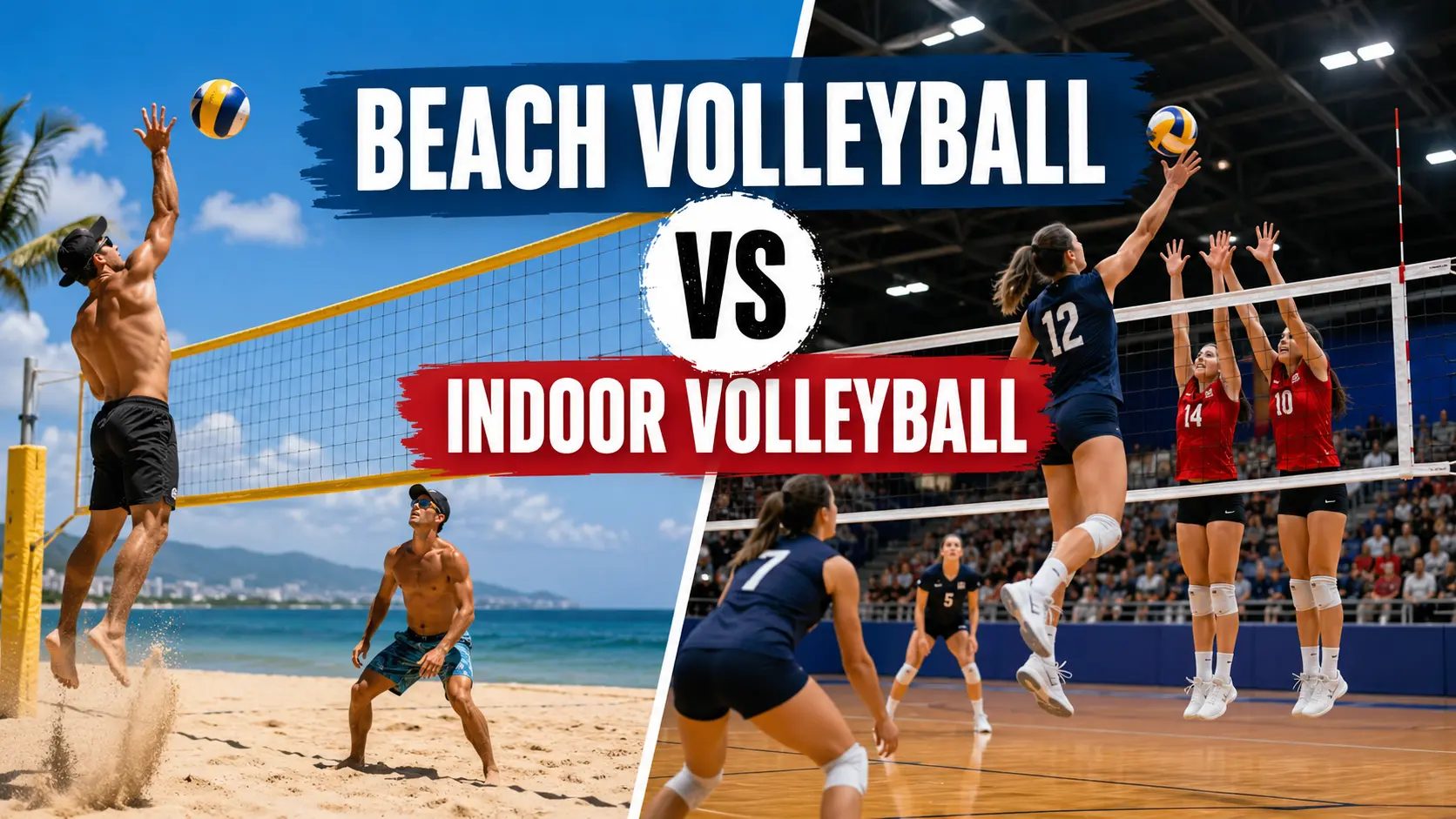
Beach Volleyball vs Indoor Volleyball: Key Differences
There’s a moment every indoor volleyball player knows— the first time they step onto sand and realise their footwork means nothing. The jump is slower. The dig lands differently and suddenly every skill they spent years building feels slightly out of reach.Â
The reverse is equally true: a beach player walking into an indoor gym for the first time is thrown off by the pace, the rotations, and the sheer number of bodies on the court. That disorientation is an actual structural gap between the two sports. These are two distinct games having the same name.
Whether you are seeking passionate gameplay, benefits of indoor games for health or the zeal of an outdoor sport adventure, knowing the distinction “Beach volleyball vs Indoor volleyball” clears a lot of doubts.
Beach Volleyball vs Indoor Volleyball: Major Differences
The fastest way to understand the comparison “beach volleyball vs indoor volleyball” is to stop treating one as a variation of the other. Yes, there’s a net, a ball, and the same basic objective. But the rules, team sizes, court dimensions, ball specs, and physical demands diverge sharply enough that players train for each format separately.
| Feature | Beach Volleyball | Indoor Volleyball |
| Team Size | 2 players per side | 6 players per side |
| Court Size | 16 m × 8 m | 18 m × 9 m |
| Net Height (Men) | 2.43 m | 2.43 m |
| Net Height (Women) | 2.24 m | 2.24 m |
| Sets to Win | Best of 3 (first to 21, final set to 15) | Best of 5 (first to 25, final set to 15) |
| Scoring System | Rally scoring in all sets | Rally scoring in all sets |
| Ball Type | Softer, slightly larger, lower pressure | Harder, standard pressure |
| Libero | No | Yes |
| Substitutions | No | Up to 6 per set |
| Open-Hand Setting Rules | Stricter | More lenient |
| Surface | Sand | Hardwood or synthetic flooring |
| Time-Outs | 1 team time-out per set (30 seconds) + technical time-outs | 2 team time-outs per set (30 seconds each) + technical time-outs |
Court Size
The doubt about beach volleyball court size vs indoor is one of the first things players notice. It tells you a lot about how each game is designed.
An indoor volleyball court is 18 metres long and 9 metres wide with a 3-metre attack line dividing the front and back zones on each side. The total playing area is 162 square metres shared by six players.
A beach volleyball court is 16 metres long and 8 metres wide. It is 128 square metres covered by two players. That’s a smaller court with fewer people. But those two players have to cover every centimetre of it, every rally, every set.
There is no attack line on a beach court. Any player can attack from anywhere. That rule shift alone changes offensive strategy completely.
Change in Game Rules
Team Size and Rotation
Indoor volleyball goes with six players who rotate positions clockwise every time their team wins back the serve. Each position has a defined role, viz., setter, libero, outside hitter, opposite, middle blockers.
Beach volleyball gives you two players and no rotation requirement. Both players serve (alternating each game), defend, and attack. One player usually takes the primary setting role. But there’s no positional lock-in. Adaptability is the whole game.
The Setting Rule
This is where the comparison “beach volleyball rules vs indoor” diverges most sharply.
In indoor volleyball, setting standards are firm but have room for interpretation. A double contact is called when the ball visibly contacts two parts of the hand separately. Lifts are called when the ball is caught or thrown. But referees allow some degree of imperfection, especially on hard-driven balls.
In beach volleyball, the standard is significantly stricter.
- A double contact is called on any set where the ball makes contact with two parts of your hand that aren’t simultaneous.
- Spin on the ball after a set is treated as evidence of a double and referees watch for it closely.
- On an open-hand set, the ball must leave cleanly. The moment there’s prolonged contact or spin, it’s a foul.
This is why experienced indoor setters get called immediately when they try to run their normal technique on sand. The motion that reads as clean in a gym reads as a lift or double on a beach court.
Blocking and Attack Rules
In indoor volleyball, a block touch does not count as one of the team’s three contacts. A player can block and then immediately play the ball as the first of three hits.
In beach volleyball, a block does count as one of the three contacts. This fundamentally changes how beach teams defend. A block-and-dig combination that’s seamless indoors becomes a strategic decision outdoors.
Also in beach volleyball, a blocker cannot open their hand over the net to redirect a set. It is called a “joust” or a “finger action” violation and is called regularly at higher levels.
Serving Rules
Both formats use rally scoring (every rally awards a point regardless of who served). Both allow jump serves and float serves.
The one difference worth noting: in beach volleyball a serve that touches the net and lands in is a point for the server. In indoor volleyball, a let serve (net touch, ball lands in) is replayed.
Net Height: Mostly the Same
Beach volleyball net height vs indoor is the same at the standard level: 2.43m for men and 2.24m for women in both formats.
Where this gets interesting is that jumping on sand is mechanically harder than jumping off hardwood. Sand absorbs energy. Players sink slightly with every step. A player who can touch 3.2 metres comfortably in a gym will find their reach reduced on sand, which means the same net height demands more from beach players in terms of raw athleticism.
Beach volleyball also allows players to penetrate under the net with hands and feet, as long as they don’t interfere with the opponent’s play. Indoor volleyball is stricter, e.g., penetration under the net is a fault if it interferes with the opponent.
The Ball
Indoor volleyballs are made of leather. They have higher internal pressure (0.300-0.325 kg/cm²) and are designed to move fast off a hard floor. The firmer construction supports powerful attacks.
Beach volleyballs are slightly larger in circumference. They are made of water-resistant panels and inflated to lower pressure (0.175-0.225 kg/cm²). The softer, slower ball accounts for wind resistance, outdoor conditions, and the slower movement mechanics that sand creates. A beach ball hit indoors would feel floaty. An indoor ball used on sand would be nearly unplayable in wind.
Physical Demands for Each Format
Beach volleyball and indoor volleyball pull from different athletic profiles.
Indoor volleyball rewards explosive vertical jump, positional precision, and teamwork within a structured system. A specialist (libero, setter, middle blocker) can excel without needing to be a complete all-around player.
Beach volleyball rewards endurance, total-court athleticism, communication under pressure, and the ability to both set and attack from any position. There are no specialists.
In terms of conditioning, beach volleyball is widely considered the more physically demanding format. Playing multiple sets in heat, on sand, while covering half a court solo is a different kind of exhaustion than the rotation-based workload of a six-player indoor team.
But if you’re weighing the importance of physical fitness in your choice, both formats are equally good in their own way.
Cost
| Aspect | Indoor Volleyball (India) | Beach Volleyball (India) |
| Court Booking | ₹500-₹1,500 per hour (depending on the city) | ₹600-₹2,000 per hour at a dedicated beach volleyball facility |
| Ball | ₹1,000-₹3,500 for a decent training ball | ₹1,500-₹4,000 for a proper outdoor ball |
| Footwear | Volleyball-specific court shoes start at ₹2,500 | No footwear required; most players go barefoot (sand socks optional) |
Beach volleyball has fewer dedicated courts in India compared to indoor. Cities like Mumbai, Goa, Chennai, and Bengaluru have facilities, but availability is limited. Booking in advance is strongly recommended.
Which Format Should You Choose?
| Choose Indoor Volleyball If… | Choose Beach Volleyball If… |
| You want a structured, team-based sport with defined positions. | You want a two-person format that demands total athletic development. |
| You’re training for school, college, or state-level competitions (indoor volleyball is far more common in institutional Indian sports). | You’re looking for a physically intense workout that doubles as skill training. |
| You prefer fast-paced rallies and a more tactically layered game. | You enjoy reading your opponent and making split-second tactical calls with one partner. |
| You’re starting out. | You’re in a city with beach volleyball infrastructure and want an alternative competitive track. |
If you’re already playing one format, the fastest way to improve at the other is to understand the rule divergences first, particularly the setting rules and the block-counts-as-touch rule in beach volleyball. Those two adjustments alone will prevent most of the early errors.
Final Word
The question around “beach volleyball vs indoor volleyball” isn’t about which is better in the abstract. They’re built differently, they reward different things, and they develop players in different ways. The net height is the same. Almost everything else shifts.
If you’re serious about volleyball in any format, play both at some point. The game you think is harder will teach you something the other never could.
Looking to book an indoor or beach volleyball court near you?Khelomore lists verified sports venues across India so you can find and book court time without the back-and-forth.Â
Check availability and book your slot directly on the platform.
FAQs
Beach volleyball vs indoor volleyball, which is better?
Neither is objectively better. They develop different skills. Indoor suits players who want team structure and tactical depth. Beach volleyball builds total athleticism and one-on-one reading ability. The answer depends on your goals.
What is a beach volleyball court size in metres?
A standard beach volleyball court is 16 metres long and 8 metres wide (128 sq m). That’s smaller than an indoor court (18m x 9m).
Is beach volleyball harder on the body?
Beach volleyball carries a lower injury risk for knees and ankles because sand absorbs impact. However, it places more strain on the shoulders and lower back over time due to the constant full-body load two players carry without substitutions.
Can a beginner start directly with beach volleyball?
Yes, but the learning curve is steeper. Sand slows every movement, the setting rules are stricter, and there’s no positional cover from teammates. Most coaches recommend building foundational skills indoors first.
When did beach volleyball become an Olympic sport?
Beach volleyball was introduced at the 1996 Atlanta Olympics, over 50 years after indoor volleyball debuted at the 1964 Tokyo Games. It still is one of the highest-attended events at the Summer Olympics.
PakarPBN
A Private Blog Network (PBN) is a collection of websites that are controlled by a single individual or organization and used primarily to build backlinks to a “money site” in order to influence its ranking in search engines such as Google. The core idea behind a PBN is based on the importance of backlinks in Google’s ranking algorithm. Since Google views backlinks as signals of authority and trust, some website owners attempt to artificially create these signals through a controlled network of sites.
In a typical PBN setup, the owner acquires expired or aged domains that already have existing authority, backlinks, and history. These domains are rebuilt with new content and hosted separately, often using different IP addresses, hosting providers, themes, and ownership details to make them appear unrelated. Within the content published on these sites, links are strategically placed that point to the main website the owner wants to rank higher. By doing this, the owner attempts to pass link equity (also known as “link juice”) from the PBN sites to the target website.
The purpose of a PBN is to give the impression that the target website is naturally earning links from multiple independent sources. If done effectively, this can temporarily improve keyword rankings, increase organic visibility, and drive more traffic from search results.

Badminton Singles vs Doubles: Key Differences
When you walk into a badminton club in Mumbai for the first time, you might see four people are smashing away on one court. On the next one, a guy is sprinting corner to corner, solo, completely drenched. You’re watching doubles and singles formats of the game at the same time.Â
Both look like a workout. Both look like fun. But if you’re a beginner to the game, you have to pick one. Most experts suggest doubles format for beginners. There are many people who challenge to play singles directly! If you’re restarting sports in your 30s, doubles might be a good choice.
Badminton singles vs doubles, that choice shapes how you learn the game and what you prefer. At the core, it influences how fast you improve and how much you enjoy showing up again the next weekend.
Badminton Singles vs Doubles: What Changes for a Beginner?
Everything! The court dimensions, the rally style, physical demands, mental load, all of it changes depending on which format you play.
In singles, the court narrows to 5.18 metres wide but stretches the full length. You’re alone covering all four corners repeatedly, sometimes moving 6-7 metres in a single rally.Â
In doubles, the court expands to 6.1 metres wide. But you’re sharing that space with a partner and the service boxes shrink front-to-back.Â
Badminton Court Rules for Singles and Doubles
| Feature | Singles | Doubles |
| Court width | 5.18m (inner tramlines) | 6.1m (outer tramlines) |
| Service box | Long and narrow | Short and wide |
| Badminton boundaries for singles and doubles | Inner sidelines, full length | Outer sidelines, shortened length for serve |
| Players per side | 1 | 2 |
| Game pace | Measured, tactical rallies | Fast exchanges, quick reactions |
| Physical demand | Aerobic endurance, typically 4–6 km of movement | Explosive bursts, stronger upper-body power |
| Best for beginners? | Harder initially, but improves skills faster | Lower barrier to entry and easier to start with |
The Case for Doubles (Especially in Mumbai)
Mumbai’s badminton culture is packed. Walk into venues like Courts of the World in Chembur or the sports complexes in Andheri, and you’ll find doubles courts filling up faster.
Doubles lets you ease into the game. You have a fellow partner reading the shuttle with you. That psychological safety matters for beginners.
For anyone exploring sports for weight loss, doubles still burns serious calories. A 60-minute doubles session can torch 400-500 calories and the pace keeps your heart rate elevated. The rallies in doubles are actually faster at the net.
The difference between singles and doubles in badminton really shows up in court coverage. In doubles, front-back positioning is the norm. One player attacks from the back, the other defends the net. That division of labour makes the game more manageable for someone who doesn’t yet have the footwork to cover the whole court alone.
And in Mumbai specifically, with courts at a premium, doubles means you split the booking cost four ways instead of two. That’s a real consideration when you’re booking at trending badminton venues like Smash Arena or Khelomore-listed courts across Powai, Malad, and Thane.
Why Singles Might Actually Be the Better Teacher
Singles is brutal for a beginner. You will get tired and make positional errors constantly. But that suffering? It’s the fastest feedback loop in the sport.Â
When you play badminton singles, there’s nowhere to hide. Every weak return, poor serve, every time you’re caught flat-footed, it shows immediately. Your footwork either improves or you lose. That pressure accelerates learning in a way doubles rarely does.
Singles also teaches you how to play badminton in its purest form. You learn to think three shots ahead. You learn to control the shuttle’s trajectory. The badminton smash techniques you develop in singles (generating power from the back court, varying pace, disguising direction) directly transfer when you eventually move to doubles.
Several badminton academies in Mumbai actually structure beginner training around singles drills precisely because the feedback is cleaner. If you’re training rather than casually playing, singles-based drills build your foundation faster.
The Real Differentiator: What Kind of Beginner Are You?
Forget the formats for a second. Ask yourself this: are you there to get fit and have fun with friends, or are you genuinely trying to learn the game and improve?
If it’s the former: doubles, no question. Grab three friends, split a court on KheloMore, and spend an hour chasing the shuttle and laughing. It’s social, it’s energetic, it’s a great workout.
If it’s the latter: start with doubles, but push yourself into singles within the first two months. Use doubles to get comfortable with the shuttle speed and court sense. Then transition.
The players who plateau in Mumbai’s recreational badminton scene are overwhelmingly the ones who stayed in doubles-only mode for years.Â
They got better at partnership play but never developed the court coverage or shot variety that badminton singles vs doubles play demands on opposite ends of the skill spectrum. When they finally stepped onto a singles court, they realised their footwork was underdeveloped.
The players who improved fastest? They rotated. Doubles on weekends with a group. Singles practice mid-week with one opponent.
Court Rules to Know Before You Step On
A lot of beginners embarrass themselves at Mumbai clubs by mixing up the badminton boundaries for singles and doubles mid-game.
Singles
- Use the inner sidelines (narrower court).
- Service must land in the long, narrow service box diagonally.
- The full length of the court is in play after the serve.
Doubles
- Use the outer sidelines (wider court).
- Service must land in the shorter service box. The back tramlines are out during serve only.
- After the serve, the full outer boundary applies.
That shift in service box dimensions is where most beginners get confused. In doubles, your serve has to be more precise because the service area is actually smaller front-to-back.
Knowing these rules cold before you walk in? It saves you that awkward moment of arguing about whether a shuttle landed in or out while three other players stare at you.
Finding Courts in Mumbai
Mumbai has no shortage of options. From the NSCI courts in Worli to community badminton halls in Borivali, the infrastructure exists. The gap for most beginners is discovery and availability.
Khelomore lists badminton courts across Mumbai with real-time availability. You’re not calling venues or navigating group chats to confirm a booking. Pick your sport, find a court near you, and lock it in.
If you want structured coaching alongside court time, several academies operate out of Khelomore-listed venues. Book a court and explore coaching options in the same place.
The Verdict
For absolute beginners in Mumbai’s badminton clubs: start with doubles. It is more forgiving. Once you can sustain a rally and your footwork feels natural, go to singles. Let it expose your gaps for a good training.Â
You can also directly go for singles if you can handle total control over your shots and court space. Doubles is more difficult for some because it requires a lot of teamwork and communication. So, the choice is as much a matter of personal preference.
Ultimately, the debate “Badminton singles vs doubles” is not a permanent allegiance. It is a toolkit. The best recreational players in Mumbai use both. So should you.
FAQs
Badminton singles vs doubles, which is more physically demanding?
Usually, singles format is considered as more physically demanding. You have to cover the full court alone, moving 4-6km per match. Doubles demands explosive bursts and faster reactions, but the physical load per player is lower overall.
Can badminton benefit diabetics?
Yes. Badminton improves insulin sensitivity and helps regulate blood sugar through sustained aerobic activity. Regular play (even 3 sessions a week) supports glucose metabolism and cardiovascular health.
Does badminton change body shape?
It does, but over time. Badminton burns 400-550 calories per hour. It builds lean leg and core muscle, and reduces body fat through regular play. Consistent sessions do improve muscle tone and posture noticeably.
Can I play badminton instead of going to gym?
For cardio, agility, and general fitness, yes! Badminton covers endurance and lower-body strength well. It won’t replace targeted strength training. As a primary fitness activity, it holds up solidly against a standard gym routine.
PakarPBN
A Private Blog Network (PBN) is a collection of websites that are controlled by a single individual or organization and used primarily to build backlinks to a “money site” in order to influence its ranking in search engines such as Google. The core idea behind a PBN is based on the importance of backlinks in Google’s ranking algorithm. Since Google views backlinks as signals of authority and trust, some website owners attempt to artificially create these signals through a controlled network of sites.
In a typical PBN setup, the owner acquires expired or aged domains that already have existing authority, backlinks, and history. These domains are rebuilt with new content and hosted separately, often using different IP addresses, hosting providers, themes, and ownership details to make them appear unrelated. Within the content published on these sites, links are strategically placed that point to the main website the owner wants to rank higher. By doing this, the owner attempts to pass link equity (also known as “link juice”) from the PBN sites to the target website.
The purpose of a PBN is to give the impression that the target website is naturally earning links from multiple independent sources. If done effectively, this can temporarily improve keyword rankings, increase organic visibility, and drive more traffic from search results.
Roma vs Bologna Europa League knockout prediction: Match preview, key stats & h2h – Kenya’s sports news, betting and casino updates
Roma will host Bologna in the second leg of their UEFA Europa League knockout playoff on Thursday night, looking to book a place in the quarterfinals.Â
The two teams played out to a 1-1 draw in the first leg last week, setting up the second leg to be a potentially explosive encounter. Lorenzo Pellegrini scored a late equalizer to salvage a point for Roma.Â
Roma have been eliminated from this stage in four of their last seven appearances in the competition. The pressure is on for a victory in the home leg as they look to qualify for the last eight.Â
Bologna are unbeaten in 10 Europa League matches and will be a true test for the hosts. Their impeccable away form also gives them more than a fighting chance at qualification.Â
We have a look at both sides ahead of the highly anticipated clash and offer our predicted outcome.Â
ALSO READ: Europa League knockout round second leg predictions: Match preview, key stats & h2h
What time does Roma vs Bologna start?Â
The game kicks off at 11PM E.A.TÂ
Roma vs Bologna team newsÂ
Paulo Dybala and Evan Ferguson remain sidelined through injury and will not feature. Zeki Celik also went off injured in the first leg and will sit this one out.Â
The goal scorer from the first leg, Pellegrini will be a key part of the hosts. The attacking trio will be completed by Stephan El Shaarawy and new signing Donyell Malen.Â
The rest of the team will remain unchanged from the first leg.Â
For the visitors, Juan Miranda is suspended and will not play. As well as Lorenzo di Silvestri and Nikola Moro who are injured.Â
Bologna are expected to remain a similar XI to the side that started at the Stadio Olimpico.Â
ALSO READ: Senegal to appeal ‘unjust’ AFCON 2025 ruling after CAF award title to Morocco
Roma vs Bologna head-to-head and current formÂ
The hosts come into the game without a win in their last four games in all competitions – losing twice in that run.Â
Bologna on the other hand have won three of the last five matches, losing just one of those games. The visiting side have won all of their last five away matches and will be confident they can extend that record here.Â
There have been two draws in the recent five head-to-head matches between these two sides, with Bologna holding a slight advantage with two wins.Â
Current form:Â
Roma – LDLDW
Bologna – WDLWW
Roma vs Bologna previous gamesÂ
Roma vs Bologna predictionÂ
Despite having home advantage, Roma’s form has been worrying, and they are expected to be under pressure from Bologna throughout the 90.Â
Bologna’s away form is impressive and they cannot be counted out here, goals are a better option for the game.Â
Prediction – Both teams to score– CLICK HERE TO PLACE YOUR BET ON THIS GAME!
Related
PakarPBN
A Private Blog Network (PBN) is a collection of websites that are controlled by a single individual or organization and used primarily to build backlinks to a “money site” in order to influence its ranking in search engines such as Google. The core idea behind a PBN is based on the importance of backlinks in Google’s ranking algorithm. Since Google views backlinks as signals of authority and trust, some website owners attempt to artificially create these signals through a controlled network of sites.
In a typical PBN setup, the owner acquires expired or aged domains that already have existing authority, backlinks, and history. These domains are rebuilt with new content and hosted separately, often using different IP addresses, hosting providers, themes, and ownership details to make them appear unrelated. Within the content published on these sites, links are strategically placed that point to the main website the owner wants to rank higher. By doing this, the owner attempts to pass link equity (also known as “link juice”) from the PBN sites to the target website.
The purpose of a PBN is to give the impression that the target website is naturally earning links from multiple independent sources. If done effectively, this can temporarily improve keyword rankings, increase organic visibility, and drive more traffic from search results.