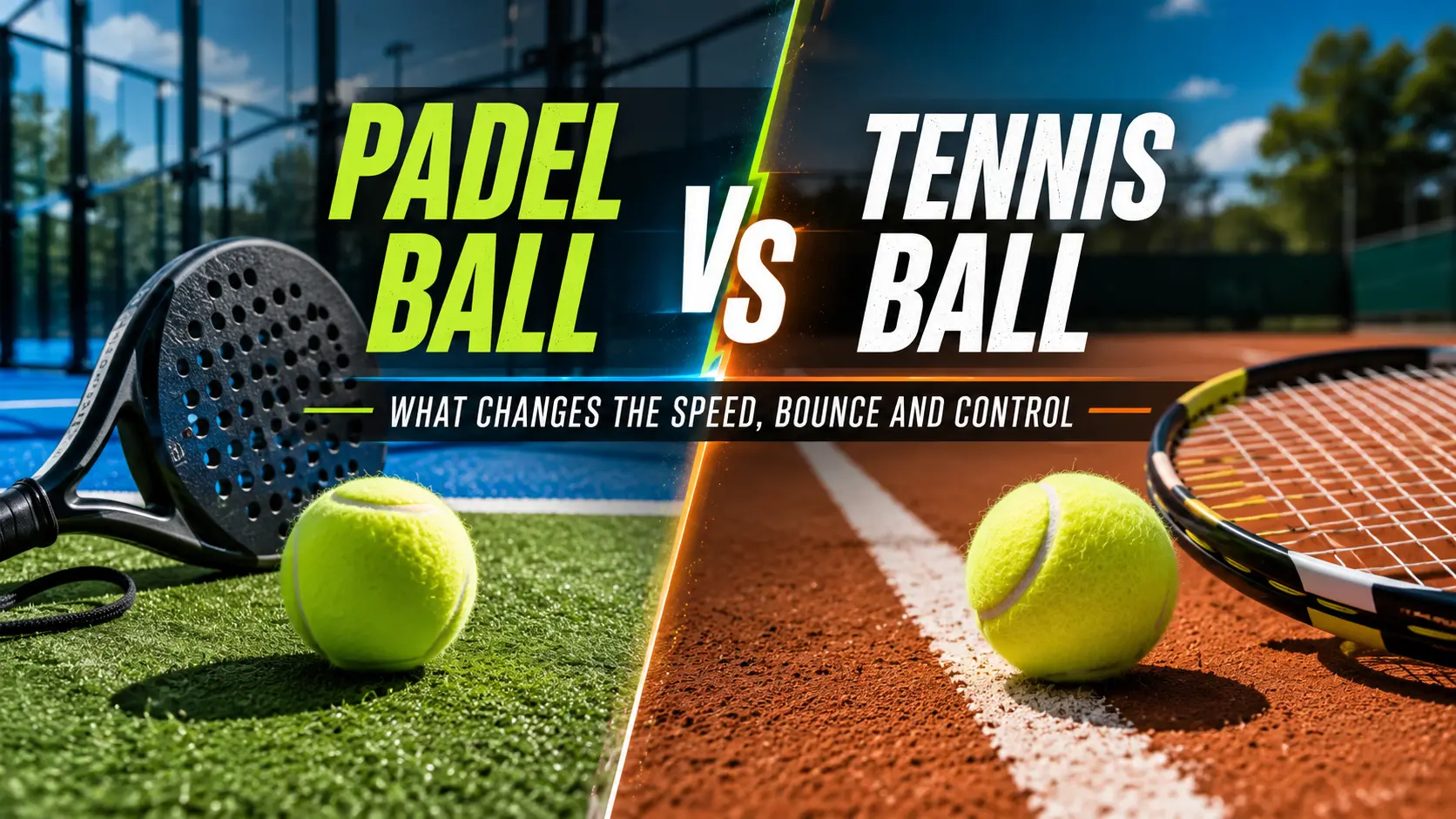
Padel Ball vs Tennis Ball: Speed, Bounce & Control
You’ve probably seen padel courts popping up across Mumbai, Bengaluru, and Delhi like they’re trying to catch up with cricket nets. And if you’ve watched anyone play, you’ve noticed something: the ball behaves differently.Â
It doesn’t bounce the same way. The rallies feel different. Even the sound is distinct. So what’s actually going on? Is it the ball, the court, the racket or all three working together?
Padel Ball vs Tennis Ball: The Core Differences
After knowing about Padel, the debate padel ball vs tennis ball starts with one deceptively simple fact: they look almost identical. Same fuzzy felt, roughly the same size. But play with the wrong one and you’ll feel the difference within five minutes.
Padel Ball Pressure: Why Lower Is Actually Smarter
Padel ball pressure is lower than that of a tennis ball. It’s a deliberate design choice that shapes the entire game.
A lower-pressure ball compresses more on contact. That extra compression gives the player a longer dwell time on the stringless padel racket face. You get more control over direction. You can redirect the ball, add spin, or kill the pace with a drop shot.
In tennis, high internal pressure means the ball launches off the racket fast. That’s great for big servers and aggressive baseliners.Â
But a high-pressure ball in a padel court would be borderline unplayable.
How Speed Changes Between the Two Balls
Ask any player who’s switched from tennis to padel: the pace is different, but not in the way you’d expect.
The padel ball travels slower off the racket. But once it hits the glass wall and comes back? That rebound can be sharp and awkward in ways a tennis baseline rally never is. You’re not dealing with unpredictable speed. The ball can die in a corner, kick up off the turf seam, or fizz back at shoulder height off the back glass.
Tennis balls with their higher internal pressure, generate more raw velocity. The professional serves clock in above 200 km/h. The ball punches through the air. On clay, the slower surface absorbs pace. On grass, it skids. The felt interacts with the surface in a way that’s central to the sport’s identity.
In padel, the felt is thinner and the pressure is lower, so the ball grips the artificial turf ever so slightly.
What Happens to Bounce
Both balls are tested for bounce from a height of 2.54 metres. The acceptable range overlaps. But padel balls are tested indoors, at room temperature, which reflects actual playing conditions. Tennis balls are tested at 20°C and the bounce requirements vary slightly across surface types.
A padel ball feels softer underfoot. Drop one on a hard surface and it doesn’t rocket back up. It bounces with a kind of muted thud. That’s by design, i.e., padel courts have turf surfaces and enclosed walls. A ball that bounces too high would constantly fly over the glass panels. A ball that bounces too low would die in the turf.
The padel ball’s bounce is calibrated for a court that’s roughly one-third the size of a tennis court. Every millimetre of bounce range matters at that scale.
Tennis balls, especially new pressurised ones fresh out of the can, bounce with authority. That pop when you open a tennis ball can is the pressurised air signalling that the ball is at peak performance. After a couple of sets, the pressure drops, the felt wears, and the bounce becomes less lively.Â
Most club players know the feeling of playing with a “dead” tennis ball. It is low and feels like hitting a lemon.
Control: Where the Real Divide Lives
If you’ve played both sports, you know that control in padel feels more immediate. Your wrist has more say. The swing is compact and the ball responds to subtle changes in angle.
That’s not just about technique, it’s the ball itself. The lower padel ball pressure allows the ball to to deform slightly more on impact. It translates directly into feedback. Mishits are obvious. Clean strikes feel satisfying in a way that’s hard to explain.
Tennis is a different contract with the ball. Control comes from footwork, swing mechanics, and racket head speed. You’re generating power through movement and technique. The high-pressure ball rewards aggression and clean mechanics. It punishes lazy swings.
Padel rewards placement and anticipation. The ball suits a game where you’re working in pairs, covering a small court, and reading your opponent’s angles off the glass. Control, in that context, means managing pace rather than generating it.
Can You Use a Tennis Ball for Padel? (Or Vice Versa?)
Technically you can. Realistically, you shouldn’t.
A tennis ball in a padel court bounces too high. It moves too fast and takes away the tactical chess match that makes padel so engaging. You’ll spend most of the time scrambling rather than constructing rallies.
A padel ball in a tennis match lacks the pace and bounce that the game demands. Serving with a padel ball is frustrating. It won’t generate spin the same way, and the lower pressure makes it feel sluggish off the strings.
Some beginners use old tennis balls for casual padel, especially when starting out. It works. But the moment you play with proper padel balls on a proper court, the difference is immediate and you won’t go back.
Tennis Ball Price vs Padel Ball Price: What to Expect in India
Tennis balls in India range widely. Entry-level balls (Cosco, Nivia) are available for ₹80-₹150 per ball, or roughly ₹300-₹600 for a can of three. Premium ITF-approved balls from Wilson or Dunlop sit between ₹600-₹900 per can. For regular club play, most players find mid-range options sufficient. Tennis ball price has stayed relatively stable, though import-dependent brands have seen marginal increases post GST adjustments.
Padel balls are slightly harder to find in India right now. Expect to pay ₹400-₹700 for a can of three from brands like Head, Bullpadel, or Wilson’s padel range. As the sport grows and more venues come up, that price will likely come down.
If you’re booking padel courts on Khelomore, some venues include balls with the court booking. Worth checking before you stock up.
The Tennis Ball vs Padel Ball Confusion: Why It Keeps Coming Up
The tennis ball vs padel ball mix-up happens because the sports share visual DNA. If you’re standing ten feet away, you can’t tell the difference.
The confusion is also marketing-driven. Padel is frequently described as a “tennis hybrid” in promotional material, which leads people to assume the equipment is interchangeable.Â
It isn’t. The ball is engineered for a specific court environment, a specific bounce range, and a specific style of play.
Understanding the difference doesn’t require a physics degree. Play both sports once with the right equipment, and your hands will explain it faster than any explanation can.
What This Means If You’re Booking Courts in India
If you’re serious about the game play with the right ball from the start. The experience of padel with proper padel ball pressure is completely different from a makeshift session with tennis balls. The rallies are longer, the tactics are clearer, and the sport starts to make sense in a way it doesn’t when you’re fighting the equipment.
Find a venue, check what’s included in the booking, and if you’re buying your own, don’t substitute one for the other. The distinction between padel ball vs tennis ball is small on paper. On court, it changes everything.
Looking to book a padel court or tennis court near you?Khelomore lists 30+ sports across courts, turfs, and play zones in your city.Â
Download the app and find your next game in one tap.
FAQs
How many balls come in a padel can?
A standard padel can contain three balls, the same as tennis. Some brands sell tubes of two for training use. Most recreational players go through one can per session before the pressure drops noticeably and the balls start feeling flat.
Do padel balls lose pressure faster than tennis balls?
Yes. Because padel balls start at lower internal pressure, the drop-off is more noticeable after heavy use. Expect usable performance for three to five hours of play. Store them in an airtight pressuriser between sessions to extend their life.
Is padel harder to learn than tennis for beginners?
Padel has a shorter learning curve. The compact court, slower ball, and solid racket face give beginners faster rally confidence. Most first-timers can sustain a proper rally within the first session.
Can altitude affect how a padel ball plays?
Absolutely. At higher altitudes, lower air density causes the ball to travel faster and bounce higher. FIP-approved balls come in pressurised variants calibrated for high-altitude play to compensate for this.
Can I use old tennis balls for padel?
Yes, but only if they still have decent bounce and feel. Old tennis balls work for casual padel practice. Padel balls are slightly less pressurised and provide better play.
PakarPBN
A Private Blog Network (PBN) is a collection of websites that are controlled by a single individual or organization and used primarily to build backlinks to a “money site” in order to influence its ranking in search engines such as Google. The core idea behind a PBN is based on the importance of backlinks in Google’s ranking algorithm. Since Google views backlinks as signals of authority and trust, some website owners attempt to artificially create these signals through a controlled network of sites.
In a typical PBN setup, the owner acquires expired or aged domains that already have existing authority, backlinks, and history. These domains are rebuilt with new content and hosted separately, often using different IP addresses, hosting providers, themes, and ownership details to make them appear unrelated. Within the content published on these sites, links are strategically placed that point to the main website the owner wants to rank higher. By doing this, the owner attempts to pass link equity (also known as “link juice”) from the PBN sites to the target website.
The purpose of a PBN is to give the impression that the target website is naturally earning links from multiple independent sources. If done effectively, this can temporarily improve keyword rankings, increase organic visibility, and drive more traffic from search results.

Spain vs Argentina: 2026 World Cup final preview, team news, current form & h2h – Kenya’s sports news, betting and casino updates
After a month of electrifying football and a whirlwind of emotions, the 2026 FIFA World Cup culminates on Sunday with a mouthwatering final between Spain and Argentina in New Jersey.
The 104th game of the World Cup sees defending champions Argentina battle it out against 2010 winners Spain, for a chance at glory. This promises to be one of the most explosive finals at the global showpiece.
Spain booked their place in Sunday’s final after a hard-fought 2-0 victory against two-time winners France, who were seeking a third consecutive finals appearance. Mikel Oyarzabal and Pedro Porro were responsible for the goals.
Luis de la Fuente’s side are keeping up their spectacular defensive show in the tournament, only conceding two goals in the seven matches played in this summers’ edition.
They will face a resilient Argentina side who came from behind once again to edge England 2-1 in their semifinal match in Atlanta on Wednesday. The victory stretched their winning run to an impressive 14 games.Â
Anthony Gordon had put the Three Lions ahead early in the second half and they held on until things began to crumble with 10 minutes left to play.
Enzo Fernandez scored his second goal in as many matches with five minutes left, before substitute Lautaro Martinez scored the winner with a majestic header in stoppage time.
ALSO READ: SportPesa Midweek Jackpot crosses over 17 million
Both goals were assisted by joint-top scorer Lionel Messi, who has scored a remarkable eight goals in the tournament – tied with France’s Kylian Mbappe. The 39-year old has the most assists ever at the World Cup with 12.
Lionel Scaloni’s Argentina are the top scorers in the 2026 World Cup – scoring a record 19 goals in seven matches. However, they come up against the best defense in the tournament.
The South Americans are seeking back-to-back titles to make modern day history by becoming the first nation to defend the World Cup since Brazil in 1958 and 1962.
Spain have only won one World Cup title in their history – beating the Netherlands 1-0 in the 2010 final in South Africa. Can they get their second title here, or will Argentina make it consecutive World titles?
Here is our detailed preview of Sunday’s final as well as our predicted outcome of the match.
What time does Spain vs Argentina start?
The match kicks off at 10PM E.A.T at the MetLife Stadium in New Jersey.
Spain vs Argentina team news
After their sensational run, La Roja are not expected to make any changes to their starting XI with no injury concerns to report.
Unai Simon is on course to win the Golden Glove award after keeping six clean sheets and will start in goal. His central defensive pairing of Pau Cubarsi and Aymeric Laporte are also fit and will start here.
Marc Cucurella and Porro, who scored in the semifinal victory against France, will also retain their places on the flanks – with the duo of Rodri and Fabian Ruiz cementing the midfield.
Teenage sensation Lamine Yamal turned 19 a few days ago and will continue his quest to inspire his nation to a World Cup title, as well as his Barcelona teammate Dani Olmo. Top scorer Mikel Oyarzabal will lead the attacking line.
After scoring off the bench, Lautaro Martinez is pushing for a start here, with Giuliano Simeone likely to be the one sacrificed from the starting lineup.
Chelsea’s Enzo Fernandez has scored in back-to-back knockout matches and he will start in midfield alongside Liverpool’s Alexis MacAllister, with Julian Alvarez on the left flank.
No changes are expected from the defensive shape with Aston Villa Emiliano Martinez in goal despite managing just two clean sheets throughout the competition.
ALSO READ: England vs Argentina: Messi’s seven-minute masterclass, two assists stun Three Lions as they reach back-to-back finals
Spain vs Argentina head-to-head and current form
La Roja have won six straight games coming into Sunday’s final, scoring 13 goals and conceding just once in a 2-1 victory against Belgium.Â
Meanwhile, Argentina are on a 14-match winning streak and have not tasted defeat since a 1-0 loss to Ecuador in September 2025.
The last time these sides met was in 2018 and Spain ran riot in a 6-1 demolition inspired by an Isco hat-trick. Spain have won three of the last five matches played between these two nations – none has ever resulted in a stalemate.
Current form:
Spain – WWWWW
Argentina – WWWWW
Spain vs Argentina previous gamesÂ
- Spain 6-1 Argentina (March 27, 2018)
- Argentina 4-1 Spain (September 7, 2010)
- Spain 2-1 Argentina (November 14, 2009)
- Spain 2-1 Argentina (October 11, 2006)
- Spain 0-2 Argentina (November 17, 1999)
Spain vs Argentina prediction
With this being a final, we can expect a cagey beginning as both teams size each other up – but they have both shown their ability to sustain pressure until the opportune moment to strike. An early goal here could set the tempo for the rest of the match.
Spain have been resolute defensively and are expected to maintain that here. The South Americans need to change their approach of waiting until the last minutes of the match to launch a barrage of attacks, because Spain will be their biggest threat yet.
Prediction – Spain to win or draw – CLICK HERE TO PLACE YOUR BET ON THIS GAME!
Related
PakarPBN
A Private Blog Network (PBN) is a collection of websites that are controlled by a single individual or organization and used primarily to build backlinks to a “money site” in order to influence its ranking in search engines such as Google. The core idea behind a PBN is based on the importance of backlinks in Google’s ranking algorithm. Since Google views backlinks as signals of authority and trust, some website owners attempt to artificially create these signals through a controlled network of sites.
In a typical PBN setup, the owner acquires expired or aged domains that already have existing authority, backlinks, and history. These domains are rebuilt with new content and hosted separately, often using different IP addresses, hosting providers, themes, and ownership details to make them appear unrelated. Within the content published on these sites, links are strategically placed that point to the main website the owner wants to rank higher. By doing this, the owner attempts to pass link equity (also known as “link juice”) from the PBN sites to the target website.
The purpose of a PBN is to give the impression that the target website is naturally earning links from multiple independent sources. If done effectively, this can temporarily improve keyword rankings, increase organic visibility, and drive more traffic from search results.
Live the Thrill of the game
By Eduard Bănulescu
The 2026 World Cup fantasy football is nearly over, but not before you give a few final samples of your expertise. Looking to win in the Semi-Finals stage? Let me try to help!
I’ve been covering the tournament and offering selection tips throughout. In fact, I’ve been writing these kinds of articles for nearly a decade. This is why I am fairly confident that I can recommend which players you need on your team and which you ought to avoid.
Remember this free 2026 Fantasy Football World Cup contestwhere you’ll challenge the best fantasy managers and, possibly, end up winning some actual prizes.Â
World Cup Fantasy Picks: Semi-Finals
Because there are only two games to pick from, we’ll try something different. I’ll include players from the four teams for the “Locks,” “Wild Cards”, and “Enablers” categories and mix them up.
France – Spain
These two are the most impressive teams in the tournament, in my opinion. They’re also the only two remaining teams that don’t look absolutely shattered.
France is the favourite to win, sure. But I think that Spain, when forced, can absolutely match the French in terms of flair and efficiency.
England – Argentina
Both these teams were lucky to qualify from the Quarter-Finals. While the South Americans have their talisman, Lionel Messi, available, England has a greater advantage. Both teams look physically drained, but the English have slightly more youthful players.
That’s a detail worth keeping in mind when choosing players for the final stages of the fantasy football World Cup.
The “Locks”
Let’s start with the goalie. In theory, Pickford‘s the one who’s managed the most points. But that’s deceiving. Some of that is due to playing more minutes than the others. Plus, the Englishman’s frequent errors aren’t exactly reflected in the points average.
Simon should be your first pick! Don’t be frightened by the marquee names in the French side’s attacking setup. The Spanish goalie can handle it.
Maignan is the runner-up and, likely, your substitute pick. Emi Martinez is a distant third.
When it comes to the defence, Cubarsi and Laporte have been simply sensational. Picking them is an easy choice.
Speaking of defenders who’ve routinely earned a lot of points, take a moment to consider Kounde. I confess to not being a fan regularly. However, his stats indicate he is one of the stronger defensive picks in World Cup fantasy football.
There is also no doubt about either Saliba or Upamecano.
Olise has been one of the best midfielders in the competition and deserves to be picked regardless of effort. His assist record alone shows that.
Dembele, Doue and Mbappe are all great. But if you had to pick one name for a game like Spain, I’d choose Dembele.
Speaking about the Argentinians, E. Fernandez, Mac Allister, and De Paul are all deserving of a chance.
Messi should be pretty knackered by this point, but can still get in the team, slightly, ahead of Alvarez. In fact, if your budget can handle it, Messi can be your top striker choice (ahead of Dembele of Kane).
Moving on to England, there’s no debating that Bellingham has had a great tournament in terms of goals, stats and fantasy football points. Pick him!
Anderson is the other clear starter on this England side.
The “Wild Cards”
Cucurella has had a few good performances, but also matches where he didn’t shine. Still, his attacking contribution makes him a strong pick.
Porro‘s stats also make him a contender. Just remember that the Tottenham wing-back appears as a midfielder in games like FootballCoin.
Lisandro Martinez and Romero have put in impressive numbers. They shine in the Argentine shirt more so than at club level. These things mean that they can be considered for selection.
Paredes makes things happen, even if it means getting kicked by the opposition and forcing them to earn a red card.
O’Reilly has managed to own the left-back position for England. He makes for a strong choice. Stones is also in that conversation.
However, Rice and Kane‘s fitness levels are becoming a concern. They did well earlier in the tournament, but may struggle against Argentina.
The “Enablers”
Ruiz, Olmo and Baena are capable of moments of brilliance. They’ve also racked up points because of Spain’s possession stats and victories. Having said that, I think that there are better players in their position.
Spain’s lone striker, Oyarzabal, is also a strange one. His movement makes a lot of Spain’s attacks possible. But, unless he scores (which doesn’t happen very often), he will not score a lot of points in fantasy football.
Digne has earned his spot in this stellar French side. But he’s not done enough to suggest that he should be your main defensive pick.
Kone isn’t likely to score for France. However, most attacks pass through him and the defensive midfielder has been known to take long-range shots. Eventually, one of those could end in a goal.
Molina does well enough to earn a place in the Argentine team. It’s just too bad that there are more exciting options available.
England’s Gordon is a bit of a risk for your selection. But, if you’re one midfielder short, you could do worse.
The “Costly Mistakes”
What I saw from Pickford against Norway in the Quarter-Finals doesn’t lend much confidence. I think that he’s a player that you can do without in an important contest like this. If only Thomas Tuchel would do the same…
Rabiot does pull the French midfield together. However, he’s an expensive pick, and there are other midfielders with a greater chance of scoring.
It’s impressive to see Tagliafico back in the Argentina squad and fighting for a World Cup medal. However, his lack of speed and vision makes me think you can do better unless you’re desperate for a deal (Tagliafico is a 2* player in FootballCoin).
On the other hand, Madueke has the speed, sure, but he’ll struggle to make the right decision against a compact Argentina defence.
Â
Set-Piece & Penalty Matrix
| Matchup | Team | Penalties | Free Kicks | Corners |
| Spain vs. France | Spain | Mikel Oyarzabal | Pedri | Nico Williams, Lamine Yamal |
| France | Kylian Mbappé | Michael Olise | Michael Olise, Ousmane Dembélé | |
| England vs. Argentina | England | Harry Kane | Declan Rice | Declan Rice |
| Argentina | Lionel Messi | Lionel Messi | Lionel Messi, Rodrigo de Paul |

PakarPBN
A Private Blog Network (PBN) is a collection of websites that are controlled by a single individual or organization and used primarily to build backlinks to a “money site” in order to influence its ranking in search engines such as Google. The core idea behind a PBN is based on the importance of backlinks in Google’s ranking algorithm. Since Google views backlinks as signals of authority and trust, some website owners attempt to artificially create these signals through a controlled network of sites.
In a typical PBN setup, the owner acquires expired or aged domains that already have existing authority, backlinks, and history. These domains are rebuilt with new content and hosted separately, often using different IP addresses, hosting providers, themes, and ownership details to make them appear unrelated. Within the content published on these sites, links are strategically placed that point to the main website the owner wants to rank higher. By doing this, the owner attempts to pass link equity (also known as “link juice”) from the PBN sites to the target website.
The purpose of a PBN is to give the impression that the target website is naturally earning links from multiple independent sources. If done effectively, this can temporarily improve keyword rankings, increase organic visibility, and drive more traffic from search results.
Best Football Coaching in Mumbai: Top Academies
Football training among young players in India has become significantly more structured in recent years. A 2022 AIFF report found that youth footballers now spend 18-22 hours a week in organised training and football activities: around 60% higher than in 2016.
In a city like Mumbai, where football academies operate across multiple suburbs and training standards vary widely, choosing the right academy has become an important decision. The right coaching can shape technical skills, match awareness, discipline, and long-term growth. If you’re searching for the best football coaching in Mumbai, knowing what separates one academy from another is the first step.
Best Football Coaching in Mumbai: Top Seven Picks
Not every academy trains players the same way. Some focus on grassroots fundamentals, while others build toward league football. A few run formal trial-and-selection processes similar to professional clubs.Â
That difference matters once you start looking at how to join a football academy in India, especially here in Mumbai. Most academies ask for an assessment session before placing a player in the right batch. The seven academies below cover the range. Match the academy to where you or your child currently stand as a player.
1. Football School of India
Football School of India has built a strong reputation since its launch in 2012 by former Indian football captain Abhishek Yadav along with Deepak Mandal and Shanmugan Venkatesh.
The academy trains over 1,000 active players across multiple centres and participates in major competitions, including the I-League. International exposure, talent scouting initiatives, and overseas training opportunities add significant value for those looking for the best football coaching in Mumbai. You can eventually compete alongside talent emerging from the top football clubs in India.
Location: Harbour Estate, Plot 49/3 (E), Sector 19A, Nerul, Navi Mumbai, Maharashtra 400706.
Timings: Varies
Fees: ₹2,500 Onwards
2. Footie First
Footie First has established itself as a respected football development organisation with programs for toddlers, children, youth players, and adults. Its achievements include winning the Indian Super League 3rd Division and strong performances in youth competitions.Â
The academy’s collaboration with Borussia Dortmund and training sessions involving football legend Lothar Matthäus demonstrate its commitment to high-quality player development. It is also a strong choice for anyone seeking the best football coaching in Mumbai for adults.
Location: 12 Rajesh Mansion, 140 M. Karve Road, Churchgate, Mumbai, Maharashtra 400020.
Timings: Varies as per location
3. Soccer School of Excellence
Established in 2010, Soccer School of Excellence focuses on football development for children aged 3 to 18 years. Its flagship SSE BFC Soccer Schools program operates in partnership with Bengaluru FC and follows a structured player development. As an AIFF-accredited academy, it provides access to elite training programs and opportunities connected to Bengaluru FC’s residential football ecosystem. Parents researching the best football coaching in Mumbai frequently consider SSE for its structured curriculum.
Location: 74, Maker Arcade, Shopping Centre, Above Terra Crafts, Cuffe Parade, Mumbai, Maharashtra 400005.
Timings: Mon-Sat: 10:00 am-7:00 pm; Sun: 9:00 am-6:00 pm.
Fees: ₹7,200-₹14,400 per term
4. Premier India Football Academy (PIFA)
Premier India Football Academy is among Mumbai’s established grassroots and youth football institutions. Training programs are delivered by AIFF-licensed coaches using methodologies developed with UEFA-certified expertise.Â
Players gain access to competitive opportunities through league participation and advanced development programs. For families comparing the best football academies in Mumbai with fees, PIFA is a well-known name due to its balance of coaching quality and competitive exposure.
Location: 2, Evergreen Industrial Estate, Dr. E. Moses Road, Mahalaxmi, Mumbai, Maharashtra 400011.
Timings: 2:30 am – 4:30 pm; Sun, Sat: Closed
Fees: ₹3,500/month
5. Feugo Tormento
Feugo Tormento has trained over 18,000 footballers across its centres in Mumbai. The academy receives recognition for its emphasis on technical development, tactical understanding, discipline, and player growth. Athletes also benefit from a supportive football culture that encourages consistent learning and participation. Its extensive presence across western suburbs gives aspiring footballers convenient access to quality training while exploring the best football coaching in Mumbai.
Location: Football Turf, Celebrations Club, Lokhandwala Complex, Andheri West, Mumbai, Maharashtra 400053.
Timings: 24 hours
6. Samuel Football Academy
Founded in 2014, Samuel Football Academy has become a prominent grassroots football organisation in South Mumbai. With over a decade of player development experience and more than 1,000 footballers trained, the academy focuses on football skills, character building, and competitive participation. Its development squads compete in Mumbai Football Association leagues across youth and women’s divisions, creating meaningful pathways for aspiring players searching for the best football coaching in Mumbai.
Location: Jai Hari CHS, B/b 607, Forjett St, opp. Bhatia Hospital, Mumbai, Maharashtra 400026.
Timings: 6:30 AM- 10 PM
Fees: ₹1,000-₹3,000 per month
7. Real Madrid Foundation Football Program
The Real Madrid Foundation Football Program brings internationally recognised football training methodologies to young players in Mumbai. Managed in partnership with Conscient Sports, the program serves boys and girls aged 4 to 17 years through multiple city locations. Certified coaches follow a structured curriculum focused on technical skills, discipline, teamwork, and holistic development. Many families evaluating the best football coaching in Mumbai shortlist this program.
Location: Multiple Locations in Mumbai
Timings: 24 Hours (Location Specific)
Fees: Vary based on the age group, location, and season
How to Choose the One Suitable to You?
Define Your Goal: Some academies focus on grassroots development, while others emphasise competitive leagues and advanced ways.
Coaching Qualifications: Look for academies that train players under AIFF-licensed or internationally certified coaches. A strong coaching program should also include technical drills, tactical learning, fitness conditioning, and customised football stamina training.
Exposure: Prioritise academies that participate in leagues, tournaments, and development competitions.
Training Structure: Review the frequency of sessions, batch sizes, player progression, and skill development framework.
Convenience and Consistency: Select a centre that is easy to reach from your home, school, or workplace. Consistent attendance on your part is important too.
Attend a Trial Session: A trial class provides firsthand insight into coaching style, training, player engagement, and the overall learning environment.
Assess Value Instead of Fees: Compare coaching quality, tournament opportunities, training facilities, and player development to determine which academy provides the best ROI.
Final Word
We have covered some of the best coaching centres in the city. But there are more for you to search and find out! Finding the best coaching ultimately comes down to aligning your goals with the academy’s strengths. Review the coaching structure, compare training programs, understand the fee model, and attend trial sessions wherever available. The right academy can create a strong foundation for long-term football development.Â
Khelomore simplifies venue discovery and a lot of nuances related to the entire process. You can explore many football coaching venues over there, book turfs, join sporting events, discover nearby venues, and manage all your sports activities in a few taps through the Khelomore app.Â
FAQs
What age should football coaching start?
Football coaching can start as early as 4 to 6 years old. Training early builds coordination, ball control, confidence, and a strong understanding of the game through age-appropriate activities.
How many coaching sessions are enough weekly?
For beginners, 2 to 3 sessions a week work well. Players seeking competitive football should train 3 to 5 times weekly along with regular match practice.
Can football coaching improve match confidence?
Yes. Regular coaching teaches decision-making, positioning, and game awareness. As players understand situations better. They become calmer and more confident during matches.
Should I switch academies if progress stalls?
Why not? If coaching, competition level, or player development no longer matches your goals, we suggest you explore another academy. It can be a smart move.
PakarPBN
A Private Blog Network (PBN) is a collection of websites that are controlled by a single individual or organization and used primarily to build backlinks to a “money site” in order to influence its ranking in search engines such as Google. The core idea behind a PBN is based on the importance of backlinks in Google’s ranking algorithm. Since Google views backlinks as signals of authority and trust, some website owners attempt to artificially create these signals through a controlled network of sites.
In a typical PBN setup, the owner acquires expired or aged domains that already have existing authority, backlinks, and history. These domains are rebuilt with new content and hosted separately, often using different IP addresses, hosting providers, themes, and ownership details to make them appear unrelated. Within the content published on these sites, links are strategically placed that point to the main website the owner wants to rank higher. By doing this, the owner attempts to pass link equity (also known as “link juice”) from the PBN sites to the target website.
The purpose of a PBN is to give the impression that the target website is naturally earning links from multiple independent sources. If done effectively, this can temporarily improve keyword rankings, increase organic visibility, and drive more traffic from search results.
Merino the hero again as La Roja march into World Cup semifinals
- Spain vs Belgium: Mikel Merino came off the bench for the second consecutive match to score a dramatic late winner and send Spain into the 2026 FIFA World Cup semifinals.
- La Roja defeated the Red Devils 2-1 on Friday, July 10, at SoFi Stadium.
- Spain will face France in the semifinal next Tuesday in Dallas.
For the second consecutive match, Arsenal’s Mikel Merino came off the bench to score a dramatic late winner as Spain edged Belgium 2-1 in Los Angeles on Friday night to book a World Cup semifinal clash against France.
With just two minutes of normal time remaining, plus seven minutes of added time, Pau Cubarsi unleashed a powerful 22-yard effort that Senne Lammens, making his World Cup debut after replacing Thibaut Courtois, could only spill.
Merino and Nico Williams reacted quickest to the loose ball, with Merino winning the race to slot home, just as he did against Portugal, sealing Spain’s place in the World Cup semifinals for the first time since 2010 and only the third time in their history.
ALSO READ: Official Spain vs Belgium Lineups: Lamine Yamal leads La Roja as both sides battle for a World Cup semifinal spot
By the half-hour mark, Spain had already broken the deadlock through Fabian Ruiz after Jeremy Doku switched off and spotted Pedro Porro’s overlapping run too late, leaving the marauding right-back free down the flank.
The Spurs defender surged into the box and fizzed a pass to Dani Olmo, whose tame effort drifted toward the centre-left of goal.
Courtois got down well to parry the shot with a strong right hand but could only divert it toward the left side of the penalty spot, where Ruiz had followed up to smash the rebound goalward.
The effort took a deflection off Timothy Castagne before beating Courtois.
Coming into this quarterfinal, Spain had kept clean sheets in all of their matches, but that defensive record finally came to an end.
Belgium equalised through a diving near-post header through Charles De Ketelaere after a delightful Kevin De Bruyne pass released Castagne beyond Marc Cucurella down the right.
It was an outstanding team move, with Leandro Trossard and Doku heavily involved in the build-up, followed by a pinpoint cross and a clever run across Cubarsí’s shoulder.
Charles De Ketelaere met it perfectly, powering his header into the back of the net to level the score with his third goal of the tournament.
The Red Devils, who had eliminated co-hosts the USA with a dominant 4-1 victory, pushed hard for a late equaliser to force extra time but could not find another breakthrough as Spain kept their World Cup dream alive.
The last time La Roja reached the semifinals, they went on to lift the trophy in South Africa in 2010.
A far tougher challenge now awaits Spain as they take on the formidable France on Tuesday in Dallas, with a place in the World Cup final at stake.
Spain vs Belgium – FIFA World Cup 2026 Quarterfinal – July 10, 2026
- Spain starting XI: Unai Simón, Pedro Porro, Aymeric Laporte, Pau Cubarsí, Marc Cucurella, Fabián Ruiz, Álex Baena, Rodri, Dani Olmo, Lamine Yamal, Mikel Oyarzabal.
- Belgium starting XI: Thibaut Courtois, Brandon Mechele, Maxim De Cuyper, Timothy Castagne, Nathan Ngoy, Kevin De Bruyne, Hans Vanaken, Nicolas Raskin, Leandro Trossard, Jérémy Doku, Charles De Ketelaere.
Read more about other World Cup teams in 2026 below:
Morocco national football team 2026
Argentina national football team 2026
Mexico national football team 2026
Spain national football team 2026
Brazil national football team 2026
France national football team 2026
Senegal national football team 2026
France vs Senegal lineups
Related
PakarPBN
A Private Blog Network (PBN) is a collection of websites that are controlled by a single individual or organization and used primarily to build backlinks to a “money site” in order to influence its ranking in search engines such as Google. The core idea behind a PBN is based on the importance of backlinks in Google’s ranking algorithm. Since Google views backlinks as signals of authority and trust, some website owners attempt to artificially create these signals through a controlled network of sites.
In a typical PBN setup, the owner acquires expired or aged domains that already have existing authority, backlinks, and history. These domains are rebuilt with new content and hosted separately, often using different IP addresses, hosting providers, themes, and ownership details to make them appear unrelated. Within the content published on these sites, links are strategically placed that point to the main website the owner wants to rank higher. By doing this, the owner attempts to pass link equity (also known as “link juice”) from the PBN sites to the target website.
The purpose of a PBN is to give the impression that the target website is naturally earning links from multiple independent sources. If done effectively, this can temporarily improve keyword rankings, increase organic visibility, and drive more traffic from search results.
Live the Thrill of the game
By Eduard Bănulescu
Do you want to win your World Cup fantasy football events when it matters most? You’d better pay attention to my suggestions. They’ve been known to work in my over 10 years of writing fantasy football columns and providing tips and tricks about who to pick.
Here are the players that you need for the Round of 16, and the ones you’d do best to avoid.
Why not win some prizes in the 2026 Fantasy Football World Cup contests in FootballCoin? It’s all free, and you’ll be competing against the top fantasy managers in the world.
Â
World Cup Fantasy Picks: Round of 16
The “Locks”
Portugal – Spain
Sure, this is one of the great European rivalries played out on a football field. Does this have the making of a classic? Will the stars come out tonight? That’s all quite possible.
I hear you asking, “Is Ronaldo worth picking here?” Probably not! Although, in fairness, there’s no reason to ever assume that Cristiano is entirely incapable of coming alive when it matters the most.
Spain, on the other hand, is a great team (according to Ralf Rangnick, the best in the competition) and is just getting revved up to make an impression when it matters most.
Cubarsi and Laporte have provided surprisingly sturdy defence. Cucurella is an attacking wing-back that gets points when he gets in front of goal, which is often. And Pedri is worth the investment.
Baena has been the biggest surprise, the element going against conventional wisdom. Is he worth stretching your budget over? Yes! The same can also always be said about Yamal.
Back to the Portuguese, I think that Leao and B. Fernandes are the better attacking choices you can make. Veiga has had a great tournament.
And while Vitinha and Neves have been relatively underwhelming, this feels like the kind of game when they finally show their worth.
Argentina – Egypt
Argentina struggled to beat Cape Verde. However, you’d expect playing Egypt to suit the South Americans’ style a little better.
This has been Messi‘s playground, once again. The stats simply state that you need him on your fantasy football team. Doing really well, somehow, are also Li. Martinez, Romero, along with E. Fernandez and Mac Allister doing most of the running for Messi in this one.
Is Salah worth a pick? This could be his last World Cup game, so he’ll likely come out swinging. But, in fairness, making a big splash here is a bit of a long shot.
On the other hand, Ashour, Marawan Attia, Ibrahim, and Rabia have done decently well. Besides, all of these players are really affordable picks, making them ones worth considering for the Round of 16 contests.
The “Enablers”
USA – Belgium
Yeah, yeah, the president of the USA had to intervene to get Balogun to play in this one. But is he worth picking? Actually, considering his stats and record, he should be on your radar.
But it’s Tillman and McKennie, along with defender Ream, who really deserve to be picked.
I would also consider taking a risk on goalkeeper Freese. The local support he’ll receive may make him improve upon his typical performances.
Belgium, on the other hand, has been a massive disappointment if you ask me, and the fantasy football stats prove it.
Still, Courtois will get to be a star again in this one. You can’t ever bet against Lukaku, even if he only comes on as a sub. And Tielemans is, by far, the team’s best outfield player.
The “Wild Cards”
Switzerland – Colombia
This, in my book, is a game against the Swiss, who are good and make football seem dull and Colombia, who are decent and make football feel exciting.
Does this have any effect on fantasy football scores?
Pick Arias, Rodriguez and Puerta in your midfield. Also, an investment in Diaz can prove a smart move.
On the Swiss side, you should go for Manzambi, by far the team’s most exciting young talent. He is a free, 2* player card in FootballCoin.
Freuler, Xhaka, and Elvedi are worth keeping on your manager’s radar if you desperately need a last-minute pick.
The “Costly Mistakes”
As mentioned before, while Ronaldo always has potential to shine if provided with the right balls in the right moments, I just think that there are better options available in the competition at this stage. I’ve seen it before in my decade of covering fantasy football, and this, likely, doesn’t work out alright for Portugal.
For similar reasons, I would pass on Olmo. And while Rodri is still important for Spain, he’s been a little sluggish.
Maybe Belgium will finally snap out of its funk against USA. But, judging by performances, I don’t see any reason to spend big on De Bruyne or De Ketelaere. I’ve also praised Vanaken’s potential before, but have been proven wrong so far. Why would things change now?
Set-Piece & Penalty Matrix
| Matchup | Team | Penalties | Free Kicks | Corners |
| Portugal vs. Spain | Portugal | Cristiano Ronaldo | Bruno Fernandes | Bruno Fernandes, Bernardo Silva |
| Spain | Mikel Oyarzabal | Pedri | Nico Williams, Lamine Yamal | |
| USA vs. Belgium | USA | Christian Pulisic | Christian Pulisic | Giovanni Reyna |
| Belgium | Romelu Lukaku | Kevin De Bruyne | Kevin De Bruyne, Youri Tielemans | |
| Argentina vs. Egypt | Argentina | Lionel Messi | Lionel Messi | Lionel Messi, Rodrigo de Paul |
| Egypt | Mohamed Salah | Mohamed Salah | Mohamed Salah | |
| Switzerland vs. Colombia | Switzerland | Granit Xhaka | Granit Xhaka | Rubén Vargas |
| Colombia | Ali Olwan, Yazan Al-Naimat | Musa Al-Taamari, Ali Olwan | Musa Al-Taamari, Mahmoud Al-Mardi |
Â
PakarPBN
A Private Blog Network (PBN) is a collection of websites that are controlled by a single individual or organization and used primarily to build backlinks to a “money site” in order to influence its ranking in search engines such as Google. The core idea behind a PBN is based on the importance of backlinks in Google’s ranking algorithm. Since Google views backlinks as signals of authority and trust, some website owners attempt to artificially create these signals through a controlled network of sites.
In a typical PBN setup, the owner acquires expired or aged domains that already have existing authority, backlinks, and history. These domains are rebuilt with new content and hosted separately, often using different IP addresses, hosting providers, themes, and ownership details to make them appear unrelated. Within the content published on these sites, links are strategically placed that point to the main website the owner wants to rank higher. By doing this, the owner attempts to pass link equity (also known as “link juice”) from the PBN sites to the target website.
The purpose of a PBN is to give the impression that the target website is naturally earning links from multiple independent sources. If done effectively, this can temporarily improve keyword rankings, increase organic visibility, and drive more traffic from search results.
Handball vs Basketball: Key Differences & Comparison
Handball and basketball are two indoor team sports that reward coordination, fitness, and tactical awareness. While both involve moving a ball through passing and teamwork, the similarities largely end there. Differences in court dimensions, scoring methods, player movement, and game structure create distinct experiences.
Participation in organised sports is growing across India at the best sports academy in India. When it comes to both these sports, many players training at local clubs are also gaining exposure. Understanding how these sports differ can provide valuable insight to explore new competitive opportunities.
Handball vs Basketball: Quick Comparison
| Aspect | Handball | Basketball |
| Players on Court | 7 per team (including goalkeeper) | 5 per team |
| Playing Area | 40m x 20m | 28m x 15m |
| Target | Goal | Hoop |
| Goalkeeper | Yes | No |
| Scoring Value | 1 point per goal | 1, 2 or 3 points per basket |
| Match Duration | 60 minutes | 40-48 minutes |
| Ball Progression | Passing and controlled dribbling | Continuous dribbling and passing |
| Contact Level | Moderate | Limited by foul rules |
At a surface level, both sports revolve around attacking space and creating scoring opportunities. The real story begins when you look at how those opportunities are created.
Why These Sports Get Compared
Both sports are played indoors. Both require players to move the ball with their hands. Both rely heavily on teamwork rather than individual play. Fast transitions, quick decision-making, and tactical awareness are central to success in either game.
These shared characteristics explain the interest in the comparison between handball and basketball. Athletes moving from one sport to the other quickly recognise concepts such as spacing, defensive rotations, passing angles, and transition play.
The many benefits of indoor games make both sports attractive options for schools, academies, and recreational players across Indian cities.
The Court Changes Everything
A standard handball court measures 40 metres long and 20 metres wide. That extra space allows teams to spread out, stretch defensive formations, and attack from multiple angles. The presence of a goal area around the net also shapes how teams build attacks.
Basketball courts are smaller. Under FIBA regulations, the playing surface measures 28 metres by 15 metres. Less space means defenders can recover faster, offensive players must work harder to create openings, and every movement carries greater importance.
This difference affects the pace of decision-making.
In handball, players can attack through wider passing sequences and larger positional rotations. Basketball compresses those decisions into a tighter area, which is why ball movement and off-ball movement become so valuable. When discussing about “handball vs basketball”, court dimensions influence far more than layout.
Possession Works Differently in Each Game
In handball, a player may take up to three steps while holding the ball and can keep possession for up to three seconds before passing, dribbling, or shooting. Players use short dribbles strategically, but passing remains the primary method of advancing the attack.
Basketball follows a different philosophy. Once a player begins moving, dribbling becomes essential. Without it, a travelling violation is called. As a result, individual ball-handling ability carries greater significance.
This is one of the most important aspects of handball vs basketball rules.
Basketball allows a skilled player to create opportunities through dribbling alone. Handball places greater emphasis on collective movement and rapid passing combinations. Neither approach is better. They simply produce different versions of attacking play.
Different Scoring Rules
In handball, every successful shot results in one point. Teams are encouraged to create a high volume of chances because there is no reward for scoring from greater distance.
Basketball introduces another layer of strategy. The value of a basket depends on where the shot originates.
- Free throws are worth one point.
- Standard field goals earn two points.
- Long-range shots beyond the arc earn three points.
This scoring structure influences everything from player development to game strategy. Coaches constantly balance risk and reward when deciding how an offence should operate.
The contrast highlights another key area in the difference between handball and basketball. Handball rewards the creation of shooting opportunities. Basketball rewards both shot creation and shot selection.
Speed is Different
People frequently describe both games as fast-paced. But the speed arrives in different forms.
Handball rarely pauses. Teams attack, defend, and counterattack in rapid succession. A turnover can transform into a scoring opportunity within seconds. The ball moves quickly, and players are constantly repositioning themselves around the defence.
Basketball has explosive moments too, but it also contains periods of controlled tempo. Teams may slow the game down, organise their offence, and search for a specific mismatch or shooting opportunity.
Handball feels relentless. Basketball feels calculated before suddenly becoming explosive. Understanding this contrast is essential to understanding handball vs basketball as a sporting experience. Both are great sports for weight loss though!
Physical Contact and Defensive Play
The physical requirements of both sports also reinforce the importance of physical fitness. Defending requires different approaches.Â
Handball permits a greater degree of physical engagement. Defenders use body positioning and controlled contact to disrupt attacking movements. Strength and resilience become important parts of the game.
Basketball places stricter limits on contact. Defenders focus on positioning, footwork, anticipation, and timing rather than physical confrontation.
The result is that athletes develop different defensive instincts.
Handball players learn to withstand pressure while attacking crowded spaces near the goal. Basketball players learn to manage space efficiently while avoiding fouls. The distinction is another important element in the difference between handball and basketball.
The Skill Requirement
| Skill Area | Handball | Basketball |
| Ball Control | Passing under pressure and quick ball circulation | Advanced ball handling and dribbling |
| Shooting Technique | Jump shooting and finishing against a goalkeeper | Shooting consistency from multiple ranges |
| Movement | Quick transition play between attack and defence | Footwork for offence, defence, and creating space |
| Tactical Awareness | Positional awareness within structured formations | Court vision and reading offensive opportunities |
| Defensive Contribution | Defensive coordination and physical engagement | Defensive positioning, anticipation, and rebounding |
| Team Impact | Success depends heavily on coordinated movement and passing sequences | Success relies on balancing individual skill with team execution |
What Both Have in Common
The focus on differences sometimes overshadows the common ground.
The most important similarities between handball and basketball lie in their reliance on teamwork and decision-making. Neither sport allows players to succeed through physical ability alone. Reading the game, understanding positioning, and communicating effectively matter at every level.
Both sports also reward athletes who can process information quickly. A passing lane that exists for a fraction of a second can determine the outcome of a possession. A delayed defensive rotation can create a scoring opportunity.
These similarities between handball and basketball explain why coaches frequently value athletes with experience across multiple team sports. The tactical lessons learned in one environment can strengthen performance in another.
Which Places Greater Demands on Athletes?
There is no definitive answer.
Handball demands repeated high-intensity sprints, physical contests, explosive jumping, and rapid transitions between attack and defence. Basketball requires exceptional coordination, agility, shooting precision, endurance, and spatial awareness.
The challenge comes from different directions.
A handball player must thrive in a highly physical environment where attacks develop quickly and space closes rapidly near the goal. A basketball player must combine technical skill with tactical execution across a variety of offensive and defensive situations.
The better question is not which sport is harder. It is which type of challenge appeals to you.
Discover Courts with Khelomore
Trying a sport is always more valuable than reading about it. Khelomore makes it easier to get onto the court by connecting players with sports venues, coaching programmes, events, and communities across India.
Through the platform, users can…
- Book courts, turfs, and play zones in a few taps.
- Access coaching programmes across different skill levels.
- Join tournaments and sports events.
- Discover nearby sports experiences.
- Purchase sports equipment, activewear, footwear, and accessories.
- Register venues and host sports events.
With access to 30+ sports categories and over 5 lakh app downloads, Khelomore continues to simplify sports participation for players looking to stay active and connected.
FAQs
Can handball players transition to basketball easily?
Yes. Handball players already possess passing skills, spatial awareness, and quick decision-making abilities. However, they must develop basketball-specific skills such as dribbling, shooting mechanics, and rebounding techniques to do so easily.
Which sport has more player rotations?
Handball generally allows more frequent substitutions during a match. Teams can rotate players to maintain intensity during defensive and attacking phases.
Does handball require taller players?
Not necessarily. While height can be an advantage, handball has many aspects to it as discussed above. Players of different builds can succeed in various positions.
Which sport develops reaction speed faster?
Both sports improve reaction speed, but in different ways. Handball emphasises rapid passing and shot responses, while basketball focuses on reading movement, defensive adjustments, and ball-handling decisions.
PakarPBN
A Private Blog Network (PBN) is a collection of websites that are controlled by a single individual or organization and used primarily to build backlinks to a “money site” in order to influence its ranking in search engines such as Google. The core idea behind a PBN is based on the importance of backlinks in Google’s ranking algorithm. Since Google views backlinks as signals of authority and trust, some website owners attempt to artificially create these signals through a controlled network of sites.
In a typical PBN setup, the owner acquires expired or aged domains that already have existing authority, backlinks, and history. These domains are rebuilt with new content and hosted separately, often using different IP addresses, hosting providers, themes, and ownership details to make them appear unrelated. Within the content published on these sites, links are strategically placed that point to the main website the owner wants to rank higher. By doing this, the owner attempts to pass link equity (also known as “link juice”) from the PBN sites to the target website.
The purpose of a PBN is to give the impression that the target website is naturally earning links from multiple independent sources. If done effectively, this can temporarily improve keyword rankings, increase organic visibility, and drive more traffic from search results.
Mbappe penalty sends Les Bleus into World Cup quarter-finals
France needed a second-half Kylian Mbappe penalty to finally unlock a stubborn Paraguay side on Sunday, scraping a gritty 1-0 victory in a tetchy World Cup last-16 showdown that books a quarter-final date with Morocco.
Paraguay’s plan to rattle France’s galaxy of stars worked for three-quarters of a bruising contest played before 68,324 sweaty souls in Philadelphia’s sweltering heatwave.
But class eventually told, with Mbappe converting from the spot in the 70th minute after Desire Doue off the bench was clumsily brought down.
This was not an attacking masterclass by the French like they had produced in their previous games, but Paraguay did not allow them to play that way.
It was very much a mismatch, though, with Les Bleus having almost all of the ball and Paraguay not managing a shot on target until the 90th minute.
Mbappe’s brilliant World Cup on a personal level continued as he rejoined Lionel Messi as the tournament’s joint-top scorer with seven goals.
The Real Madrid striker now has 19 World Cup goals from just 19 appearances, leaving him only one shy of Messi’s overall record of 20.
Didier Deschamps’ team will now return to their Boston base to prepare for a last-eight clash in nearby Foxborough next Thursday against the Moroccans, who beat Canada 3-0 earlier.
It was a sweltering day in Philadelphia, with temperatures of 38 degrees Celsius (100 Fahrenheit) and extreme weather warnings in place in case of storms.
France had practically all of the ball but struggled to do anything with it, being restricted to shots from long range.
Manu Kone had one attempt deflected just wide midway through the first half and another tipped over by Orlando Gill not long after the restart.
Paraguay’s attempts to frustrate France were working, but the dark arts would only get them so far.
While Michael Olise and Ousmane Dembele were struggling to influence the game, Deschamps opted to remove Bradley Barcola and put Doue on the left wing in his place.
That was just after the hour mark, and Doue quickly made an impact. When he attempted to dribble his way through a sea of Paraguayan defenders, he went down under contact from Diego Gomez. The foul was clear and the Uzbek referee pointed to the spot after a review.
Dembele protected the penalty spot as several Paraguay players tried to rough it up. Mbappe then stepped forward and slotted in. Having won on penalties in the last round, Paraguay’s resistance was broken by one this time.
It was not a vintage France performance, but Mbappe almost scored again in stoppage time, and they have taken another step towards their goal.
In 1998 they needed a golden goal to beat Paraguay at the same stage of the competition. And they went on to win that World Cup.
Read more about other World Cup teams in 2026 below:
Morocco national football team 2026
Argentina national football team 2026
Mexico national football team 2026
Spain national football team 2026
Brazil national football team 2026
France national football team 2026
Senegal national football team 2026
France vs Senegal lineups
Related
PakarPBN
A Private Blog Network (PBN) is a collection of websites that are controlled by a single individual or organization and used primarily to build backlinks to a “money site” in order to influence its ranking in search engines such as Google. The core idea behind a PBN is based on the importance of backlinks in Google’s ranking algorithm. Since Google views backlinks as signals of authority and trust, some website owners attempt to artificially create these signals through a controlled network of sites.
In a typical PBN setup, the owner acquires expired or aged domains that already have existing authority, backlinks, and history. These domains are rebuilt with new content and hosted separately, often using different IP addresses, hosting providers, themes, and ownership details to make them appear unrelated. Within the content published on these sites, links are strategically placed that point to the main website the owner wants to rank higher. By doing this, the owner attempts to pass link equity (also known as “link juice”) from the PBN sites to the target website.
The purpose of a PBN is to give the impression that the target website is naturally earning links from multiple independent sources. If done effectively, this can temporarily improve keyword rankings, increase organic visibility, and drive more traffic from search results.
Live the Thrill of the game
By Eduard Bănulescu
The top nations are shivering in fear, with big names falling out of the competition every day. But who do you need in your 2026 Fantasy Football World Cup in order to win? Here are the names that I recommend you select and the ones that you’d better watch out for.
I’ve been writing fantasy football guides for nearly ten years, and I hope to give you the inside look that you need.
Think you know better? Take that attitude to the free FootballCoin contest, including games from the Round of 32 at the 2026 World Cup.
Â
World Cup Fantasy Picks: Round of 32 (2 – 4 July Matches)
Set-Piece & Penalty Matrix
The “Locks”
Spain – Austria
I had Spain down as my favourite to win the World Cup. Should I reconsider? Playing against the well-organised, but predictable Austria should help extend the Spanish team’s run for at least a while longer.
Yamal and Oyarzabal are must-picks and for obvious reasons. Simonshould be your main goalie pick. Pedri and Cucurella tend to shine in games like this one. Llorenteis a bit of a wild card, but the form he’s displayed this season warrants your attention as a fantasy football manager.
But the Austrians also have something to offer. Seiwald and LienhartÂare consistent, if unexciting, performers at this World Cup. Both are affordable in FootballCoin.
Switzerland – Algeria
Switzerland is not the most exciting team at this tournament. But playing the Round of 32 against Algeria looks like one of the best draws the Swiss could have got. Still, I think you need to be careful here.
Kobel can be a good backup goalkeeper choice. Vargas can do well here. But Manzambi, Xhaka, and Elvedi are the players you cannot do without.
Algeria’s stars, Mahrez and Mandi, are worth considering.
Argentina – Cape Verde
Argentina, along with France, are the only top teams that have genuinely impressed. While Cape Verde is a feel-good story, the South Americans should have enough about them to win comfortably here. This is, in my expert opinion, the perfect match to exploit for fantasy football.
Sure, how can you look past Messi when he keeps scoring so many goals? This looks like a match that suits him perfectly. Veterans Otamendi and Tagliafico are the picks with which you can surprise your opponents. Mac Allister should be in the first team and doing plenty of running to compensate for Messi and La. Martinez.
Meanwhile, Vozinha and P. Lopes are the Cape Verde players you should have on your shortlist.
The “Enablers”
Portugal – Croatia
Frankly, this could go either way. Both teams have shown traces of brilliance as well as considerable defensive frailties. This is a game that you can make work for you if you choose smartly.
Portugal’s Veiga and B. Fernandes make my list. Vitinha and Mendes are also worth considering.
But I’ve been particularly impressed by Croatia’s youngsters Sutalo, Sucic and Musa (if he does start).
Colombia – Ghana
Colombia is one of the teams that I enjoy watching the most at World Cup tournaments. But the South Americans’ attacking flair is about to come against one of the toughest defensive units at this tournament. Here’s who you might need in your fantasy football team.
You know all about Luis Diaz. But I would, particularly, think about taking a chance on J. Rodriguez and Jhon Arias.
Ghana’s defenders Mensah and Senaya impressed me. Both are rated 2* in FootballCoin, by the way.
The “Wild Cards”
Australia – Egypt
This is another game that’s hard to call. Australia and Egypt, to my mind, are evenly matched. It’ll be up to whichever team is more ambitious here. Having said that, there are players that you can get which will improve your chances of winning your fantasy football league.
Trezeguet is worth considering based on his last performance. Meanwhile, the Aussie stalwarts Bos and Irankunda could cause some surprises.
The “Costly Mistakes”
I’d avoid Embolo based on there simply being better options available.
Ronaldo can still do the business in front of goal. But Croatia might not leave him any opportunities to do so.
Similarly, I think that there are better options available than the highly-touted Modric, Gvardiol and Kovacic, although this might be the perfect opportunity for them to live up to their reputation.
Salah is expensive and, likely, injured.
PakarPBN
A Private Blog Network (PBN) is a collection of websites that are controlled by a single individual or organization and used primarily to build backlinks to a “money site” in order to influence its ranking in search engines such as Google. The core idea behind a PBN is based on the importance of backlinks in Google’s ranking algorithm. Since Google views backlinks as signals of authority and trust, some website owners attempt to artificially create these signals through a controlled network of sites.
In a typical PBN setup, the owner acquires expired or aged domains that already have existing authority, backlinks, and history. These domains are rebuilt with new content and hosted separately, often using different IP addresses, hosting providers, themes, and ownership details to make them appear unrelated. Within the content published on these sites, links are strategically placed that point to the main website the owner wants to rank higher. By doing this, the owner attempts to pass link equity (also known as “link juice”) from the PBN sites to the target website.
The purpose of a PBN is to give the impression that the target website is naturally earning links from multiple independent sources. If done effectively, this can temporarily improve keyword rankings, increase organic visibility, and drive more traffic from search results.
Indoor Badminton Courts Mumbai: Prices & Booking
Finding the best indoor badminton courts in Mumbai is easier today than it was a few years ago. With multiple venues spread across the city, players can choose courts based on their preference. Whether you play regularly, train with a group, or book occasional weekend games, comparing courts before booking can help you find the right fit. Let us cover the pricing, timings, locations, amenities, and booking details of some of the most popular indoor badminton courts.
What You Pay for Indoor Badminton Courts in Mumbai
Most people want Indoor badminton courts in Mumbai with fees. Well, the cost is roughly ₹250 to ₹800 per hour. The exact cost depends on its location, the quality of the surface, the lighting, and the slot you choose. Prime evening hours are at the top end. Early mornings and weekday afternoons cost less.
A low rate alone does not make a court worth booking. Weak lights or a slippery floor can spoil an entire session. The smart pick balances three things: price, surface, and how close the court is to you. Many players also select a court for badminton fitness training, helping improve stamina, speed, and agility between competitive matches.
A Closer Look at Each Court
Here is how the indoor badminton courts in Mumbai on the list compare venue by venue.
1. Shuttle Whizz Badminton Academy
A well-kept court and a relaxed vibe suit both lone players and a full group. The basics are covered: drinking water, floodlights, parking, rental rackets, a warm-up area, and washrooms. Up to six players fit on a single court, which gives you room for doubles plus a couple of subs. The venue is also a practical choice for players working on drills to improve badminton footwork, thanks to the spacious setup and consistent playing surface.
Plans shift, so the venue lets you move a slot up to six hours before it begins. Fresh bookings also earn 40% cashback up to ₹400.
Location: 6, Rd Number 1, Chembur West, Sector 3,, Chembur West, Chedda Nagar, Mumbai 400089.Â
Timings: 12:00 pm – 3:00 pm.Â
Booking Cost: ₹600 onwards.
2. Inbox Woods x PHorce x TSG Sports Arena– North Park
This badminton court in Mumbai carries eight courts. But it also has pickleball, box cricket, and football across 20 playing areas. The focus leans firmly toward racquet sports. Doors stay open 24 hours, so a 1 am rally is as workable as a sunrise one. Two things to note: it is a non-AC facility and parking is pay-and-park. Squads over 18 players on one pitch shift to tournament rates.
Location: Jaichandlal Karwa Marg, Mindspace, Goregaon West, Siddharth Nagar, Mumbai 400104.Â
Timings: 12:00 am – 11:59 pm.Â
Booking Cost: ₹800 onwards.
3. Hotfut Monte South
Two full courts are right by Byculla station, which works well for anyone coming in from south or central Mumbai. Non-marking shoes are compulsory, so carry the correct pair. The base rate covers up to four people, and anyone extra pays on top. You get changing rooms, first aid, rental gear, and floodlights. Two offers are here: 20% off and 40% cashback.
Location: Monte South, Fire Brigade, Khatau Mills Compound, Bridge, Next to Byculla Station, Near Y, Mumbai 400008.
Timings: 6:00 am – 11:59 pm.
Booking Cost: ₹525 onwards.
4. TSG Sports Arena @ Harmony Mall
At ₹300 onwards, this is among the lighter rates in the western belt. Two full courts open early and go up to midnight. The cancellation policy reads cleanly: a full refund two days out, half a day out, and nothing inside 24 hours. The 40% cashback offer is live here as well.
Location: New Link Rd, Sejal Park, Colony No 1, Bhagat Singh II, Goregaon West, Mumbai, Maharashtra 400104.Â
Timings: 6:00 am – 11:59 pm.Â
Booking Cost: ₹300 onwards.
5. Finland International School
Thane players land a full multi-sport campus with badminton, pickleball, box cricket, and football. The courts use artificial turf, backed by changing rooms, drinking water, and floodlights. Two discounts apply right now: 30% off and 20% off. Reach the venue ten minutes early so your slot starts on time.
Location: Finland International School, Mulund Thane Corridor. Ashram Road, Wagle Estate, Shree Nagar, Thane 400604.Â
Timings: 6:00 am – 10:00 pm
Booking Cost: ₹350 onwards
6. Shri Rajasthan Recreation Club
A short walk from Chakala JB Nagar metro, this club pairs badminton with a gym and a dance space. Rental rackets stay on hand, so you can arrive empty-handed. If you’re seeking between singles vs doubles, the venue works equally well for both.
A split-payment option lets every player clear their share through a link. Weekend happy hours carry 15% off, and new bookings earn 40% cashback. The spot is also a quick drive from Powai. Anyone after a badminton court Powai players can reach without crossing the city will find JB Nagar a practical pick.
Location: Behind Seth Piramal Garden, J B Nagar, near Chakala J B Nagar Metro Station, Andheri East, Marol Village, Mumbai 400059.Â
Timings: 6:00 am – 11:00 pmÂ
Booking Cost: ₹300 onwards
7. Poinsur Gymkhana Badminton Courts
Two courts inside a public sports complex pull a loyal neighborhood crowd. The venue does not rent gear, so pack your own rackets and shuttles. Each court takes up to six players. Barefoot play stays allowed at your own discretion. You can reschedule up to 24 hours ahead of the slot.
Location: Netaji Subhash Chandra Bose Kridangan, Boraspada Rd, Poisar, Kandivali West, Parekh Nagar, Mumbai 400067.Â
Timings: 6:00 am – 11:00 pm.
Booking Cost: ₹708 onwards.
8. Langeswar Sports Academy
Ulwe and the wider Navi Mumbai stretch get a neat court here, with rental rackets ready. Drinking water, floodlights, parking, and a warm-up area cover the essentials. The long daily window fits shift workers and night owls without fuss.
Location: Morave Gaothan, Sector 3, Ulwe, Langeshwar Maidan, Navi Mumbai 410206. Timings: 6:00 am – 11:59 pm.
Booking Cost: ₹500 onwards.
9. MAKS Badminton
At ₹250 onwards, this is the cheapest court on the list. Mira Road players get bright courts, locker rooms, a seating lounge, a walking track, and easy parking. Rental gear is on hand for anyone arriving light.
Location: ISF TURF, RBK ROAD, BEHIND POONAM GARDEN, Mira Road, Mira Bhayandar, Mumbai 401107.Â
Timings: 6:00 am – 2:00 am.Â
Booking Cost: ₹250 onwards.
10. Karnala Sports Academy
Panvel and the outer harbour side get their court here. Two full courts open from 5:30 am, which puts a sunrise game on the menu. Rain insurance adds cover during the monsoon months. Over six players on a court bumps you to tournament rates. The 40% cashback offer works at this venue too.
Location: Behind HOC colony, opp. Kalsekar College, Panvel, Sector 16, Navi Mumbai 410206.Â
Timings: 5:30 am – 11:00 pm.
Booking Cost: ₹300 onwards.
How Booking Works
When you search “indoor badminton courts in Mumbai near me”, booking through Khelomore takes only a couple of minutes. Select your area, scan the open slots, and lock the time you want. There are no busy phone lines or waiting on a callback.
- Open the Khelomore app or site and set your location.
- Filter by badminton and your chosen area.
- Weigh the price, timing, and amenities for each court.
- Pick a slot and pay online.
- Turn up and play.
Cashback and discounts apply at checkout where the venue lists them. Many courts allow a reschedule, but the window varies. Read the cancellation terms before you confirm, as some venues turn non-refundable as the slot nears.
Once your slot is confirmed, you can focus on improving your game, whether that means refining badminton smash techniques, building endurance or practising match-specific movement patterns.
What Khelomore Brings Close
Khelomore works as a sports venue booking platform that reaches across the country. The app has crossed 5 lakh downloads and covers over 30 sports categories. You can book courts, turfs, and play zones for badminton and many other sports.
Khelomore is not only a booking tool. It also gives you…
- Coaching programs across sports and skill levels.
- Events and tournaments you can join near you.
- A shop stocked with equipment, activewear, shoes, and accessories.
- A way to host your own event or register your venue and earn through bookings.
For regulars, the booking history feature keeps past and upcoming games in one view. Venue discovery goes without calls or group chats and that removes the usual scramble before a match.
Final Word
A good game rests on a good court. The ten venues here cover the western suburbs, the central belt, and Navi Mumbai. Sort by area first, budget, then the amenities you actually use. Reserving indoor badminton courts in Mumbai now takes under five minutes once you have a shortlist.Â
Open Khelomore, claim your slot, and get on court.
FAQs
How early should I book badminton courts?
For evening and weekend slots, booking 2-5 days in advance is usually enough. Popular courts in Mumbai can fill up faster during holidays, tournaments, and peak playing seasons.
Are indoor badminton courts affected by monsoon?
Indoor courts remain playable during monsoon. It is one reason they stay in high demand. However, travel disruptions and venue-specific policies may affect bookings during heavy rainfall.
What court surface is best for badminton?
Wooden and synthetic badminton surfaces generally provide better grip, shock absorption, and player comfort than multipurpose flooring. The ideal choice depends on your playing level and frequency.
Can beginners book professional badminton courts?
Yes. Most indoor badminton courts in Mumbai accept bookings from players of all skill levels. You do not need club membership, coaching enrollment, or tournament experience to reserve a court.
PakarPBN
A Private Blog Network (PBN) is a collection of websites that are controlled by a single individual or organization and used primarily to build backlinks to a “money site” in order to influence its ranking in search engines such as Google. The core idea behind a PBN is based on the importance of backlinks in Google’s ranking algorithm. Since Google views backlinks as signals of authority and trust, some website owners attempt to artificially create these signals through a controlled network of sites.
In a typical PBN setup, the owner acquires expired or aged domains that already have existing authority, backlinks, and history. These domains are rebuilt with new content and hosted separately, often using different IP addresses, hosting providers, themes, and ownership details to make them appear unrelated. Within the content published on these sites, links are strategically placed that point to the main website the owner wants to rank higher. By doing this, the owner attempts to pass link equity (also known as “link juice”) from the PBN sites to the target website.
The purpose of a PBN is to give the impression that the target website is naturally earning links from multiple independent sources. If done effectively, this can temporarily improve keyword rankings, increase organic visibility, and drive more traffic from search results.