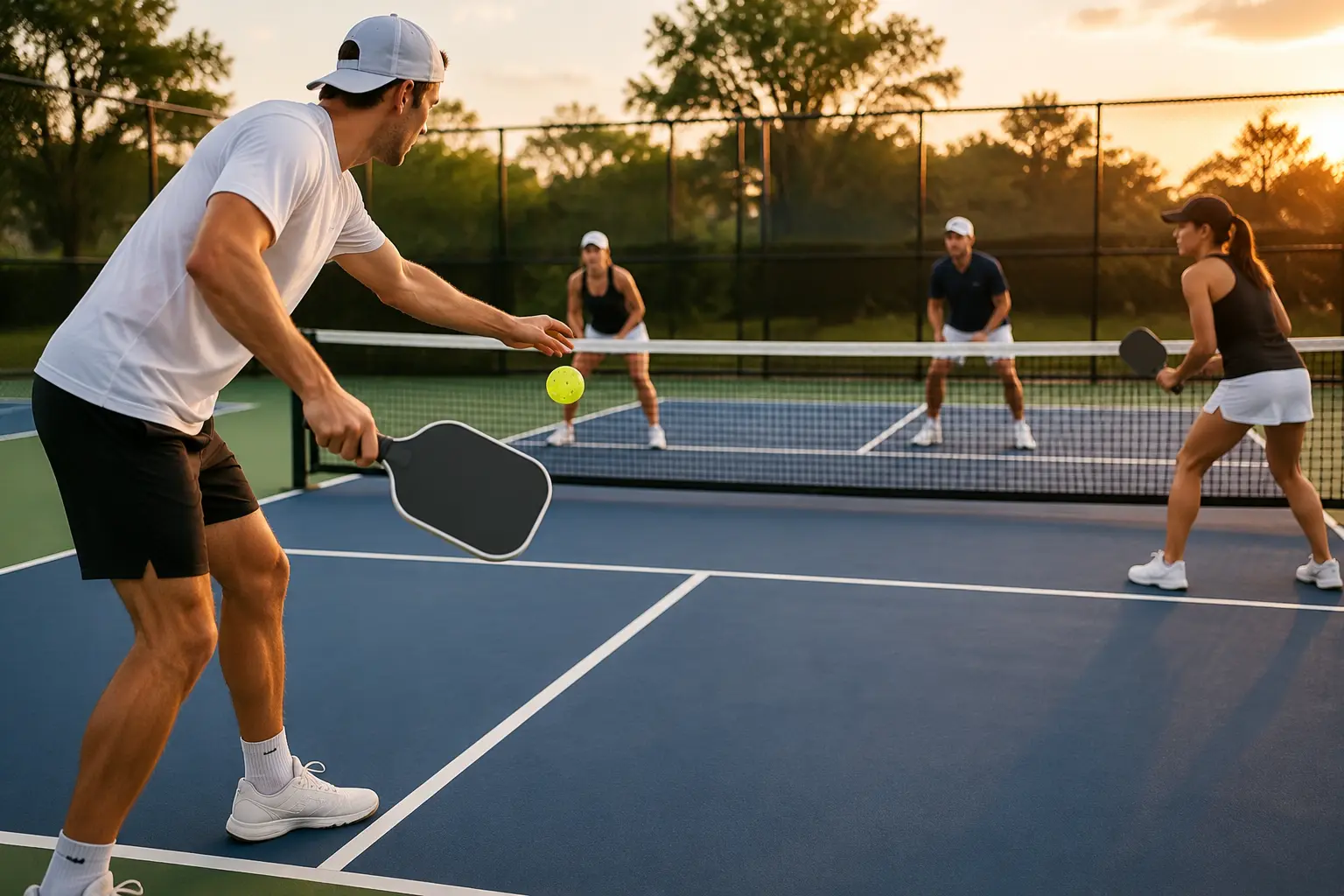
Guide to Strategy & Scoring
The serve is the only shot in pickleball that starts every single point, which makes it far more important than most beginners realize. A legal serve keeps the rally alive in your favor, while a faulty one hands the point straight to your opponent.
Pickleball serving rules cover more than just the motion of your swing. They decide where you can stand, how the score changes hands, and even how you should plan your shot selection for the rest of the point. This guide walks through the serving rules, common faults, and the serving order, then shows how each rule shapes real match strategy.
Pickleball Serving Rules: The Basics You Need to Know
Every serve in pickleball must follow a few core requirements. Under the current rulebook, a legal volley serve must:
- Contact the ball below the waist (roughly your navel line).
- Keep the paddle head clearly below the wrist at the moment of contact.
- Swing in a continuous, clearly upward arc, with no pause or hitch.
- Be hit with at least one foot behind the baseline and none touching the court.
There is also a legal alternative called the drop serve, where you drop the ball and let it bounce before striking it. The drop serve removes the strict waist and paddle-angle requirements, which is why many newer players prefer it.
The served ball must clear the net and the opponent’s non-volley zone (the kitchen), landing in the correct diagonal service court. If it clips the net but still lands in the right box, the serve is live and play continues as normal.
Pickleball Serving Order: Who Serves and From Where
In doubles, the serving order works like this:
- The game starts with one team serving from the right-side court, since the starting score is always 0-0-2 (the “2” shows the second server is serving first).
- Players on the serving team alternate sides after each point they win, serving from the right when their score is even and the left when it is odd.
- When the serving team loses a rally, the serve passes to their partner, unless it was the very first server of the game, in which case the serve goes directly to the opposing team.
- Once both players on a team have served and lost the rally, the serve moves to the other team.
In singles, there is only one player per side, so the same person serves the entire time it is their turn, switching sides between even and odd scores just like in doubles.
Common Pickleball Serving Faults
A fault results in an immediate loss of serve, so understanding these rules helps you avoid giving away free points.
| Fault Type | What Happens |
| Foot fault | Server steps on or over the baseline before contact |
| Illegal contact | Ball is struck above the waist or with the paddle head above the wrist |
| Out of bounds | Served ball lands outside the correct service court |
| Hits the net and fails to clear the kitchen | Serve does not cross the non-volley zone |
| Hits a permanent object | Ball touches a fence, post, or other fixture before landing |
| Hits the receiver | Served ball contacts the receiver or their gear before bouncing |
| Not grounded | Both of the server’s feet leave the ground at contact |
Since 2026, referees have more authority to call borderline serves as faults rather than giving the benefit of the doubt, so keeping your motion clean and clearly within the rules matters more than ever in competitive play.
Pickleball Serving Techniques Worth Practicing
A legal serve is only the starting point. The technique behind it decides whether your serve sets up an easy return for your opponent or puts you on the front foot.
- Deep serves push the receiver back toward their baseline, giving your team more time to move into position before the return arrives.
- Spin serves use paddle angle at contact to curve the ball’s bounce, making it harder for the receiver to time a clean return.
- Soft, short serves land near the kitchen line and can catch an opponent who is anticipating a deep, powerful serve.
- Drop serves are a reliable option under pressure since they remove the strict paddle-angle and waist-height requirements, reducing your risk of a fault.
How Pickleball Serving Rules Shape Strategy
Because the serving team cannot score unless they win the rally they started, serving rules directly affect how aggressively teams play their opening shots.
- The two-bounce rule requires the ball to bounce once on each side before either team can volley. This means the server usually cannot rush the net immediately, so serves are often used to set up the third shot rather than to win the point outright.
- Serve placement decides positioning. A deep serve to the backhand corner limits an opponent’s return options, often forcing a defensive shot your team can attack on the next ball.
- Faults cost more than a point. Since a serving fault hands the serve over entirely, teams that serve conservatively in tight games tend to protect their lead better than those chasing aggressive, high-risk serves.
- Serving order affects momentum. Because only one partner serves first in doubles at the start of a game, teams often put their more consistent server up first to avoid an early, costly fault.
Pickleball Singles Serving Rules
Singles follows the same core serve mechanics as doubles, but with a simpler side-switching pattern since there is no serving partner to rotate through.
- The server always starts from the right court when their score is even and the left court when it is odd.
- There is no second server; if the server loses the rally, the serve passes directly to the opponent.
- Because there is more open court to cover alone, many singles players favor deep, well-placed serves over risky spin serves that could result in a fault.
Pickleball Serving Strategy for Beginners
If you are new to the game, focus on consistency before power or spin. A serve that reliably clears the net and lands deep in the correct box, even without much pace, wins more points over a full match than a powerful serve that faults one time in four. Once your basic serve is dependable, start adding depth variation and the occasional short serve to keep opponents guessing.
Why Getting the Serve Right Matters on Court
Serving rules might look like a technical checklist, but they shape almost every point in pickleball. Getting comfortable with the serve, both the rules and the strategy behind it, is one of the fastest ways to improve your game. If you want hands-on practice, Khelomore’s pickleball clinics and starter camps are a good way to work on your serve with proper guidance before your next match.
Final Thoughts
A consistent, legal serve is far more valuable than one that is powerful but unreliable. A serve that regularly lands deep in the correct service box will win you more points over time than an aggressive serve that frequently results in faults. Once you have built confidence with the basics, start experimenting with deeper placement, angles, and the occasional short serve to keep your opponents guessing.
Serving is more than just the first shot of a rally. It sets the tone for every point and can influence the outcome of the entire match. By understanding pickleball serving rules and practising with purpose, you will avoid unnecessary faults and develop a smarter serving strategy. If you want to improve your technique with expert guidance, Khelomore’s pickleball clinics and community events provide an excellent opportunity to sharpen your skills before your next game.
Frequently Asked Questions
1. What are the basic pickleball serving rules?Â
The ball must be served underhand, contacting below the waist with the paddle head below the wrist, or hit as a legal drop serve after a bounce. The server needs at least one foot behind the baseline and must land the ball in the correct diagonal service court.
2. What counts as a serving fault in pickleball?Â
Common faults include stepping on the baseline before contact, hitting the ball above the waist, serving out of bounds, hitting the net without clearing the kitchen, or striking the receiver before the ball bounces. Any of these results in an immediate loss of serve.
3. How does the pickleball serving order work in doubles?Â
The starting team serves once before the serve passes to the opposing team. After that, both players on a serving team get a turn to serve before the serve changes sides, alternating between the right and left court based on the score.
4. What is a drop serve in pickleball?Â
A drop serve lets you drop the ball and let it bounce once before hitting it, instead of striking it out of the air. It removes the strict waist-height and paddle-angle rules that apply to a traditional volley serve, making it a safer choice under pressure.
5. Why is serve placement important in pickleball strategy?Â
Where you serve determines how your opponent can return the ball. A deep serve limits their options and often produces a weaker return, while a short or angled serve can catch an opponent out of position, setting up an easier next shot for your team.
PakarPBN
A Private Blog Network (PBN) is a collection of websites that are controlled by a single individual or organization and used primarily to build backlinks to a “money site” in order to influence its ranking in search engines such as Google. The core idea behind a PBN is based on the importance of backlinks in Google’s ranking algorithm. Since Google views backlinks as signals of authority and trust, some website owners attempt to artificially create these signals through a controlled network of sites.
In a typical PBN setup, the owner acquires expired or aged domains that already have existing authority, backlinks, and history. These domains are rebuilt with new content and hosted separately, often using different IP addresses, hosting providers, themes, and ownership details to make them appear unrelated. Within the content published on these sites, links are strategically placed that point to the main website the owner wants to rank higher. By doing this, the owner attempts to pass link equity (also known as “link juice”) from the PBN sites to the target website.
The purpose of a PBN is to give the impression that the target website is naturally earning links from multiple independent sources. If done effectively, this can temporarily improve keyword rankings, increase organic visibility, and drive more traffic from search results.

Pickleball Serving Rules: Strategy, Scoring & Faults
The serve is the only shot in pickleball that starts every single point, which makes it far more important than most beginners realize. A legal serve keeps the rally alive in your favor, while a faulty one hands the point straight to your opponent.
Pickleball serving rules cover more than just the motion of your swing. They decide where you can stand, how the score changes hands, and even how you should plan your shot selection for the rest of the point. This guide walks through the serving rules, common faults, and the serving order, then shows how each rule shapes real match strategy.
Pickleball Serving Rules: The Basics You Need to Know
Every serve in pickleball must follow a few core requirements. Under the current rulebook, a legal volley serve must:
- Contact the ball below the waist (roughly your navel line).
- Keep the paddle head clearly below the wrist at the moment of contact.
- Swing in a continuous, clearly upward arc, with no pause or hitch.
- Be hit with at least one foot behind the baseline and none touching the court.
There is also a legal alternative called the drop serve, where you drop the ball and let it bounce before striking it. The drop serve removes the strict waist and paddle-angle requirements, which is why many newer players prefer it.
The served ball must clear the net and the opponent’s non-volley zone (the kitchen), landing in the correct diagonal service court. If it clips the net but still lands in the right box, the serve is live and play continues as normal.
Pickleball Serving Order: Who Serves and From Where
In doubles, the serving order works like this:
- The game starts with one team serving from the right-side court, since the starting score is always 0-0-2 (the “2” shows the second server is serving first).
- Players on the serving team alternate sides after each point they win, serving from the right when their score is even and the left when it is odd.
- When the serving team loses a rally, the serve passes to their partner, unless it was the very first server of the game, in which case the serve goes directly to the opposing team.
- Once both players on a team have served and lost the rally, the serve moves to the other team.
In singles, there is only one player per side, so the same person serves the entire time it is their turn, switching sides between even and odd scores just like in doubles.
Common Pickleball Serving Faults
A fault results in an immediate loss of serve, so understanding these rules helps you avoid giving away free points.
| Fault Type | What Happens |
| Foot fault | Server steps on or over the baseline before contact |
| Illegal contact | Ball is struck above the waist or with the paddle head above the wrist |
| Out of bounds | Served ball lands outside the correct service court |
| Hits the net and fails to clear the kitchen | Serve does not cross the non-volley zone |
| Hits a permanent object | Ball touches a fence, post, or other fixture before landing |
| Hits the receiver | Served ball contacts the receiver or their gear before bouncing |
| Not grounded | Both of the server’s feet leave the ground at contact |
Since 2026, referees have more authority to call borderline serves as faults rather than giving the benefit of the doubt, so keeping your motion clean and clearly within the rules matters more than ever in competitive play.
Pickleball Serving Techniques Worth Practicing
A legal serve is only the starting point. The technique behind it decides whether your serve sets up an easy return for your opponent or puts you on the front foot.
- Deep serves push the receiver back toward their baseline, giving your team more time to move into position before the return arrives.
- Spin serves use paddle angle at contact to curve the ball’s bounce, making it harder for the receiver to time a clean return.
- Soft, short serves land near the kitchen line and can catch an opponent who is anticipating a deep, powerful serve.
- Drop serves are a reliable option under pressure since they remove the strict paddle-angle and waist-height requirements, reducing your risk of a fault.
How Pickleball Serving Rules Shape Strategy
Because the serving team cannot score unless they win the rally they started, serving rules directly affect how aggressively teams play their opening shots.
- The two-bounce rule requires the ball to bounce once on each side before either team can volley. This means the server usually cannot rush the net immediately, so serves are often used to set up the third shot rather than to win the point outright.
- Serve placement decides positioning. A deep serve to the backhand corner limits an opponent’s return options, often forcing a defensive shot your team can attack on the next ball.
- Faults cost more than a point. Since a serving fault hands the serve over entirely, teams that serve conservatively in tight games tend to protect their lead better than those chasing aggressive, high-risk serves.
- Serving order affects momentum. Because only one partner serves first in doubles at the start of a game, teams often put their more consistent server up first to avoid an early, costly fault.
Pickleball Singles Serving Rules
Singles follows the same core serve mechanics as doubles, but with a simpler side-switching pattern since there is no serving partner to rotate through.
- The server always starts from the right court when their score is even and the left court when it is odd.
- There is no second server; if the server loses the rally, the serve passes directly to the opponent.
- Because there is more open court to cover alone, many singles players favor deep, well-placed serves over risky spin serves that could result in a fault.
Pickleball Serving Strategy for Beginners
If you are new to the game, focus on consistency before power or spin. A serve that reliably clears the net and lands deep in the correct box, even without much pace, wins more points over a full match than a powerful serve that faults one time in four. Once your basic serve is dependable, start adding depth variation and the occasional short serve to keep opponents guessing.
Why Getting the Serve Right Matters on Court
Serving rules might look like a technical checklist, but they shape almost every point in pickleball. Getting comfortable with the serve, both the rules and the strategy behind it, is one of the fastest ways to improve your game. If you want hands-on practice Khelomore’s pickleball clinics and starter camps are a good way to work on your serve with proper guidance before your next match.
Final Thoughts
A consistent, legal serve is far more valuable than one that is powerful but unreliable. A serve that regularly lands deep in the correct service box will win you more points over time than an aggressive serve that frequently results in faults. Once you have built confidence with the basics, start experimenting with deeper placement, angles, and the occasional short serve to keep your opponents guessing.
Serving is more than just the first shot of a rally. It sets the tone for every point and can influence the outcome of the entire match. By understanding pickleball serving rules and practising with purpose, you will avoid unnecessary faults and develop a smarter serving strategy. If you want to improve your technique with expert guidance, Khelomore’s pickleball clinics and community events provide an excellent opportunity to sharpen your skills before your next game.
Frequently Asked Questions
1. What are the basic pickleball serving rules?Â
The ball must be served underhand, contacting below the waist with the paddle head below the wrist, or hit as a legal drop serve after a bounce. The server needs at least one foot behind the baseline and must land the ball in the correct diagonal service court.
2. What counts as a serving fault in pickleball?Â
Common faults include stepping on the baseline before contact, hitting the ball above the waist, serving out of bounds, hitting the net without clearing the kitchen, or striking the receiver before the ball bounces. Any of these results in an immediate loss of serve.
3. How does the pickleball serving order work in doubles?Â
The starting team serves once before the serve passes to the opposing team. After that, both players on a serving team get a turn to serve before the serve changes sides, alternating between the right and left court based on the score.
4. What is a drop serve in pickleball?Â
A drop serve lets you drop the ball and let it bounce once before hitting it, instead of striking it out of the air. It removes the strict waist-height and paddle-angle rules that apply to a traditional volley serve, making it a safer choice under pressure.
5. Why is serve placement important in pickleball strategy?Â
Where you serve determines how your opponent can return the ball. A deep serve limits their options and often produces a weaker return, while a short or angled serve can catch an opponent out of position, setting up an easier next shot for your team.
PakarPBN
A Private Blog Network (PBN) is a collection of websites that are controlled by a single individual or organization and used primarily to build backlinks to a “money site” in order to influence its ranking in search engines such as Google. The core idea behind a PBN is based on the importance of backlinks in Google’s ranking algorithm. Since Google views backlinks as signals of authority and trust, some website owners attempt to artificially create these signals through a controlled network of sites.
In a typical PBN setup, the owner acquires expired or aged domains that already have existing authority, backlinks, and history. These domains are rebuilt with new content and hosted separately, often using different IP addresses, hosting providers, themes, and ownership details to make them appear unrelated. Within the content published on these sites, links are strategically placed that point to the main website the owner wants to rank higher. By doing this, the owner attempts to pass link equity (also known as “link juice”) from the PBN sites to the target website.
The purpose of a PBN is to give the impression that the target website is naturally earning links from multiple independent sources. If done effectively, this can temporarily improve keyword rankings, increase organic visibility, and drive more traffic from search results.
Strategy, Faults & Scoring Guide
The serve is the only shot in pickleball that starts every single point, which makes it far more important than most beginners realize. A legal serve keeps the rally alive in your favor, while a faulty one hands the point straight to your opponent.
Pickleball serving rules cover more than just the motion of your swing. They decide where you can stand, how the score changes hands, and even how you should plan your shot selection for the rest of the point. This guide walks through the serving rules, common faults, and the serving order, then shows how each rule shapes real match strategy.
Pickleball Serving Rules: The Basics You Need to Know
Every serve in pickleball must follow a few core requirements. Under the current rulebook, a legal volley serve must:
- Contact the ball below the waist (roughly your navel line).
- Keep the paddle head clearly below the wrist at the moment of contact.
- Swing in a continuous, clearly upward arc, with no pause or hitch.
- Be hit with at least one foot behind the baseline and none touching the court.
There is also a legal alternative called the drop serve, where you drop the ball and let it bounce before striking it. The drop serve removes the strict waist and paddle-angle requirements, which is why many newer players prefer it.
The served ball must clear the net and the opponent’s non-volley zone (the kitchen), landing in the correct diagonal service court. If it clips the net but still lands in the right box, the serve is live and play continues as normal.
Pickleball Serving Order: Who Serves and From Where
In doubles, the serving order works like this:
- The game starts with one team serving from the right-side court, since the starting score is always 0-0-2 (the “2” shows the second server is serving first).
- Players on the serving team alternate sides after each point they win, serving from the right when their score is even and the left when it is odd.
- When the serving team loses a rally, the serve passes to their partner, unless it was the very first server of the game, in which case the serve goes directly to the opposing team.
- Once both players on a team have served and lost the rally, the serve moves to the other team.
In singles, there is only one player per side, so the same person serves the entire time it is their turn, switching sides between even and odd scores just like in doubles.
Common Pickleball Serving Faults
A fault results in an immediate loss of serve, so understanding these rules helps you avoid giving away free points.
| Fault Type | What Happens |
| Foot fault | Server steps on or over the baseline before contact |
| Illegal contact | Ball is struck above the waist or with the paddle head above the wrist |
| Out of bounds | Served ball lands outside the correct service court |
| Hits the net and fails to clear the kitchen | Serve does not cross the non-volley zone |
| Hits a permanent object | Ball touches a fence, post, or other fixture before landing |
| Hits the receiver | Served ball contacts the receiver or their gear before bouncing |
| Not grounded | Both of the server’s feet leave the ground at contact |
Since 2026, referees have more authority to call borderline serves as faults rather than giving the benefit of the doubt, so keeping your motion clean and clearly within the rules matters more than ever in competitive play.
Pickleball Serving Techniques Worth Practicing
A legal serve is only the starting point. The technique behind it decides whether your serve sets up an easy return for your opponent or puts you on the front foot.
- Deep serves push the receiver back toward their baseline, giving your team more time to move into position before the return arrives.
- Spin serves use paddle angle at contact to curve the ball’s bounce, making it harder for the receiver to time a clean return.
- Soft, short serves land near the kitchen line and can catch an opponent who is anticipating a deep, powerful serve.
- Drop serves are a reliable option under pressure since they remove the strict paddle-angle and waist-height requirements, reducing your risk of a fault.
How Pickleball Serving Rules Shape Strategy
Because the serving team cannot score unless they win the rally they started, serving rules directly affect how aggressively teams play their opening shots.
- The two-bounce rule requires the ball to bounce once on each side before either team can volley. This means the server usually cannot rush the net immediately, so serves are often used to set up the third shot rather than to win the point outright.
- Serve placement decides positioning. A deep serve to the backhand corner limits an opponent’s return options, often forcing a defensive shot your team can attack on the next ball.
- Faults cost more than a point. Since a serving fault hands the serve over entirely, teams that serve conservatively in tight games tend to protect their lead better than those chasing aggressive, high-risk serves.
- Serving order affects momentum. Because only one partner serves first in doubles at the start of a game, teams often put their more consistent server up first to avoid an early, costly fault.
Pickleball Singles Serving Rules
Singles follows the same core serve mechanics as doubles, but with a simpler side-switching pattern since there is no serving partner to rotate through.
- The server always starts from the right court when their score is even and the left court when it is odd.
- There is no second server; if the server loses the rally, the serve passes directly to the opponent.
- Because there is more open court to cover alone, many singles players favor deep, well-placed serves over risky spin serves that could result in a fault.
Pickleball Serving Strategy for Beginners
If you are new to the game, focus on consistency before power or spin. A serve that reliably clears the net and lands deep in the correct box, even without much pace, wins more points over a full match than a powerful serve that faults one time in four. Once your basic serve is dependable, start adding depth variation and the occasional short serve to keep opponents guessing.
Why Getting the Serve Right Matters on Court
Serving rules might look like a technical checklist, but they shape almost every point in pickleball. Getting comfortable with the serve, both the rules and the strategy behind it, is one of the fastest ways to improve your game. If you want hands-on practice, Khelomore’s pickleball clinics and starter camps are a good way to work on your serve with proper guidance before your next match.
Final Thoughts
A consistent, legal serve is far more valuable than one that is powerful but unreliable. A serve that regularly lands deep in the correct service box will win you more points over time than an aggressive serve that frequently results in faults. Once you have built confidence with the basics, start experimenting with deeper placement, angles, and the occasional short serve to keep your opponents guessing.
Serving is more than just the first shot of a rally. It sets the tone for every point and can influence the outcome of the entire match. By understanding pickleball serving rules and practising with purpose, you will avoid unnecessary faults and develop a smarter serving strategy. If you want to improve your technique with expert guidance, Khelomore’s pickleball clinics and community events provide an excellent opportunity to sharpen your skills before your next game.
Frequently Asked Questions
1. What are the basic pickleball serving rules?Â
The ball must be served underhand, contacting below the waist with the paddle head below the wrist, or hit as a legal drop serve after a bounce. The server needs at least one foot behind the baseline and must land the ball in the correct diagonal service court.
2. What counts as a serving fault in pickleball?Â
Common faults include stepping on the baseline before contact, hitting the ball above the waist, serving out of bounds, hitting the net without clearing the kitchen, or striking the receiver before the ball bounces. Any of these results in an immediate loss of serve.
3. How does the pickleball serving order work in doubles?Â
The starting team serves once before the serve passes to the opposing team. After that, both players on a serving team get a turn to serve before the serve changes sides, alternating between the right and left court based on the score.
4. What is a drop serve in pickleball?Â
A drop serve lets you drop the ball and let it bounce once before hitting it, instead of striking it out of the air. It removes the strict waist-height and paddle-angle rules that apply to a traditional volley serve, making it a safer choice under pressure.
5. Why is serve placement important in pickleball strategy?Â
Where you serve determines how your opponent can return the ball. A deep serve limits their options and often produces a weaker return, while a short or angled serve can catch an opponent out of position, setting up an easier next shot for your team.
PakarPBN
A Private Blog Network (PBN) is a collection of websites that are controlled by a single individual or organization and used primarily to build backlinks to a “money site” in order to influence its ranking in search engines such as Google. The core idea behind a PBN is based on the importance of backlinks in Google’s ranking algorithm. Since Google views backlinks as signals of authority and trust, some website owners attempt to artificially create these signals through a controlled network of sites.
In a typical PBN setup, the owner acquires expired or aged domains that already have existing authority, backlinks, and history. These domains are rebuilt with new content and hosted separately, often using different IP addresses, hosting providers, themes, and ownership details to make them appear unrelated. Within the content published on these sites, links are strategically placed that point to the main website the owner wants to rank higher. By doing this, the owner attempts to pass link equity (also known as “link juice”) from the PBN sites to the target website.
The purpose of a PBN is to give the impression that the target website is naturally earning links from multiple independent sources. If done effectively, this can temporarily improve keyword rankings, increase organic visibility, and drive more traffic from search results.
Everything Changes and Everything Stays the Same – Even in Cloud Strategy
Everything changes and everything stays the same.
I’ve found myself repeating that phrase more than once over the last couple of weeks, partly because it’s true, and partly because it explains a pattern I’m seeing again and again across organisations.
Most of the time, we talk about technology as if it moves in a straight line: from old to new, from on-premises to cloud, from siloed to shared, from manual to automated. But in the real world, it’s rarely a one-way journey. Strategy is cyclical. Priorities shift. Economic and political pressures change the conversation. And suddenly, decisions that felt “settled” are back on the table.
A conversation that took me back 22 years
I recently had a call with a UK local authority. I always have a soft spot for local government because that’s where I started my career in the early 2000s. In my first few years, I worked across both Caerphilly and Torfaen, and those years shaped how I think about public service, accountability, and the reality of delivering technology with limited budgets and high expectations.
When I left local authority employment at the tail end of 2004, there was a major push for shared services. The idea was simple: neighbouring authorities would combine back-office functions, IT, HR, finance and so on to reduce duplication, save money, and provide more consistent services.
I remember discussions about setting up shared service organisations across multiple councils. I kept in touch with people after I left, and I know those changes did happen.
Fast forward 22 years, which makes me feel slightly ancient writing it down, and I’m speaking to a different local authority about SQL Server training. The reason? They’d been operating within shared services, and the DBA function was largely a contractor team. A decision had now been made to dismantle that shared model and bring services back in-house within each authority.
Full circle.
Everything changes and everything stays the same.
On-premises reporting is back in the conversation
That local authority conversation wasn’t the only “cycle” moment. Since the tail end of last year, I’ve had several separate conversations with clients about Power BI training. That’s not unusual, we deliver a lot of Power BI training, but what is unusual is the direction of travel.
Historically, most organisations wanted training aligned to the cloud-based Power BI Service, the PL-300 style path: semantic models, publishing to the Service, governance, sharing, workspaces, and deployment considerations.
And until very recently, if you’d asked me how many clients we have ever had that have been actively using Power BI Report Server on-premises, I’d have said “one” without hesitation. They were using it back in 2018 when they still had a strict “no-cloud” policy. It was a transitional step until internal policy changed and cloud adoption became possible.
But in the last few months, I’ve seen a noticeable increase in interest in on-premises Power BI Report Server, not as a short-term workaround, but as a deliberate choice.
Is this about SQL Server 2025… or something bigger?
Some of this renewed interest may be linked to the reporting changes announced with SQL Server 2025, particularly the consolidation of on-premises reporting into the Power BI Report Server model. I recently wrote about those changes because, candidly, I’d almost forgotten the announcement myself, and I know plenty of organisations still rely heavily on SSRS today.
However, based on the conversations I’m having, I’m not convinced product announcements alone explain the shift. In several chats, the motivation feels broader, and sometimes unspoken.
Some organisations are reassessing cloud dependency. Others are responding to data sovereignty requirements, governance concerns, budget controls, or procurement constraints. In some cases, it’s about cost predictability. In others, it’s about control, simplicity, and the comfort of having reporting entirely within the boundary of the corporate network.
And in a few conversations with certain clients, I’ve simply sensed a cultural recalibration: a pause and a question being asked “Do we need or want all of this in the cloud?”
To be clear: I’m not suggesting for an instant that the cloud story is reversing wholesale. It isn’t. Azure adoption remains strong. Microsoft Fabric momentum is real. AI workloads are undeniably cloud-led. But at the same time, I’m seeing more organisations pursuing optionality: hybrid models, on-premises reporting capability, and architectures that feel internally governed.
The real constant is decision-making
Which brings me back to the phrase. Everything changes and everything stays the same.
Twenty years ago, local authorities were centralising into shared services. Today, some are decentralising again. Over the last decade, many organisations moved reporting to the cloud. Now, more are reconsidering where the balance should sit.
Products evolve. Licensing models shift. Platforms merge. But the underlying questions remain remarkably consistent:
- Where should control sit?
- How do we manage cost and predictability?
- What risk profile are we comfortable with?
- What skills do we need in-house?
- What reporting experience do users actually need day-to-day?
As a consultant and training provider, I find this fascinating, and it’s a useful reminder that technology decisions are rarely purely technical. They’re organisational, political, financial, and cultural.
Is your organisation moving back from the cloud?
So I’m curious:
Are you seeing similar shifts? Are you doubling down on cloud-first strategies, or introducing more on-premises or hybrid components again? Is Power BI Report Server on-premises back on your roadmap?
If you’re exploring on-premises reporting, need to upskill your team, or want an honest view of the trade-offs, we can help.
If you want tailored training (Power BI Service or Power BI Report Server) or practical guidance on modernising your reporting stack, get in touch via gethynellis.com.
Â
FAQ
What is Power BI Report Server?
Power BI Report Server is Microsoft’s on-premises reporting platform for hosting Power BI reports (and paginated reports) within your own infrastructure, rather than in the Power BI Service.
Why are organisations reconsidering on-premises reporting?
Common drivers include governance and data sovereignty requirements, cost predictability, procurement constraints, reduced cloud dependency, or a preference for keeping reporting fully within the corporate network boundary.
Is on-premises reporting replacing the cloud?
In most cases, no. Many organisations are aiming for hybrid capability — using cloud where it fits, while keeping specific reporting workloads on-premises for control, compliance, or operational reasons.
News
Berita Teknologi
Berita Olahraga
Sports news
sports
Motivation
football prediction
technology
Berita Technologi
Berita Terkini
Tempat Wisata
News Flash
Football
Gaming
Game News
Gamers
Jasa Artikel
Jasa Backlink
Agen234
Agen234
Agen234
Resep
Cek Ongkir Cargo
Download Film