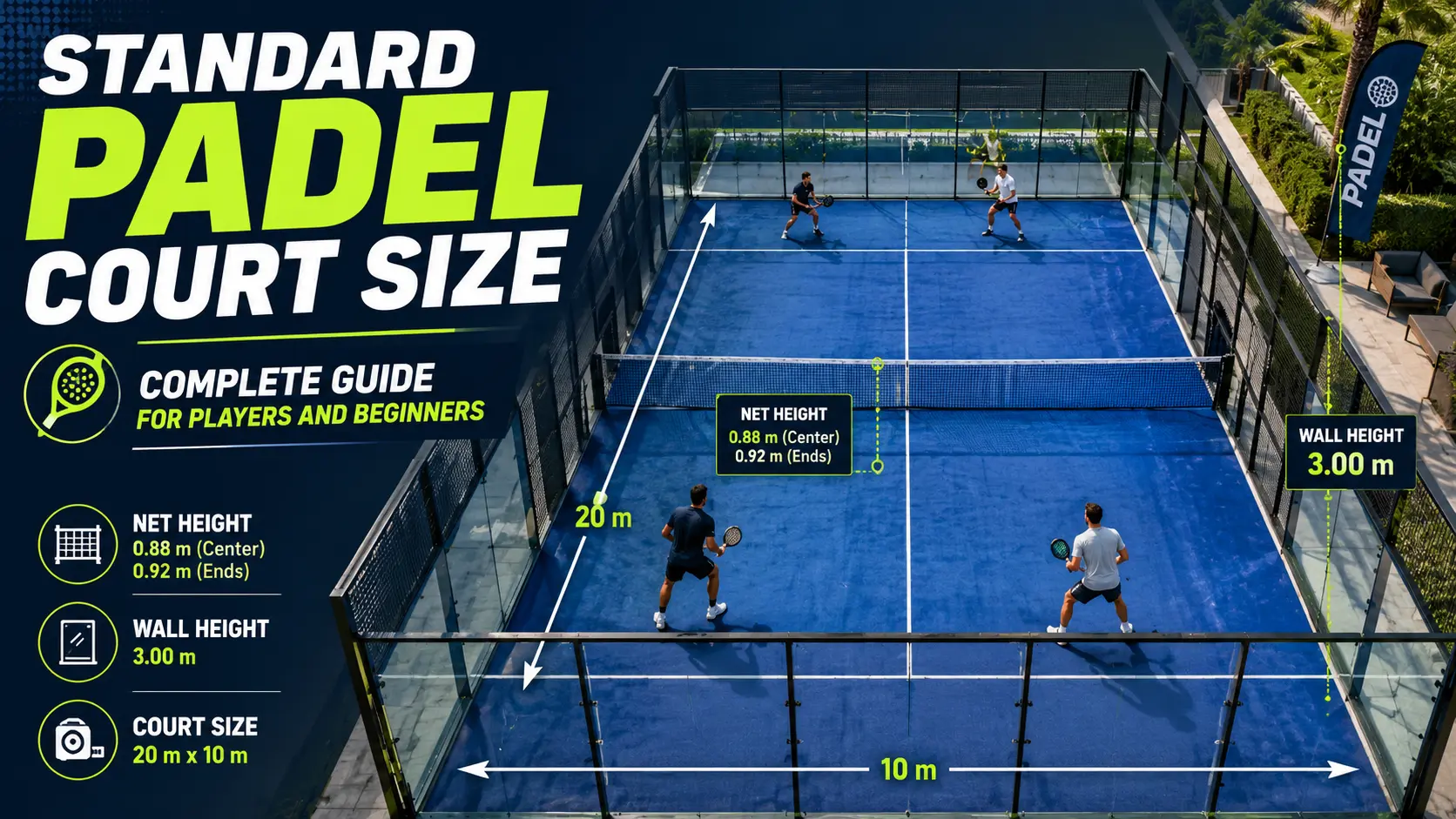
Standard Dimensions & Player Guide
When selecting a padel court, most players book courts without knowing the actual dimensions. That’s a missed advantage. Court size directly affects how you move, where you position yourself and which shots work.Â
A padel court isn’t a tennis court with walls. It is a completely different space. Knowing the exact measurements tells you what to expect before you step on court. Padel court size also impacts how quickly beginners learn and how difficult or easy it is while playing. At the core, it reveals the mechanics of the game and various strategies that players can evolve.
It also explains why professionals won’t play on non-standard courts. Hence, the following discussion matters.Â
What Is the Standard Padel Court Size?
A standard padel court measures 20 metres long and 10 metres wide. That’s your baseline. Every official padel court in tournaments and certified facilities follows this exact footprint. Length includes both the service boxes and the court lines. Width spans from baseline wall to baseline wall.
In feet, that is 65.6 feet by 32.8 feet. Most Indian venues list dimensions in both metric and imperial units. Knowing both helps when you’re comparing courts or analysing court layouts across different facilities.
| Feature | Metric | Imperial |
| Court length | 20 m | 66 ft |
| Court width | 10 m | 33 ft |
| Playing surface area | 200 sq m | 2,178 sq ft |
| Recommended total area (with perimeter space) | 231 sq m | 2,486 sq ft |
| Minimum perimeter clearance | 0.5 m | 1 ft 8 in |
| Minimum overhead clearance | 6 m | 20 ft |
| Back wall height | 4 m | 13 ft |
| Side wall (first panel) | 4 m | 13 ft |
| Side wall (second panel) | 3 m | 10 ft |
| Side glass wall height | 3 m | 10 ft |
| Line marking width | 5 cm | 2 in |
| Service line distance from net | 6.95 m | 23 ft |
| Distance: service line to back wall | 3 m | 10 ft |
| Net height (centre) | 0.88 m | 3 ft |
| Net width (court width) | 10 m | 33 ft |
The court is at ground level in most facilities. You’ll notice the court doesn’t float or sit elevated like some tennis courts.
Padel Tennis Court Dimensions
The 20×10 m tells only half the story. The court layout includes multiple zones that affect gameplay. The service box, baseline area, and net position all follow strict padel tennis court dimensions set by the International Padel Federation.
Service Box and Baseline Areas
Each service box measures 6.95 metres long from the net. That’s roughly 23 feet. The baseline is 1.05 metres behind the service line.
Net Height and Position
The net stands 0.88 metres high at the centre and 0.92 m at posts. That’s about 3 feet. The net stretches the entire 10-meter width. The slightly lower net compared to tennis encourages more attacking shots.
| Dimension | Metres | Feet |
| Court Length | 20 m | 65.6 ft |
| Court Width | 10 m | 32.8 ft |
| Service Box Length | 6.95 m | 22.8 ft |
| Baseline Depth | 1.05 m | 3.4 ft |
| Net Height (Centre) | 0.88 m | 3.0 ft |
| Court Height (Ceiling) | 4 m | 13.1 ft |
| Wall Height | 3-4 m | 10-13 ft |
Wall Configuration and Enclosure
Walls define padel. Unlike tennis, the padel court is enclosed on all sides. Walls are 3-4 metres high— the backcourt walls reach this height. Side walls also follow this specification. The back wall and side walls remain in play during rallies.
The walls are generally constructed from tempered glass, metal mesh, or plexiglass. Different materials affect ball behaviour slightly. Courts built to international standards maintain these exact padel court size measurements regardless of the construction material chosen.
Padel Court Size Height
The 4-meter ceiling height is calculated to prevent endless lobs and maintain rally intensity. A lob that travels above 4 metres hits the ceiling. The ball drops back into play at the point of contact. This rule keeps matches fast and forces aggressive positioning near the net.
Beginners often underestimate the ceiling impact. In your first matches, you’ll hit ceiling balls. The standard padel court size height at 4 metres creates this dynamic. The low ceiling compared to other racquet sports accelerates play and emphasises net control over baseline rallies.
Indian Padel Federation Court Standards
The Indian Padel Federation follows international standards set by the World Padel Tour and the International Padel Federation. Every certified Indian padel federation court must adhere to the 20×10 meter specification.
Some uncertified or smaller facilities might deviate slightly. A private club court might run 19.5 metres long or cut width to 9.5 metres. These variations change gameplay significantly.Â
When booking through aggregators like Khelomore, look for certified venues that maintain regulation padel court size measurements.
Why Consistency Matters for Your Game
Developing consistent positioning and movement requires standardised court dimensions. Training on courts with varying padel court size measurements forces you to recalibrate each session. Certified venues using proper padel tennis court dimensions let you focus purely on skill development.
Padel Court Size in Feet vs Metres
India operates in both metric and imperial units depending on context. Most sporting facilities now list padel court size in metres as their primary measurement. But many players still think in feet, e.g., those familiar with tennis courts or playing in clubs with mixed sports.
The conversions are straightforward. Twenty metres equals 65.6 feet. Ten metres equals 32.8 feet. Most professional courts simply post both measurements.Â
When you’re booking a court through an app, the listing should display padel court size measurements in both units for absolute clarity.
Storage and transport of equipment assumes metric court dimensions in international standards. If you’re buying padel racquets or planning training programs, suppliers reference meter-based dimensions. Understanding both systems prevents confusion when researching technique videos or court diagrams online.
Final Word
Standard padel court size follows a global specification: 20 metres by 10 metres with a 4-meter ceiling. These dimensions define the game itself. Court layout, movement, and strategy all flow from these exact padel court size measurements. When you understand the dimensions, you understand the sport.
Book your next session at a certified facility that maintains proper padel tennis court dimensions. The difference between regulation and non-standard courts becomes obvious after your first match. Your improvement will accelerate when you’re playing on courts that meet international standards.
Ready to Play?
Stop researching and start booking certified padel courts with standardised dimensions. Khelomore connects you to 30+ sports facilities with regulation padel courts across major Indian cities.
Download the KheloMore App to
Available on Android and iOS. Court booking in a few taps. No calls. No group coordination. Just courts that meet international standards for padel court size.
FAQs
What’s the Minimum Height Needed for a Padel Court?
Four metres is the minimum height for a padel court. Some facilities push to 4.5 metres for additional clearance.
Can Court Size Change During a Match?
No. The padel tennis court dimensions are constant throughout a match. What changes is line calls and positioning. Players adapt their strategy to the exact court they’re playing on.
How many players fit on a padel court?
Padel is a doubles sport designed for four players at a time. Two players occupy each side of the net. The court dimensions and wall placement optimise play specifically for doubles competition only.
How much does it cost to build a padel court?
In India, building a padel court usually costs between ₹15 lakhs and ₹30 lakhs. Major expenses include foundation and civil work, plus the steel structure and tempered glass enclosure.
PakarPBN
A Private Blog Network (PBN) is a collection of websites that are controlled by a single individual or organization and used primarily to build backlinks to a “money site” in order to influence its ranking in search engines such as Google. The core idea behind a PBN is based on the importance of backlinks in Google’s ranking algorithm. Since Google views backlinks as signals of authority and trust, some website owners attempt to artificially create these signals through a controlled network of sites.
In a typical PBN setup, the owner acquires expired or aged domains that already have existing authority, backlinks, and history. These domains are rebuilt with new content and hosted separately, often using different IP addresses, hosting providers, themes, and ownership details to make them appear unrelated. Within the content published on these sites, links are strategically placed that point to the main website the owner wants to rank higher. By doing this, the owner attempts to pass link equity (also known as “link juice”) from the PBN sites to the target website.
The purpose of a PBN is to give the impression that the target website is naturally earning links from multiple independent sources. If done effectively, this can temporarily improve keyword rankings, increase organic visibility, and drive more traffic from search results.

What is Box Cricket League? Full Guide
Cricket in India has never needed an excuse. Give ten people a rubber ball, a lamppost, and twelve square feet of open ground, and a match breaks out. So when the Box Cricket League showed up on Indian television in 2014 with celebrities swinging bats in a walled indoor enclosure. The country did what it always does with cricket. It adopted it immediately.
But here’s the part that the show’s creators at Marinating Films probably didn’t script: the format leaked out of the TV studio and into real life. Today, box cricket is one of the fastest-growing recreational formats in urban India.Â
Office teams book indoor arenas on Saturday mornings. College squads play elimination rounds on weekday evenings. And it’s the Box Cricket League that put all of this in motion, both the show and the concept. What started as a team-based indoor game is now turning into a high-stakes 1v1 showdown, thanks to Khelomore Sixer, where there are no teammates, no second chances, just six balls to hit as many sixes as possible or walk away.
What is Box Cricket League?
The Box Cricket League (BCL) is an Indian sports reality television show that brings celebrities, TV actors, digital creators, and public figures together to play indoor box cricket in a fast-paced, competitive league format. Think of it as the offspring of the IPL and a reality TV show, compressed into a walled playing area roughly the size of a large living room.
The show premiered in 2014-15, inspired loosely by the Celebrity Cricket League, and quickly found its audience. Matches are played indoors. Teams represent cities.Â
Over three or four seasons, the competition grew from 8 teams to 10, then consolidated down to 6. It has aired on Sony Entertainment Television, Colours TV, and MTV India— three very different channels. It tells you something about how broadly the show tried to cast its net.
What distinguishes the box cricket league from regular cricket is the enclosure itself. Walls replace boundary ropes. A ball cannoning off a wall can still count as a four or six, depending on the rules in play. LBW doesn’t exist here. The ceiling height matters. The pitch is shorter. Everything is compressed, faster, and louder.
That’s the show. But the box cricket league concept is now something India plays, not just watches.
The Seasons, the Teams, and Delhi Dragons’ Reign
Four seasons in, the BCL has produced some clear storylines. The biggest one? Delhi Dragons absolutely dominated this league.
| Season | Year | No. of Teams | Winner | Broadcast |
| Season 1 | 2014–15 | 8 | Delhi Dragons | Sony Entertainment Television |
| Season 2 | 2016 | 10 | Delhi Dragons | Colors TV |
| Season 3 | 2018 | 10 | Lucknow Nawabs | Colors TV |
| Season 4 | 2019 | 6 | Delhi Dragons | MTV India |
Three titles out of four. The Dragons didn’t build a dynasty in the traditional sense (this is a celebrity cricket show, after all!). But the consistency says something about team cohesion and good casting decisions by whoever assembled that squad.
The teams themselves are city-based and celebrity-led, with some names that became genuinely recognisable to BCL fans: Mumbai Tigers, Chandigarh Cubs, Kolkata Babu Moshai, Jaipur Raj Joshile, Ahmedabad Express, Rowdy Bangalore, Chennai Swaggers, Goa Killers, Lucknow Nawabs.Â
Some appeared for one season and vanished. Others stuck around.Â
The format of the competition across all seasons follows a league stage → semi-finals → final progression.
BCL also expanded into regional editions: BCL Punjab, BCL Marathi, BCL Sandalwood (Kannada), and BCL Kollywood (Telugu). Regional language audiences got their own celebrity cricket content. It is a smart move, honestly.
What IPL Did to Cricket, and What BCL Did Next
You can’t tell the box cricket league story without acknowledging what the IPL did to cricket’s cultural footprint in India.Â
When the IPL launched in 2008, it didn’t just create a new tournament. It created a blueprint: shorter formats, city loyalty, entertainment value layered on top of the sport, celebrity ownership, and prime-time television. It proved that cricket could be packaged differently and still sell out stadiums.
BCL took that same logic one step further. If the IPL compressed Test cricket into T20, BCL compressed T20 into a 6-to-10-over slugfest inside four walls. It lowered the participation barrier.Â
You no longer needed a full ground, eleven players, a proper pitch, or professional equipment. Except the same cricket fitness on ground. Suddenly, cricket was accessible to anyone with a turf booking and six friends.
That’s the real legacy of BCL in India. The normalisation of box cricket as a format that actual people can play.
Box Cricket League Rules to Note
Team Size:6 to 8 players per side.
Match Length:3 to 10 overs per innings. BCL television matches run around 10 overs per side. Recreational games often go shorter.
Bowling Limit:Usually a maximum of 2 overs per bowler. Prevents one person from bowling the whole match.
Boundaries & Walls:Walls replace ropes. A ball hitting the wall can count as 4 runs. Clearing a designated mark = 6. Rules vary by venue.
Wickets & Dismissals:Bowled, caught (including catches off walls), and run-out are all valid. LBW is not.
Extras & Penalties:Wides and no-balls add runs to the batting side. Some formats apply a penalty (like -5 runs) per wicket, to keep scores interesting.
Height Restrictions:Deliveries above a certain height (usually shoulder or head level) are called wide. Essential in a low-ceiling indoor space.
Retirements:Batters sometimes retire after a set number of runs (e.g., 30 or 40) so everyone in the team gets time in the middle.
The Ground and Equipment
Ground size: Roughly 40–50 feet in length, 25–30 feet in width
Ceiling height: 10–12 feet for indoor venues
Pitch length: 18–22 yards, sometimes shorter depending on the venue
Walls: Padded or netted, surrounding the entire playing area
As for the equipment used in cricket of this format, it adapts to the indoor setting. A softer rubber or tennis ball replaces the hard leather ball in most recreational games, protecting both players and the walls.Â
Lightweight bats are preferred since the backswing space is limited. Stumps and bails are standard. Gloves and pads are optional at the recreational level.
The confined space is the whole point. You can’t slog it to deep midwicket. You can’t run four and a half steps to the boundary. Every shot has to be deliberate, and every bowler has to think about angles differently. That’s what makes box cricket legitimately skill-heavy despite the format looking chaotic from the outside.
Why the Box Cricket League Still Matters
The show itself has been on and off the air. Season 4 aired in 2019, and there’s been no confirmed return since. But the box cricket league as a cultural moment already did its job. It took a format that existed in pockets across India and gave it a name, a structure, and a prime-time stage.
Today, thousands of Indians play box cricket every week without having watched a single episode of BCL. They play it because it’s fast. Because it fits inside a 90-minute slot after work. Because it doesn’t require eleven players or a maidan or a groundsman. The show normalised the format, and the format found its own life.
That’s the real answer to “what is box cricket league?”Â
It’s a show that became a movement. A celebrity sport that turned civilian. And right now, it’s probably being played within a few kilometres of wherever you’re reading this.
Khelomore Sixer: Box Cricket as a 1v1 Sport
Box cricket is usually a team game. Khelomore flipped that.
The Khelomore Sixer is a 1v1 format. One batter, one bowler, one over. The batter’s only job is to hit as many sixes as possible. Win the match, advance to the next round. Lose, and you’re out. Simple as that.
So far, 30 games have been held across Mumbai, Navi Mumbai, and Pune.
Mumbai was the starting point, and the response there was strong right from the first event. That’s what led to expanding into Navi Mumbai, the suburbs, and eventually Pune. Winners walk away with a cash prize of ₹15,000, plus a trophy and medal.
And it’s only getting bigger from here.
After the initial run of games, Khelomore Sixer caught real traction in the box cricket community. Now, Tenxu is coming on board as a collaborator, and the next two months will see 10 tournaments across 10 IPL cities. The Mumbai edition is the one to watch, Sachin Tendulkar is expected to be there.Â
Find a Box Cricket Venue Near You
No group chats. No calling venues. Open the Khelomore app, pick your sport, choose your time, and book a court nearby. It’s that straightforward.
Book a Court on Khelomore
FAQs
Is the Box Cricket League still active?
The TV show hasn’t aired new seasons since 2019. However, the format it popularised is widely played across India in recreational leagues, corporate events, and local tournaments.
Who owns Box Cricket League?
Box Cricket League was created and produced by Marinating Films, a production company known for celebrity-driven television content in India.
Where can I watch the Box Cricket League?
Past seasons are occasionally available on TV network platforms or streaming services associated with channels like Sony, Colours, or MTV, depending on licensing availability.
How is box cricket different from gully cricket?
Box cricket is played in enclosed indoor turfs with structured rules, scoring systems, and bookings. Gully cricket is informal, played in open streets with flexible, improvised rules.
PakarPBN
A Private Blog Network (PBN) is a collection of websites that are controlled by a single individual or organization and used primarily to build backlinks to a “money site” in order to influence its ranking in search engines such as Google. The core idea behind a PBN is based on the importance of backlinks in Google’s ranking algorithm. Since Google views backlinks as signals of authority and trust, some website owners attempt to artificially create these signals through a controlled network of sites.
In a typical PBN setup, the owner acquires expired or aged domains that already have existing authority, backlinks, and history. These domains are rebuilt with new content and hosted separately, often using different IP addresses, hosting providers, themes, and ownership details to make them appear unrelated. Within the content published on these sites, links are strategically placed that point to the main website the owner wants to rank higher. By doing this, the owner attempts to pass link equity (also known as “link juice”) from the PBN sites to the target website.
The purpose of a PBN is to give the impression that the target website is naturally earning links from multiple independent sources. If done effectively, this can temporarily improve keyword rankings, increase organic visibility, and drive more traffic from search results.
How To Do Batting In Box Cricket (Beginner Guide)
You’ve walked into a box cricket ground, the net walls are close, the pitch is short, and your teammates are watching. Now what?
Box cricket is not the test match your dad watched on a Sunday afternoon. The rules are tighter. Boundaries are literal walls and every delivery demands a decision. If you’ve never batted in this format before, the first few balls can feel completely foreign, even if you’ve played gully cricket all your life.
That’s exactly why this guide exists. Real, usable technique that works from ball one.
How To Do Batting In Box Cricket: The Basics
So, how to do batting in box cricket when you’re starting from scratch?Â
The short answer: forget everything you know about big-ground cricket and its glory. Box cricket compresses the field into a cage (30×60 feet wide). It changes shot selection entirely.
Your stance and backlift still matter. But the shots that score runs here aren’t lofted drives toward a midwicket boundary. They’re calculated deflections, powerful pulls, and controlled sweeps that use the cage walls to your advantage.
Stance: Stand slightly open to the bowler. Not a full-on open stance, but a subtle turn that opens your hip toward mid-on. You should be able to hit on wide yorkers and protect stumps. It gives you faster rotation on pull and sweep shots too.
Grip: Keep a firm top hand. Loose grips lead to mistimed shots and sky-high catches. In a compact ground, even a slightly mis-hit ball can sit up for a fielder.
Play Late:There will be fast, skidding balls. Hence, play the ball late and keep your head on top of the ball always.Â
Runs:Be prepared for making quick runs between wickets, based on the distance (usually 10-12 metres).
Covering Leg-Side:When bowlers aim at your legs, position yourself with an open stance outside the leg stump so those deliveries either become wides or easier scoring opportunities.
Backlift: Keep it low and straight. A high backlift eats time. Box cricket is bowled fast and close. A clean, low backlift gets the bat down quicker.
General Scoring Rules
| Shot | Usual Runs (Can vary based on agreed rules) |
| The ball hits the Side net | 1 or 2 runs awarded (depending on agreement or setup) |
| Direct Back of the net | 6 runs |
| Back net after a bounce | 4 runs |
| The ceiling | Batter is out; penalty of 5 runs may apply (varies by venue rules) |
Shot Selection: What Actually Works
This is where most beginners go wrong. They try to play big cover drives or straight sixes. Shots that work on full-sized grounds but get you out in a cage. The angles are different. The gaps are different.
Hence, these are the shots that get you a score.
The Pull Shot: Any short delivery, and you pull it toward the side netting. The wall acts as the boundary. Time it and the ball ricochets for runs. Mis-time it and it goes straight to a fielder. Practice this shot more than any other.
The Sweep: Slower bowlers in box cricket love tossing it up. A hard, flat sweep that keeps the ball low and angled toward a corner gap is gold. Don’t try a slog sweep; it goes too high.
The Flick: Off your hip, through the leg side. Minimum effort, maximum runs if you connect cleanly. You can play this even when you’re out of form.
The Punch: Off the back foot, punching through covers. There is no full swing or follow-through drama. A sharp, short punch that drives the ball along the ground into the gap.
What you want to avoid: lofted shots to long-on or long-off. Those are caught every time. The fielding positions in box cricket cut off those angles easily.
Rules That Directly Affect How You Bat
Understanding the box cricket rules changes how you approach each ball. A few that matter most for batters.
No-Ball Rule: In most formats, a full toss above waist height is a no-ball. Hold your ground and take advantage.
No Free Hit: No-balls don’t give you a free hit. Execute your shot smartly on the next ball.
Dot Ball Pressure: With short formats like 6 or 8 overs, dot balls hurt. You can’t afford to “settle in”.
Wides: Wides are called strictly. Think of moving across the crease and forcing bowlers into errors or accessing scoring angles.
Switch Hit: If you switch stance (right to left or vice versa), don’t expect leg-side wides. Once you switch, you own that side.
Caught off Net/Wall: In some formats, if the ball rebounds off the net or wall and is caught, you’re out. Always confirm local rules before batting.
No LBW (in many formats): Play more aggressively with your pads. Use your body to guard the stumps if needed.
Limited Batters: Teams usually have only six batters with no substitutions.
Retire Out Option: You can choose to retire when the ball is dead, but it counts as a wicket.
Retired Hurt Rule: If you retire due to injury, you can return later as the last batter.
Last Batter Rule: The final batter continues alone with a runner. You’ll face every ball, so shot selection and stamina become critical.
Non-Striker Discipline: The non-striker must stay in the crease until the ball is released. Leaving early can get you run out (Mankaded) without warning.
Crease Blocking: You cannot completely block all three stumps before the ball is bowled. Maintain a fair stance.
Boundary Restrictions: If the ball goes outside the playing area (not through the boundary, but say through a door or broken net), it counts as just 1 run. Don’t overhit blindly.
Equipment You Should Know About
You don’t need a full kit, but the right box cricket equipment makes a real difference in comfort and performance.
The bat weight deserves a specific mention. Box cricket requires constant rotation and quick bat speed. A heavier bat slows your swing in tight spaces. Go lighter than you think you need.
The equipment used in cricket varies across formats. But box cricket prefers compact, agile gear.
What About Fitness
Here’s something most beginners underestimate: cricket fitness in box cricket is explosive, not endurance-based.Â
- Wrist strength: Rotate a cricket ball in your hand for 5 minutes daily. It builds the wrist stability that controls your pull and sweep shots.
- Core rotation: Rotational exercises directly improve your shot power, e.g., Russian twists, cable woodchops.
- Lateral quickness: Ladder drills and side shuffles keep your feet active at the crease.
- Eye-hand reaction: Facing a tennis ball against a wall from 8 feet away sharpens your reaction time faster than any net session.
Spend 20 focused minutes three times a week.
Finding Venues and Getting Your Reps In
You can read all the techniques in the world. The only thing that actually makes you better is hitting balls in a real box cricket ground.
Trending box cricket venues in India are all over metro cities now— Mumbai, Hyderabad, Bengaluru, Delhi, Pune. The sport has exploded because the barrier to entry is low and the games are quick. Most venues run games in under 90 minutes.
Box cricket booking has gotten genuinely simple with Khelomore. You pick your city, find courts near you, check availability, and lock in a slot. There are no phone calls, no group chat chaos. Khelomore lists 30+ sports across hundreds of venues, and box cricket is one of the fastest-growing categories on the platform.
For beginners, the move is to book a casual slot with friends first. Get comfortable with the ground, the angles, and the pace. After two or three sessions, your shot selection will naturally start adapting to the space.
One Last Thing
How to bat in box cricket comes down to three things: a clean stance, smart shot selection, and the willingness to adapt fast. The format doesn’t reward stubbornness. The batter who scores in box cricket is the one who reads the situation in the first two balls and adjusts.
Get your footwork right. Keep your shots low and angled. And get yourself onto a box cricket ground as soon as possible. There’s no substitute for real match pressure when it comes to learning how to do batting in box cricket the right way.
Exploring box cricket venues? Book your first slot on Khelomore and start putting this into practice.
FAQs
How many players bat in a box cricket team?
Box cricket is played between two teams of 6-8 players each. All six batters get a fixed number of overs, and the batting order is set before the match begins. Some formats allow a batter to return if wickets fall early.
Can a batter be out hit wicket in box cricket?
Yes. Hit-wicket dismissals are valid in box cricket. If your bat or body dislodges the bails while playing a shot or taking your first step to run, you’re out.
What type of ball is used in box cricket?
Most box cricket venues use a tennis ball or a seasoned rubber ball. Hard leather balls are rare indoors. The softer ball changes how you play. It doesn’t swing or seam, so bowlers rely more on pace variation and yorkers.
Is there a minimum age to play box cricket?
There’s no universal age limit. Most venues in India allow players aged 12 or older for casual bookings. Younger children can play at venues with dedicated junior setups. Always check with the specific venue before booking.
Does batting average matter in casual box cricket?
In organised box cricket leagues and tournaments, yes. Batting averages and strike rates are tracked. For casual venue bookings, no formal stats are recorded. Track your own strike rate across sessions though. It is a practical way to measure improvement.
PakarPBN
A Private Blog Network (PBN) is a collection of websites that are controlled by a single individual or organization and used primarily to build backlinks to a “money site” in order to influence its ranking in search engines such as Google. The core idea behind a PBN is based on the importance of backlinks in Google’s ranking algorithm. Since Google views backlinks as signals of authority and trust, some website owners attempt to artificially create these signals through a controlled network of sites.
In a typical PBN setup, the owner acquires expired or aged domains that already have existing authority, backlinks, and history. These domains are rebuilt with new content and hosted separately, often using different IP addresses, hosting providers, themes, and ownership details to make them appear unrelated. Within the content published on these sites, links are strategically placed that point to the main website the owner wants to rank higher. By doing this, the owner attempts to pass link equity (also known as “link juice”) from the PBN sites to the target website.
The purpose of a PBN is to give the impression that the target website is naturally earning links from multiple independent sources. If done effectively, this can temporarily improve keyword rankings, increase organic visibility, and drive more traffic from search results.
Box Cricket Ground Size Guide for Setup & Play
A standard box cricket ground size ranges from 30 × 60 feet (minimum) to 60 × 120 feet (maximum) for recreational play. The most commonly used box cricket size for 6-a-side matches in Indian cities is 40 × 80 feet. Underarm box cricket grounds are typically smaller, around 30 × 50 feet, to suit slower play and mixed-age groups. Turfs are fully enclosed with side nets and end walls.
Key TakeawaysÂ
- Standard box cricket ground size: 40 × 80 ft (most common in Indian cities).
- Minimum playable size: 30 × 60 ft | Maximum recreational size: 60 × 120 ft.
- Underarm box cricket is played on smaller courts; the popular format is 30 × 50 ft.
- All four sides must be enclosed with nets, a minimum of 10–15 feet high.
- The pitch length on a box cricket turf is typically 18–22 yards.
- KheloMore lists 500+ box cricket and multi-sport venues across 250+ cities in India.
What Is the Standard Box Cricket Ground Size?
The standard box cricket ground size is 40 feet wide × 80 feet long (approximately 12 × 24 meters). This is the most widely adopted dimension across recreational turfs in Mumbai, Bengaluru, Hyderabad, Pune, and Delhi.
There is no single governing body that mandates a universal set of rules for box cricket. However, turf builders, housing societies, and venue operators across India have converged on a practical range based on available urban space and player safety.
Accepted Size Range
| Format | Minimum Size | Standard Size | Maximum Size |
| Box Cricket (Overarm) | 30 × 60 ft | 40 × 80 ft | 60 × 120 ft |
| Underarm Box Cricket | 25 × 45 ft | 30 × 50 ft | 40 × 70 ft |
| Premium 8-a-Side | 50 × 100 ft | 55 × 110 ft | 60 × 120 ft |
These dimensions refer to the playing area inside the net enclosure. The total footprint of a box cricket setup, including the net poles, walkways, and boundary padding, adds roughly 5–8 feet on each side.
What Is the Underarm Box Cricket Ground Size?
The underarm box cricket ground size is 30 × 50 feet for standard recreational play. Some venues run it at 25 × 45 feet when space is restricted, such as on rooftops or within gated housing societies.
Underarm format is specifically designed for:
- Mixed-age family groups
- Children aged 8–14
- Corporate events and team-building activities
- Housing society games during evenings
Because deliveries are bowled underarm, the pitch length is shorter, typically 12–15 yards compared to 18–22 yards in overarm box cricket. This means a smaller overall court works well without compromising gameplay.
If you are booking an underarm cricket turf near you, check the turf’s listed dimensions before confirming your slot. Venues vary significantly in size, and knowing the court dimensions helps you set up teams and batting orders correctly.
How to Set Up a Box Cricket Ground: Step by Step
Setting up a box cricket ground requires planning across five areas: dimensions, surface, pitch, netting, and lighting.
Step 1: Finalize Your Ground Dimensions
Measure the available space and match it against the size range above. For a standard 6-a-side game, 40 × 80 feet is ideal. If your space is smaller, opt for the underarm format on a 30 × 50 feet court.
Leave at least 3 feet of clearance between the boundary line and the net wall. This protects fielders from injury.
Step 2: Choose the Right Surface
Most modern box cricket venues use artificial turf (synthetic grass). The recommended pile height for a cricket turf is 12–18 mm, short enough to give a true ball bounce without the ball gripping and dying.
According to IMARC Group’s India Artificial Turf Market Report, the market is projected to reach USD 504.60 million by 2033, growing at a CAGR of 4.10%. The sports segment is the dominant driver of this growth, not residential or landscaping use. This indicates that more venues are being built and that competition for high-quality surface installations is rising.
Alternatives to artificial turf include:
- Cement/concrete pitch with sand outfield: lower cost, higher injury risk
- Rubber mat over existing floor: suitable for indoor setups only
- Paved surface: common in gated societies, not ideal for competitive play
Step 3: Mark the Pitch
Inside your box cricket turf, mark a pitch of 18–22 yards (16.5–20 meters) for overarm play or 12–15 yards for underarm. Center it lengthwise within the court, with at least 8–10 feet of run-up space at each end.
Use white crease markings matching standard cricket dimensions:
- Popping crease: 4 feet in front of the stumps
- Return crease: Extends from the popping crease perpendicular to the pitch
- Bowling crease: Aligned with the stumps
Step 4: Install Side Nets and End Walls
All four sides of a box cricket court must be enclosed. This is what makes it “box” cricket, the ball stays in play off the walls and nets, creating continuous action.
- Side and end netting: Minimum 10 feet high; premium venues go up to 15–20 feet
- Net material: Knotless HDPE or nylon netting is preferred; it does not fray when hit repeatedly
- End walls: Some venues use solid walls at the bowling end; others use high nets with a curtain panel
Important: If you are building a ground inside a housing society or on a rooftop, check with your local municipal authority before installation. Under the National Building Code of India 2016 (NBC 2016), published by the Bureau of Indian Standards (BIS), temporary and semi-permanent structures, including sports enclosures, require classification, permits, and structural safety certification. Most major cities adopt NBC 2016 as the basis for local building bylaws, and any structural addition to an existing building, including a rooftop, must comply with these norms.
Step 5: Add Lighting
A full-size LED floodlight setup for a standard 40 × 80 ft box cricket ground uses four to six LED poles, each rated at 100–150 watts. Lighting should achieve a minimum of 200–300 lux for recreational night play.
Good lighting is what separates a venue that fills weekday evening slots from one that goes empty. If you want to list your venue on KheloMore, floodlights are one of the top filters players use when booking slots after 6 PM.
Does Box Cricket Ground Size Affect Gameplay?
Yes, significantly. Here is how size directly shapes the playing experience:
Smaller grounds (30 × 60 ft): More sixes, higher scores, favors batters. Best for casual play and beginners. Fielding positions are cramped, which reduces tactical variety.
Mid-size grounds (40 × 80 ft): Balanced contest between bat and ball. This is why it is the most popular format for league play. Fielding positions work naturally, and the pitch feels properly proportioned.
Larger grounds (55–60 × 110–120 ft): Fairer for bowlers, lower average scores, and more tactical fielding. Preferred for corporate tournaments and semi-serious league cricket.
Pitch width also matters, but is often overlooked. A 40-foot-wide court gives each batter a natural hitting arc on both sides. Courts narrower than 30 feet force batters into restricted drives and make leg-side play difficult.
The “Size-First” Booking Mistake, and How to Avoid It
One pattern KheloMore has observed across thousands of bookings on its platform: groups book a turf by location and price alone, only to find the size does not suit their format.
A group of 12 that books a 30 × 50-foot underarm turf for a full overarm match will find the court too cramped. Conversely, a family of 8 booking a premium 60 × 120 foot venue for a casual Saturday game finds the space too large for relaxed play.
Think of this as the Size-Format Match Rule: match your turf size to your format first, then filter by location and price. Always check the listed dimensions on the venue page before confirming your booking.
On KheloMore’s venue pages, each cricket turf listing includes dimensions, surface type, floodlight availability, and amenities. This makes it easier to apply the Size-Format Match Rule before you even leave home.
How Popular Is Box Cricket in India?
Box cricket is part of a broader surge in urban cricket participation. According to Research and Markets’ Cricket Market Global Report 2026, the global cricket market is valued at USD 6.69 billion in 2026, growing at 8% year-on-year, with Asia-Pacific and India specifically, as the largest and fastest-growing region.
At the urban recreational level, cricket’s dominance is clear. According to Mordor Intelligence’s India Spectator Sports Market Report (2026), cricket accounted for 61.26% of India’s spectator sports market in 2024, and grassroots participation trends mirror this. Box cricket has become the city dweller’s answer to dwindling open space.
KheloMore’s platform reflects this directly: across its 500+ listed venues and 250+ cities, box cricket turf bookings consistently rank among the highest-demand categories, especially during weekday evenings and weekend mornings.
What Equipment Do You Need for Box Cricket?
Once your box cricket ground size is set, you need the right equipment. Here is a practical checklist:
Core Equipment:
- Plastic or tennis ball (most recreational box cricket uses a tennis ball)
- Plastic bat or short-handle cricket bat
- Stumps with bales (set of three at each end)
- Boundary cones or rope, if you want a marked inner circle
Safety Gear (recommended for overarm play):
- Batting pads
- Batting gloves
- Wicketkeeper gloves and pads
- Helmet for overarm formats
Venue Infrastructure:
- Scoreboard (physical or digital)
- Drinking water station
- Basic first aid kit
Box Cricket vs. Regular Cricket: Key Differences
| Feature | Box Cricket | Regular Cricket |
| Ground Size | 30 × 60 ft to 60 × 120 ft | 450 ft diameter (full oval) |
| Players per Side | 4 to 8 | 11 |
| Overs | 2 to 6 per side | 20 to 50 (or more) |
| Ball Type | Tennis or rubber ball | Leather ball |
| Enclosure | Four-sided net enclosure | Open boundary |
| Walls in Play | Yes — walls count as live | No |
| Setup Cost | ₹5–20 lakh (turf setup) | ₹50 lakh+ (full ground) |
The biggest tactical difference: in box cricket, the side walls and end nets are in play. A hard drive that hits the side net is alive; fielders can still prevent runs. This creates faster, more intense action in a fraction of the space a full cricket ground requires.
Frequently Asked Questions
What is the minimum box cricket ground size?Â
The minimum playable box cricket size is 30 × 60 feet for a standard overarm 4-a-side or 5-a-side game. Anything smaller than this makes batting and fielding unsafe.
What is the standard underarm box cricket ground size?Â
The standard underarm box cricket ground size is 30 × 50 feet. This suits mixed-age groups, housing society evenings, and beginner formats. Some venues run it at 25 × 45 feet for very restricted indoor spaces.
Can I build a box cricket ground in a housing society?Â
Yes. A 40 × 80-foot box cricket court fits in most large housing society open areas. You will need a structural safety check for netting poles and may require local municipal approval, depending on your city.Â
How high should the nets be on a box cricket ground?Â
Nets should be a minimum of 10 feet high. Most well-built venues use 12–15-foot nets. For overarm hard-ball formats, 15–20 feet is recommended to prevent balls from clearing the enclosure.
Where can I book a box cricket ground near me?Â
You can use KheloMore’s app or website to find and book box cricket venues near you. Listings include turf dimensions, surface type, lighting details, and real-time slot availability across 250+ cities in India.
PakarPBN
A Private Blog Network (PBN) is a collection of websites that are controlled by a single individual or organization and used primarily to build backlinks to a “money site” in order to influence its ranking in search engines such as Google. The core idea behind a PBN is based on the importance of backlinks in Google’s ranking algorithm. Since Google views backlinks as signals of authority and trust, some website owners attempt to artificially create these signals through a controlled network of sites.
In a typical PBN setup, the owner acquires expired or aged domains that already have existing authority, backlinks, and history. These domains are rebuilt with new content and hosted separately, often using different IP addresses, hosting providers, themes, and ownership details to make them appear unrelated. Within the content published on these sites, links are strategically placed that point to the main website the owner wants to rank higher. By doing this, the owner attempts to pass link equity (also known as “link juice”) from the PBN sites to the target website.
The purpose of a PBN is to give the impression that the target website is naturally earning links from multiple independent sources. If done effectively, this can temporarily improve keyword rankings, increase organic visibility, and drive more traffic from search results.
Understanding Schema Ownership in PostgreSQL: A Practical Guide for DBAs
Understanding Schema Ownership in PostgreSQL: A Practical Guide for DBAs (With StackOverflow Examples)
Database administration involves far more than simply writing queries or maintaining backups. One of the most important concepts, especially in environments with multiple users or applications, is schema ownership. In PostgreSQL, schemas are central to organising your database objects and controlling who can administer them, alter them, or even see them.
For many DBAs, schema ownership becomes an essential tool in managing large systems, especially those with multiple applications, multiple teams, or strict governance requirements. In this post, we explore how schema ownership works, why it matters, and how to manage it effectively — using the popular StackOverflow sample database as a practical example.
What Is a Schema in PostgreSQL?
A schema is a logical container within a database. You can think of it as a folder inside your database, holding objects such as:
- Tables
- Views
- Functions
- Sequences
- Types
Schemas help organise objects and avoid naming collisions. For example, two schemas can both contain a table called Users without conflict:
public.Users reporting.UsersWhen working with a database as large as StackOverflow, which contains tables like Users, Posts, Comments, Badges, and Votes, schemas become even more important. They help group objects, control access, and separate workloads such as:
- Operational tables
- Reporting tables
- ETL staging areas
- Historical or archival layers
All of this links directly to schema ownership.
Default Ownership: The User Who Creates a Schema Owns It
PostgreSQL uses a simple and predictable rule:
The user who creates a schema automatically becomes its owner.
The owner receives full control over that schema and every object inside it.
For example, imagine you load the StackOverflow database into PostgreSQL and a developer creates a new reporting schema:
CREATE SCHEMA reporting;That developer now owns the schema and can create objects inside it, such as aggregated reporting tables:
CREATE TABLE reporting.TopTags AS SELECT TagName, COUNT(*) AS PostCount FROM Tags t JOIN PostTags pt ON t.Id = pt.TagId GROUP BY TagName;This model works well until responsibilities change — a common issue on larger teams.
Transferring Ownership Using ALTER SCHEMA
Ownership can easily be reassigned using a single SQL command:
ALTER SCHEMA reporting OWNER TO dba_team;Here are practical examples using the StackOverflow dataset.
Example: Moving Reporting Ownership to the DBA Team
Suppose an analyst creates a schema for Power BI models, containing objects such as:
reporting.TopAnswerersreporting.WeeklyPostTrendsreporting.TopTagsreporting.DailyActivity
When the environment moves to production, the DBA team might need to take ownership. A simple transfer command handles this cleanly.
Example: ETL and Staging Schemas
Many data pipelines load raw StackOverflow data into a staging area, such as:
staging.StackOverflowRawPostsIf DevOps originally created the staging schema, transferring ownership to a controlled service account improves governance:
ALTER SCHEMA staging OWNER TO service_etl;Ownership transfer is safe, predictable, and essential for clean administration.
Administrative Control: Governance and Security
Schema ownership directly influences your permission model. The owner controls:
- Who can create, drop, or modify objects
- Who can read or write inside the schema
- Security policies
- Permission grants and revocations
This means schema ownership is tightly aligned with:
Security
The StackOverflow dataset contains sensitive fields such as:
DisplayNameLocationEmailHash- Optional PII fields in other dumps
Incorrect schema ownership could expose personal data to the wrong team or department.
Governance
It is common to separate environments into logical schemas such as:
raw– imported StackOverflow dataclean– standardised tablessemantic– business modelling layerreporting– analytics-ready datasets
Each requires a clear ownership model to maintain consistency across development, testing, and production.
Operational Risk Reduction
Allowing a developer to own a production schema can lead to accidental changes or dropped objects. Transferring ownership to controlled roles significantly reduces this risk.
Conclusion
Schema ownership is a foundational element of PostgreSQL’s security and administrative model. Whether you’re working with a small application or analysing millions of records using the StackOverflow dataset, the key principles remain consistent:
- Schemas are owned by their creators by default
- Ownership can be transferred safely using ALTER SCHEMA
- Correct ownership improves governance, security, and operational stability
Taking time to review schema ownership, especially in environments with shared ownership or large development teams — can help prevent permissions conflicts, security gaps, and operational risks.
Ready to Learn More?
Contact us for a discssion aroudn your training platform consulting and training needs
Â
Useful Links
Who Wins Database Connection Limit or Instance Limit?
Querying Data with Microsoft Transact-SQL
Are You Paying Too Much for Your Database Expertise?
News
Berita Teknologi
Berita Olahraga
Sports news
sports
Motivation
football prediction
technology
Berita Technologi
Berita Terkini
Tempat Wisata
News Flash
Football
Gaming
Game News
Gamers
Jasa Artikel
Jasa Backlink
Agen234
Agen234
Agen234
Resep
Cek Ongkir Cargo
Download Film