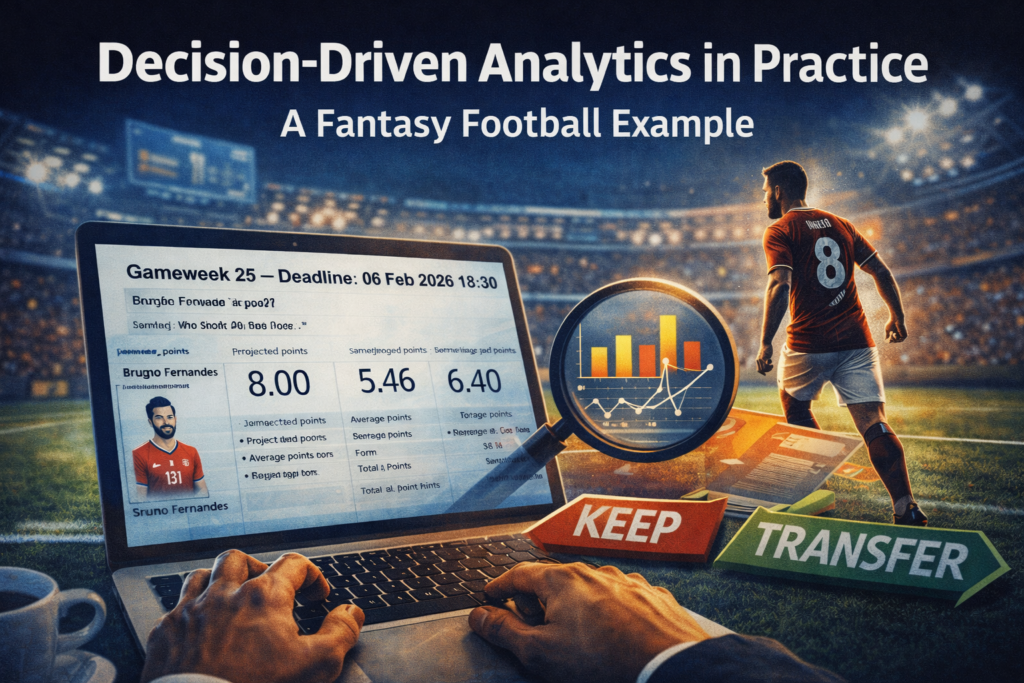
Fantasy Football and Decision-Driven Analytics: A Practical Example
From Data to Insight
Â
Earlier in this series, we discussed how insight only exists when meaning is made explicit.
Numbers don’t speak for themselves. Visuals don’t explain themselves. People create meaning.
In business dashboards, we often jump from raw data straight to visuals and assume the insight will land.
Fantasy Football exposes that flaw immediately.
You don’t just want to see player stats. You want to know:
- Who should I transfer in?
- Who should I captain?
- What gives me the highest chance of scoring more points this week?
That’s not an exploration exercise. It’s a decision.
Gameweek 25: One Question

Â
Let’s take this Gameweek 25 example.
The report asks one very simple question:
“What transfer should I make this week?”
Not ten questions.
Not “let’s explore everything.”
Not “let’s see what the data says.”
One decision.
Everything on this page exists to support that single choice.
- Projected points (ep_next)
- Average points
- Form
- Total points
Each metric has a purpose.
They aren’t there because they were available. They’re there because they influence the decision.
What Makes This Different?
This isn’t a neutral dashboard. It has intent.
The layout guides attention. The metrics are prioritised. The context is explicit. The narrative is implied:
- Here’s the player
- Here’s why they matter
- Here’s the evidence
- Here’s why this is the rational move
That’s what data-driven storytelling looks like in practice. It reduces uncertainty. It increases confidence. It makes the choice easier.
Why This Matters Beyond Fantasy Football
This might be a game. But the structure is exactly the same in business. Imagine replacing “Who should I transfer?” with:
- Which supplier should we renegotiate with?
- Which region deserves investment?
- Which product line should we discontinue?
The goal isn’t to show every possible metric. The goal is to design an artefact that helps someone make a decision now. Not next week. Not after three more breakdowns. Now.
Good Analytics Doesn’t Answer Everything
This is the uncomfortable part. Good analytics does not answer every possible question. It answers the right question well.
In this case:
What transfer should I make this week?
That constraint is powerful. It forces discipline. It forces prioritisation. It forces clarity. And that’s exactly what most business dashboards lack.
Decision-Driven Analytics in Practice
This is what I mean when I talk about moving from reporting to decision support.
The report isn’t there to show how clever the model is.
It’s there to reduce cognitive load and increase confidence.
That’s the difference between:
- A dashboard
- A decision tool
Fantasy Football just makes the stakes obvious. If you make the wrong transfer, you lose points. In business, the stakes are higher. But the principle is identical.
The Standard We Should Aim For
We should not be building dashboards that show everything. We should be building artefacts that help someone make a decision.
That means:
- Starting with the question
- Selecting only the signals that matter
- Structuring the page intentionally
- Making the implication obvious
If your dashboard disappeared tomorrow, would a specific decision become harder? If not, it’s reporting. If yes, it’s decision-driven analytics.
Where This Leads
This practical example is exactly how we approach analytics inside the Data Accelerator.
We don’t start with datasets. We start with decisions. And then we design everything backwards from there. Whether it’s Fantasy Football or forecasting revenue, the standard should be the same:
Not more dashboards. Better decisions.
Useful Links
Dashboards Don’t Drive Decisions
Data Overload Is Killing Decision-Making
Why Data Initiatives Stall as Organisations Grow
Â
News
Berita Teknologi
Berita Olahraga
Sports news
sports
Motivation
football prediction
technology
Berita Technologi
Berita Terkini
Tempat Wisata
News Flash
Football
Gaming
Game News
Gamers
Jasa Artikel
Jasa Backlink
Agen234
Agen234
Agen234
Resep
Cek Ongkir Cargo
Download Film
Understanding Schema Ownership in PostgreSQL: A Practical Guide for DBAs
Understanding Schema Ownership in PostgreSQL: A Practical Guide for DBAs (With StackOverflow Examples)
Database administration involves far more than simply writing queries or maintaining backups. One of the most important concepts, especially in environments with multiple users or applications, is schema ownership. In PostgreSQL, schemas are central to organising your database objects and controlling who can administer them, alter them, or even see them.
For many DBAs, schema ownership becomes an essential tool in managing large systems, especially those with multiple applications, multiple teams, or strict governance requirements. In this post, we explore how schema ownership works, why it matters, and how to manage it effectively — using the popular StackOverflow sample database as a practical example.
What Is a Schema in PostgreSQL?
A schema is a logical container within a database. You can think of it as a folder inside your database, holding objects such as:
- Tables
- Views
- Functions
- Sequences
- Types
Schemas help organise objects and avoid naming collisions. For example, two schemas can both contain a table called Users without conflict:
public.Users reporting.UsersWhen working with a database as large as StackOverflow, which contains tables like Users, Posts, Comments, Badges, and Votes, schemas become even more important. They help group objects, control access, and separate workloads such as:
- Operational tables
- Reporting tables
- ETL staging areas
- Historical or archival layers
All of this links directly to schema ownership.
Default Ownership: The User Who Creates a Schema Owns It
PostgreSQL uses a simple and predictable rule:
The user who creates a schema automatically becomes its owner.
The owner receives full control over that schema and every object inside it.
For example, imagine you load the StackOverflow database into PostgreSQL and a developer creates a new reporting schema:
CREATE SCHEMA reporting;That developer now owns the schema and can create objects inside it, such as aggregated reporting tables:
CREATE TABLE reporting.TopTags AS SELECT TagName, COUNT(*) AS PostCount FROM Tags t JOIN PostTags pt ON t.Id = pt.TagId GROUP BY TagName;This model works well until responsibilities change — a common issue on larger teams.
Transferring Ownership Using ALTER SCHEMA
Ownership can easily be reassigned using a single SQL command:
ALTER SCHEMA reporting OWNER TO dba_team;Here are practical examples using the StackOverflow dataset.
Example: Moving Reporting Ownership to the DBA Team
Suppose an analyst creates a schema for Power BI models, containing objects such as:
reporting.TopAnswerersreporting.WeeklyPostTrendsreporting.TopTagsreporting.DailyActivity
When the environment moves to production, the DBA team might need to take ownership. A simple transfer command handles this cleanly.
Example: ETL and Staging Schemas
Many data pipelines load raw StackOverflow data into a staging area, such as:
staging.StackOverflowRawPostsIf DevOps originally created the staging schema, transferring ownership to a controlled service account improves governance:
ALTER SCHEMA staging OWNER TO service_etl;Ownership transfer is safe, predictable, and essential for clean administration.
Administrative Control: Governance and Security
Schema ownership directly influences your permission model. The owner controls:
- Who can create, drop, or modify objects
- Who can read or write inside the schema
- Security policies
- Permission grants and revocations
This means schema ownership is tightly aligned with:
Security
The StackOverflow dataset contains sensitive fields such as:
DisplayNameLocationEmailHash- Optional PII fields in other dumps
Incorrect schema ownership could expose personal data to the wrong team or department.
Governance
It is common to separate environments into logical schemas such as:
raw– imported StackOverflow dataclean– standardised tablessemantic– business modelling layerreporting– analytics-ready datasets
Each requires a clear ownership model to maintain consistency across development, testing, and production.
Operational Risk Reduction
Allowing a developer to own a production schema can lead to accidental changes or dropped objects. Transferring ownership to controlled roles significantly reduces this risk.
Conclusion
Schema ownership is a foundational element of PostgreSQL’s security and administrative model. Whether you’re working with a small application or analysing millions of records using the StackOverflow dataset, the key principles remain consistent:
- Schemas are owned by their creators by default
- Ownership can be transferred safely using ALTER SCHEMA
- Correct ownership improves governance, security, and operational stability
Taking time to review schema ownership, especially in environments with shared ownership or large development teams — can help prevent permissions conflicts, security gaps, and operational risks.
Ready to Learn More?
Contact us for a discssion aroudn your training platform consulting and training needs
Â
Useful Links
Who Wins Database Connection Limit or Instance Limit?
Querying Data with Microsoft Transact-SQL
Are You Paying Too Much for Your Database Expertise?
News
Berita Teknologi
Berita Olahraga
Sports news
sports
Motivation
football prediction
technology
Berita Technologi
Berita Terkini
Tempat Wisata
News Flash
Football
Gaming
Game News
Gamers
Jasa Artikel
Jasa Backlink
Agen234
Agen234
Agen234
Resep
Cek Ongkir Cargo
Download Film