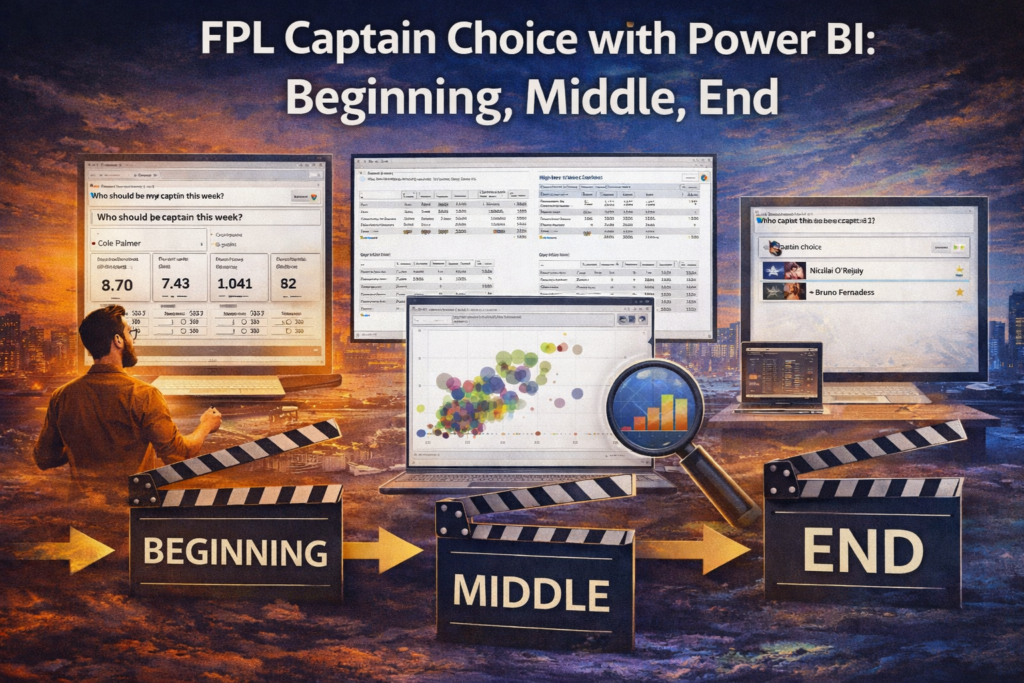
FPL Captain Choice with Power BI: A Story-Structured Report
FPL Captain Choice with Power BI: A Story-Structured Report
If you’ve been following my series on data-driven storytelling, particularly the last post on structuring reports with a beginning, middle, and end, you’ll know I’ve been building toward something practical.
So now it’s time to apply that framework to my own FPL report.
Because if the structure works, it should work where the stakes are obvious: picking the right captain each week in your fantasy premier league team.
Turning My FPL Report Into a Story: Beginning, Middle, End
Your FPL captain choice is the most important decision you make each gameweek. This post applies the beginning–middle–end report framework to my Fantasy Premier League Power BI report and shows how to design it to deliver a clear recommendation.
Power BI report structure should follow stories
In the last post, I argued that a Power BI report should follow the same structure as a story:
Not because it sounds nice. Because it reduces cognitive load and improves decisions. So let’s apply that properly. Not in theory. In Fantasy Premier League.
The beginning: why should I care?
In FPL, there is one decision each week that matters more than any other:
Who is my captain?
Get it right and you double the points of your highest-performing player. So you get the score of your best player twice! If you make the right selection.
Get it wrong and you can drop thousands of places overnight.
This isn’t just another metric. It’s the highest leverage decision in the game. So the beginning of the report must frame that explicitly.
Not:
- “Gameweek Overview”
- “Player Metrics”
But:
Who should I captain this week?
That is the context. That is the scope. That is the decision. Everything that follows exists to reduce uncertainty around that one question.
If the opening page of the report doesn’t make that obvious within seconds, it’s not doing its job. As you can see from the screen shot below of the report page aptly named Beginning – Which player should I captain this week the data suggested based on estimated points next week that the captain should be Cole Palmer or Nico Reily with a bit of Power BI Co-pilot for a bit of fun too.
The middle: what’s happening and why?
Once the decision is framed, we move into the middle.
This is where most dashboards live. But in a story structure, this part has a job: to build confidence in the decision.
In FPL terms, that means analysing:
- high form players
- high projected points
- strong historical scorers
- good value players
- position-based comparisons
But here’s the discipline: We only include what influences the captaincy or transfer decision. Not everything.
1) High form players
Form is one of the clearest short-term signals in FPL. If a player has scored well in the last 3–5 gameweeks, that’s meaningful momentum. So the report should clearly surface:
- Top players by form
- With context (position, price, minutes played)
Not buried in a table with rows and rows of data. It should be highlighted. Because form directly influences captain confidence.
2) High projected points (EP_Next)
Projected points matter because captaincy is a forward-looking decision, you have heard it all before, “Past performance does not mean future returns”. Your report should clearly show:
- Top projected points overall
- And top projected points by position
This is where the story narrows. We’re not asking “Who is interesting?” We’re asking:
Who is most likely to deliver points this week?
So our middle section, page one of two aptly named Middle – Top Players by Form EP and PositionÂlooks like this
3) High scoring but cheap – Good ROI for the business people out there
Transfers matter too. Let’s not forget that. The middle section should also surface:
- players with high total points
- relative to their cost
- with strong recent form
That’s how you identify value.
A £5.5m defender averaging 6 points per game might be a better transfer than a £7.5m underperforming midfielder.
The report should help answer:
- If I need a transfer this week, where is the value?
- Which positions offer upside?
This builds the case. This builds the confidence.

The end: what do we do next?
Now comes the part most dashboards miss. The ending. The implication. The recommendation.
Based on:
- form
- projected points
- value
- position comparisons
The report must land on:
This is the captain.
And optionally:
These are the top alternatives by position.
So one of the previous post in this series made Brent Ozar’s newsletter, it was the one called Data Overload Is Killing Decision-Making and he added comment in his newsletter about my post that said “Gethyn Ellis says Data overload is killing decision-making, and I’ll add this one of the reasons people are leaning harder on AI to distill stuff” So I did, for my ending I got Power BI Copilot describe based on my data the best team this week. Here it is if you want it for Friday’s deadline
This doesn’t remove nuance. It removes ambiguity. It gives the manager clarity.
Why this works
This structure works because it aligns with how the brain processes decisions.
Beginning: Why should I care? → Captaincy decision.
Middle: What’s happening and why? → Form, projections, value.
End: What do we do next? → Captain selection + alternatives.
That’s not creative writing. It’s cognitive alignment.
What this means for business analytics
Now zoom out. Replace:
“Who should I captain?”
With:
- Which supplier should we renegotiate with?
- Which product should we prioritise?
- Which region should we invest in?
The structure is identical. Most business dashboards stop in the middle. The FPL example makes it obvious because the stakes are visible and immediate. If I publish an FPL dashboard that never tells me who to captain, it’s useless. The same should be true in business.
The real test
If someone opens your Power BI report and asks:
“So what should we do?”
Then your story hasn’t finished. In FPL, that costs you rank.
In business, it costs you clarity, speed, and alignment. That’s why structure matters.
Want to apply this beyond FPL?
Fantasy Premier League makes the stakes obvious.
Get the captain wrong and you drop rank. Get the decision wrong in business and you lose time, money, and momentum. The structure is the same.
Inside the Data Accelerator, we work with teams to move from reporting to decision support — starting with the decision, structuring reports with intent, and making the implication explicit.
If you’re serious about turning your Power BI reports into decision tools, not just dashboards, that’s exactly what we focus on.
In the next post, we’ll look at something even more uncomfortable: you are not the hero of the report — the audience is.
Related: Power BI Report Structure: Beginning, Middle, End
Example: Decision-Driven Analytics in Practice: A Fantasy Football Example
News
Berita Teknologi
Berita Olahraga
Sports news
sports
Motivation
football prediction
technology
Berita Technologi
Berita Terkini
Tempat Wisata
News Flash
Football
Gaming
Game News
Gamers
Jasa Artikel
Jasa Backlink
Agen234
Agen234
Agen234
Resep
Cek Ongkir Cargo
Download Film
Best FPL Players of the 2025/26 Season So Far: A Power BI Analysis of Points and Form
What happens if we let FPL data decide?
Rather than opinions, narratives, or club bias, I decided to use my Power BI FPL model to answer two very specific questions:
- Who are the best-performing players this season so far, based purely on points?
- Who are the players in form right now, based on recent performance?
The results were interesting, and in one case, mildly controversial.
Ranking Players by Total FPL Points
The first step was straightforward. I already have a Power BI semantic model with:
- A Detailed Player Data fact table (match-level FPL data)
- Dimension tables for Player, Club, and Position
To rank players objectively, I added a DAX measure that calculates a dense rank across all players based on total FPL points.
Player Rank Measure (Season to Date)
Player Rank in Club = RANKX( ALL ( 'Player Data (Dim)'[Player Name] ), CALCULATE( [Total Player Points] ), , DESC, DENSE )This measure ignores any filters on individual players and ranks everyone globally by points scored so far this season.
Building the “Best Team So Far” in Power BI
With the ranking measure in place, I created four table visuals in Power BI, one for each position:
- Goalkeepers
- Defenders
- Midfielders
- Forwards
Each visual was filtered by position and sorted by Player Rank. From there, I selected the top performers to assemble a 15-man FPL squad.
To be clear:
- This team does not consider FPL budget constraints
- It sticks to the FPL squad requirements
- It is purely performance-driven
The Best FPL Players So Far (By Points)
Goalkeepers
- Robin Roefs – Sunderland
- Jordan Pickford – Everton
Defenders
- Gabriel – Arsenal
- Marc Guéhi – Crystal Palace
- Trevoh Chalobah – Chelsea
- Jurriën Timber – Arsenal
- James Tarkowski – Everton
Midfielders
- Declan Rice – Arsenal
- Antoine Semenyo – Bournemouth
- Bruno Guimarães – Newcastle
- Bruno Fernandes – Manchester United
- Morgan Rogers – Aston Villa
Forwards
- Erling Haaland – Manchester City
- Thiago – Brentford
- Jarrod Bowen – West Ham
Two observations stand out immediately:
- This squad would leave you around £17m over budget
- There isn’t a single Liverpool player in the list
Data can be uncomfortable like that.
The Problem with Total Points
Season-long points are useful, but they have a major weakness: recency bias works both ways.
- A player who started the season hot but faded still ranks highly
- A player returning from injury or hitting form late can be under-represented
To solve that, I introduced a form-based approach.
Measuring Player Form (Last 30 Days)
Instead of looking at the entire season, I created a measure that calculates average points over the last 30 days, based on actual kickoff times.
Player Form Measure
Form = VAR TodayDate = MAX('Detailed Player Data (Fact)'[Kickoff_Time]) VAR StartDate = TodayDate - 30 RETURN CALCULATE( AVERAGE('Detailed Player Data (Fact)'[Total Points]), 'Detailed Player Data (Fact)'[Kickoff_Time] >= StartDate && 'Detailed Player Data (Fact)'[Kickoff_Time] <= TodayDate )This dynamically adjusts as new matches are played, ensuring that form always reflects current performance, not historical reputation.
Ranking Players by Form
With form calculated, I applied the same ranking logic as before.
Player Rank by Form
Player Rank Form = VAR ThisPlayerForm = [Form] RETURN RANKX( ALL ( 'Player Data (Dim)'[Player Name] ), CALCULATE( [Form] ), , DESC, DENSE )Now I can instantly answer questions like:
- Which defenders are actually delivering right now?
- Are premium midfielders justifying their price recently?
- Is a forward on a hot streak or living off one big haul?
This is where Power BI really shines: switching between season consistency and short-term momentum without rebuilding anything.
Why This Matters for FPL Strategy
Using both views together gives you a much stronger decision framework:
- Total points highlight reliable, season-long performers
- Form identifies momentum, rotation risk, and short-term opportunity
If you’re planning transfers for the second half of the season, form-based rankings are often the difference between climbing the mini-league and standing still.
More importantly, this approach removes emotion from decision-making. No hype. No narratives. Just data.
From FPL to Real Business Decisions
What I’ve described here isn’t really about Fantasy Premier League.
It’s about:
- Clear metrics
- Trusted models
- Decision-making backed by data
The same principles apply whether you’re picking an FPL captain or making multi-million-pound business decisions from dashboards.
Want This Level of Clarity in Your Organisation?
If your reporting feels slow, inconsistent, or hard to trust, that’s exactly the problem my Data Platform & Analytics Accelerator is designed to solve.
It helps organisations:
- Build reliable Power BI and Microsoft Fabric foundations
- Define consistent metrics that people actually trust
- Move from dashboard noise to decision clarity
Book a call today to discuss the Accelerator and see how it could work for your organisation:
Book an appointment to talk about the Data Platform Accelerator
Because whether it’s FPL or the boardroom, better data always wins.
Useful Links
Why Data Platforms Like Microsoft Fabric Don’t Fix Broken Data Culture
Why Reporting Slows Down as Organisations Grow
Xander’s First Season – A Proud Dad’s Reflection
News
Berita Teknologi
Berita Olahraga
Sports news
sports
Motivation
football prediction
technology
Berita Technologi
Berita Terkini
Tempat Wisata
News Flash
Football
Gaming
Game News
Gamers
Jasa Artikel
Jasa Backlink
Agen234
Agen234
Agen234
Resep
Cek Ongkir Cargo
Download Film
Moneyball Fantasy Premier League Power BI: Data-Driven FPL Decisions from My Madrid Talk
Moneyball in Madrid: Data, Decisions, and a Weekend of FPL Analytics
I’ve spent the weekend in Madrid delivering my talk “Moneyball: Building a Killer Fantasy Football Team with Power BI.”It was a brilliant event, and despite my session being in English, the turnout was fantastic. A big thank you to everyone who came along, engaged with the content, and stayed behind afterwards to ask questions. Events like this remind me why I love blending data, football, and teaching.
One question stood out above the rest. Joaquín González Galdo LinkedIn profile asked:
“What is the key metric you use when making decisions in FPL?”
It’s a deceptively simple question, yet powerful. Choosing a single metric to define your decision-making process is something every analyst and FPL manager wrestles with. It deserves a full blog post of its own, and it’s the kind of question I’ll be bringing to the next episode of the Power BI FPL Show with Ben Ferry and Justin Bird. There’s a lot to unpack, from expected points to form trends, fixture difficulty, and effective ownership. Watch this space for a deeper dive.
Power BI File and API Scripts Now Available
During the session, I promised to make my Power BI file available, along with the PowerShell script I used to connect to the FPL API and pull individual player gameweek data. I’ve now uploaded everything to my GitHub hub repo, and you can access it here:
Feel free to explore, clone, modify, and test the model. The Power BI report demonstrates how to build a star-schema model for FPL, how to perform gameweek-level analysis, and how to apply metrics and calculations that help drive decision-making. The PowerShell connector script is lightweight but effective, making it a useful starting point for anyone wanting to extend their own FPL-powered data pipelines.
When Your Internet Fails and You Panic-Transfer Your Keeper
Ironically, just as I was demonstrating the value of data-driven decisions, the venue Wi-Fi failed—leaving me
unable to update my own team live during the talk. Classic.
Once I returned to a stable connection, the first move I made was in goal: Roefs out, Henderson in.
Henderson’s estimated points came in at around 7, compared with Roefs at 2.7, making the swap a straightforward one under my evaluation framework. Even small improvements at the goalkeeper position can meaningfully shift weekly variance, so this one was a no-brainer.
Semenyo vs Grealish – A Tale of Two Underperformers
I’m still torn on whether to transfer out Semenyo. His numbers and projected points definitely suggest that he should go—yet selling him would mean losing team value. Value preservation is a key element of long-term strategy, so for now he survives.
Grealish, however, hasn’t been pulling his weight either, and unlike Semenyo, I’m not emotionally invested in holding him. His form has dipped, and Everton have been erratic.
So I made the switch: Grealish → Harvey Barnes (Newcastle United)
Barnes has been sharp, has strong underlying metrics, and a very favourable run of fixtures. There’s also some interesting off-the-pitch chatter about him potentially switching international allegiance to Scotland following their World Cup qualification, nothing like a burst of motivation to keep his form trending upward.
Woltemade Out – But Who Comes In?
The next move was shipping out Nick Woltemade. West Ham’s Callum Wilson is in form, and although the fixture against Liverpool looks challenging on paper, the FDR simply isn’t capturing how poor Liverpool have been defensively. There’s a part of me that thinks Wilson could genuinely haul. He’s clinical, he’s confident, and he loves a headline moment.
The alternative I’m considering is Igor Thiago from Brentford. He’s less injury-prone than Wilson, he’s been ticking along nicely, and the fixtures are much kinder. His underlying numbers put him firmly in the “viable punt” category. I may still pivot before the deadline.
I chose Thiago.
When Gut Instinct Creeps Back In
One thing I admitted during the session: over the past few weeks, I let my gut start to override my framework. With Manchester City’s tough run of matches, I tried to be clever and avoid captaining Haaland. It hasn’t paid off. This week, the data actually suggested that Harvey Barnes could be a viable captaincy option. His estimated points placed him right in the conversation. But there’s one metric that trumps everything: effective ownership. Haaland’s remains huge. If he hauls—and he’s due—going without him as captain would be catastrophic.
So, despite Barnes being a legitimate option under the model, I’ve done the sensible thing: Haaland is back as captain.Here’s my final lineup
A good reminder that data-driven decision-making is a discipline. It requires consistency.
Final Thoughts
Madrid was superb. Great city, great people, great conversations, and a great reminder of how global the FPL and Power BI communities have become. I’ll be writing more about key metrics, decision frameworks, and how to build your own analytics workflow for Fantasy Premier League.
Until then, enjoy the files, enjoy the data, and good luck for the gameweek ahead.
Useful Links
Exploring Microsoft Fabric Through Fantasy Premier League Data
The Cost of Doing Nothing: How Ignoring Data Strategy Drains SME Growth
How to Win at Fantasy Premier League Using Data Analytics and Power BI
News
Berita Teknologi
Berita Olahraga
Sports news
sports
Motivation
football prediction
technology
Berita Technologi
Berita Terkini
Tempat Wisata
News Flash
Football
Gaming
Game News
Gamers
Jasa Artikel
Jasa Backlink
Agen234
Agen234
Agen234
Resep
Cek Ongkir Cargo
Download Film