Standard Dimensions & Player Guide
When selecting a padel court, most players book courts without knowing the actual dimensions. That’s a missed advantage. Court size directly affects how you move, where you position yourself and which shots work.Â
A padel court isn’t a tennis court with walls. It is a completely different space. Knowing the exact measurements tells you what to expect before you step on court. Padel court size also impacts how quickly beginners learn and how difficult or easy it is while playing. At the core, it reveals the mechanics of the game and various strategies that players can evolve.
It also explains why professionals won’t play on non-standard courts. Hence, the following discussion matters.Â
What Is the Standard Padel Court Size?
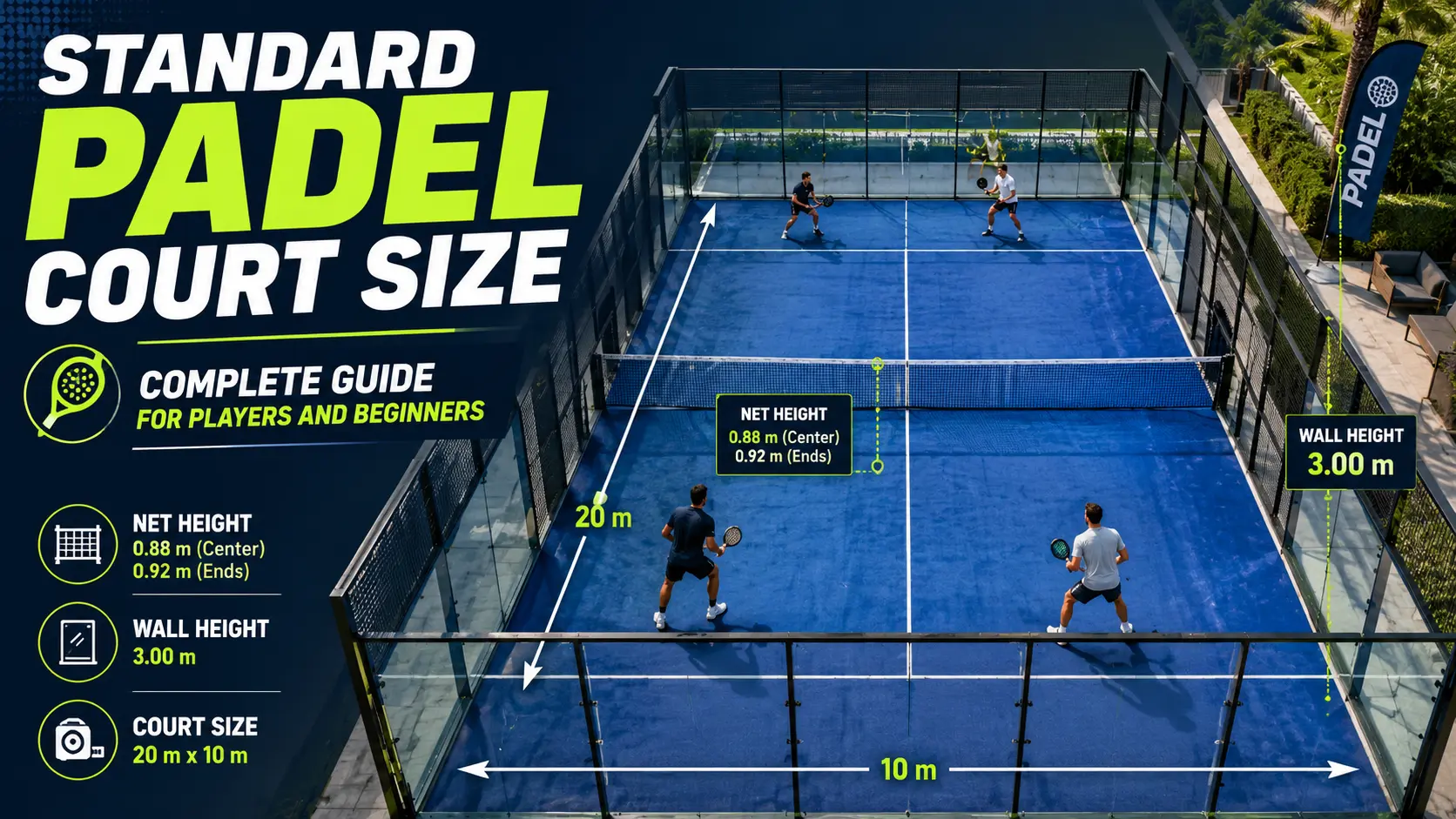
A standard padel court measures 20 metres long and 10 metres wide. That’s your baseline. Every official padel court in tournaments and certified facilities follows this exact footprint. Length includes both the service boxes and the court lines. Width spans from baseline wall to baseline wall.
In feet, that is 65.6 feet by 32.8 feet. Most Indian venues list dimensions in both metric and imperial units. Knowing both helps when you’re comparing courts or analysing court layouts across different facilities.
| Feature | Metric | Imperial |
| Court length | 20 m | 66 ft |
| Court width | 10 m | 33 ft |
| Playing surface area | 200 sq m | 2,178 sq ft |
| Recommended total area (with perimeter space) | 231 sq m | 2,486 sq ft |
| Minimum perimeter clearance | 0.5 m | 1 ft 8 in |
| Minimum overhead clearance | 6 m | 20 ft |
| Back wall height | 4 m | 13 ft |
| Side wall (first panel) | 4 m | 13 ft |
| Side wall (second panel) | 3 m | 10 ft |
| Side glass wall height | 3 m | 10 ft |
| Line marking width | 5 cm | 2 in |
| Service line distance from net | 6.95 m | 23 ft |
| Distance: service line to back wall | 3 m | 10 ft |
| Net height (centre) | 0.88 m | 3 ft |
| Net width (court width) | 10 m | 33 ft |
The court is at ground level in most facilities. You’ll notice the court doesn’t float or sit elevated like some tennis courts.
Padel Tennis Court Dimensions
The 20×10 m tells only half the story. The court layout includes multiple zones that affect gameplay. The service box, baseline area, and net position all follow strict padel tennis court dimensions set by the International Padel Federation.
Service Box and Baseline Areas
Each service box measures 6.95 metres long from the net. That’s roughly 23 feet. The baseline is 1.05 metres behind the service line.
Net Height and Position
The net stands 0.88 metres high at the centre and 0.92 m at posts. That’s about 3 feet. The net stretches the entire 10-meter width. The slightly lower net compared to tennis encourages more attacking shots.
| Dimension | Metres | Feet |
| Court Length | 20 m | 65.6 ft |
| Court Width | 10 m | 32.8 ft |
| Service Box Length | 6.95 m | 22.8 ft |
| Baseline Depth | 1.05 m | 3.4 ft |
| Net Height (Centre) | 0.88 m | 3.0 ft |
| Court Height (Ceiling) | 4 m | 13.1 ft |
| Wall Height | 3-4 m | 10-13 ft |
Wall Configuration and Enclosure
Walls define padel. Unlike tennis, the padel court is enclosed on all sides. Walls are 3-4 metres high— the backcourt walls reach this height. Side walls also follow this specification. The back wall and side walls remain in play during rallies.
The walls are generally constructed from tempered glass, metal mesh, or plexiglass. Different materials affect ball behaviour slightly. Courts built to international standards maintain these exact padel court size measurements regardless of the construction material chosen.
Padel Court Size Height
The 4-meter ceiling height is calculated to prevent endless lobs and maintain rally intensity. A lob that travels above 4 metres hits the ceiling. The ball drops back into play at the point of contact. This rule keeps matches fast and forces aggressive positioning near the net.
Beginners often underestimate the ceiling impact. In your first matches, you’ll hit ceiling balls. The standard padel court size height at 4 metres creates this dynamic. The low ceiling compared to other racquet sports accelerates play and emphasises net control over baseline rallies.
Indian Padel Federation Court Standards
The Indian Padel Federation follows international standards set by the World Padel Tour and the International Padel Federation. Every certified Indian padel federation court must adhere to the 20×10 meter specification.
Some uncertified or smaller facilities might deviate slightly. A private club court might run 19.5 metres long or cut width to 9.5 metres. These variations change gameplay significantly.Â
When booking through aggregators like Khelomore, look for certified venues that maintain regulation padel court size measurements.
Why Consistency Matters for Your Game
Developing consistent positioning and movement requires standardised court dimensions. Training on courts with varying padel court size measurements forces you to recalibrate each session. Certified venues using proper padel tennis court dimensions let you focus purely on skill development.
Padel Court Size in Feet vs Metres
India operates in both metric and imperial units depending on context. Most sporting facilities now list padel court size in metres as their primary measurement. But many players still think in feet, e.g., those familiar with tennis courts or playing in clubs with mixed sports.
The conversions are straightforward. Twenty metres equals 65.6 feet. Ten metres equals 32.8 feet. Most professional courts simply post both measurements.Â
When you’re booking a court through an app, the listing should display padel court size measurements in both units for absolute clarity.
Storage and transport of equipment assumes metric court dimensions in international standards. If you’re buying padel racquets or planning training programs, suppliers reference meter-based dimensions. Understanding both systems prevents confusion when researching technique videos or court diagrams online.
Final Word
Standard padel court size follows a global specification: 20 metres by 10 metres with a 4-meter ceiling. These dimensions define the game itself. Court layout, movement, and strategy all flow from these exact padel court size measurements. When you understand the dimensions, you understand the sport.
Book your next session at a certified facility that maintains proper padel tennis court dimensions. The difference between regulation and non-standard courts becomes obvious after your first match. Your improvement will accelerate when you’re playing on courts that meet international standards.
Ready to Play?
Stop researching and start booking certified padel courts with standardised dimensions. Khelomore connects you to 30+ sports facilities with regulation padel courts across major Indian cities.
Download the KheloMore App to
Available on Android and iOS. Court booking in a few taps. No calls. No group coordination. Just courts that meet international standards for padel court size.
FAQs
What’s the Minimum Height Needed for a Padel Court?
Four metres is the minimum height for a padel court. Some facilities push to 4.5 metres for additional clearance.
Can Court Size Change During a Match?
No. The padel tennis court dimensions are constant throughout a match. What changes is line calls and positioning. Players adapt their strategy to the exact court they’re playing on.
How many players fit on a padel court?
Padel is a doubles sport designed for four players at a time. Two players occupy each side of the net. The court dimensions and wall placement optimise play specifically for doubles competition only.
How much does it cost to build a padel court?
In India, building a padel court usually costs between ₹15 lakhs and ₹30 lakhs. Major expenses include foundation and civil work, plus the steel structure and tempered glass enclosure.
PakarPBN
A Private Blog Network (PBN) is a collection of websites that are controlled by a single individual or organization and used primarily to build backlinks to a “money site” in order to influence its ranking in search engines such as Google. The core idea behind a PBN is based on the importance of backlinks in Google’s ranking algorithm. Since Google views backlinks as signals of authority and trust, some website owners attempt to artificially create these signals through a controlled network of sites.
In a typical PBN setup, the owner acquires expired or aged domains that already have existing authority, backlinks, and history. These domains are rebuilt with new content and hosted separately, often using different IP addresses, hosting providers, themes, and ownership details to make them appear unrelated. Within the content published on these sites, links are strategically placed that point to the main website the owner wants to rank higher. By doing this, the owner attempts to pass link equity (also known as “link juice”) from the PBN sites to the target website.
The purpose of a PBN is to give the impression that the target website is naturally earning links from multiple independent sources. If done effectively, this can temporarily improve keyword rankings, increase organic visibility, and drive more traffic from search results.

Understanding Slowly Changing Dimensions – Gethyn Ellis
Understanding Slowly Changing Dimensions
Slowly Changing Dimensions (SCDs) are a cornerstone of data warehousing design. They ensure that the descriptive attributes of business entities—customers, products, employees, locations—are handled correctly when they change over time. Without a clear strategy for tracking changes in dimension data, analytical systems either lose valuable history or become inconsistent, leading to inaccurate reporting.
In this post, we explore the major SCD types, what they mean in practice, and how they fit into a typical dimension-loading routine. We also take a closer look at the most commonly used approach: the Type 2 Slowly Changing Dimension.
What Are Slowly Changing Dimensions?
A dimension becomes “slowly changing” when its attributes do not remain static. Customer names change, product descriptions evolve, and organisation structures shift. A data warehouse needs a strategy for handling these changes in a predictable, auditable manner.
The most recognised SCD types include:
- Type 0: Fixed — no changes allowed A Type 0 dimension attribute is effectively read-only. Once loaded, it never changes. This is useful for values that should remain permanently tied to the original record, such as a customer’s join date or the original product launch category.
- Type 1: Overwrite — no history Type 1 simply overwrites old values with new ones. The historical value is lost. This approach is suitable for correcting errors or updating non-critical attributes such as a standardised name format.
- Type 2: Add a new record — full history preserved Type 2 is the workhorse of dimensional modelling. Each time a change occurs, a new version of the record is inserted, and the old version is closed off using effective dates. This preserves a complete history of how the entity evolved over time.
- Type 3: Add a new column — limited history Here, the old value is stored in an additional “previous value” column. This gives only a snapshot of one historical state. It is useful when you only need to compare “current” versus “prior” attributes.
- Type 4: History table — archive old records Older versions are moved into a dedicated history table. The current table stays small and fast, while detailed historical records remain accessible when required.
- Type 5/6: Hybrid approaches Large or complex organisations sometimes blend techniques, such as combining Type 1 and Type 2 behaviours for different sets of attributes, or maintaining both current and historical versions for performance reasons.
Why Type 2 Is the Most Common
Most real-world data warehouses favour Type 2 SCDs, particularly for customer, product, and employee dimensions. Businesses need to analyse behaviour and performance based on what was true at the time, not what is true today. For example:
- What product category did this item belong to when the sale was made?
- What address was the customer living at when the invoice was issued?
- Which department was the employee assigned to when the project started?
Type 2 SCDs allow reports to reflect the correct historical context by storing every version of the record along with a validity range.
A Typical Type 2 Loading Workflow
A standard SCD Type 2 loading routine follows a clear and predictable pattern. The process often uses metadata columns such as ValidFrom, ValidTo, and an IsCurrent flag.
A typical workflow looks like this:
- Identify changed records in the source system The ETL pipeline queries the source tables for rows updated since the last load. This is usually done using a
ModifiedDateorLastUpdatedcolumn. - Compare the incoming values with the current dimension records If no attribute has changed, do nothing. If one or more tracked attributes differ, the current record is closed off by setting its ValidTo date to the current timestamp.
- Insert the new version A new row is inserted into the dimension table with the updated values. The ValidFrom is set to the load timestamp, while ValidTo is set to a high placeholder date (for example, 9999-12-31).
- Track load status A load statistics table or metadata table records how many rows were processed, updated, or inserted during the run. This is essential for troubleshooting and operational visibility.
The result is a dimension table that behaves like a temporal record of business history. Analysts can reliably reconstruct what the world looked like at any point in time through simple date-based filtering.
Why SCDs Matter
Slowly Changing Dimensions enable time-aware analytics—one of the main reasons organisations build data warehouses in the first place. Without SCDs, historical analysis becomes unreliable. With them, organisations gain:
- Accurate period-over-period comparisons
- Reliable trend analysis
- Confidence in audit trails
- Support for full regulatory and financial reporting
As your warehouse grows, choosing the right SCD strategy becomes vital. Understanding these patterns—and implementing them consistently—sets the foundation for a robust analytical ecosystem.
If you’d like help designing or implementing your dimensional models or data loading routines, feel free to get in touch and we can explore how to apply these patterns in your environment.
News
Berita Teknologi
Berita Olahraga
Sports news
sports
Motivation
football prediction
technology
Berita Technologi
Berita Terkini
Tempat Wisata
News Flash
Football
Gaming
Game News
Gamers
Jasa Artikel
Jasa Backlink
Agen234
Agen234
Agen234
Resep
Cek Ongkir Cargo
Download Film