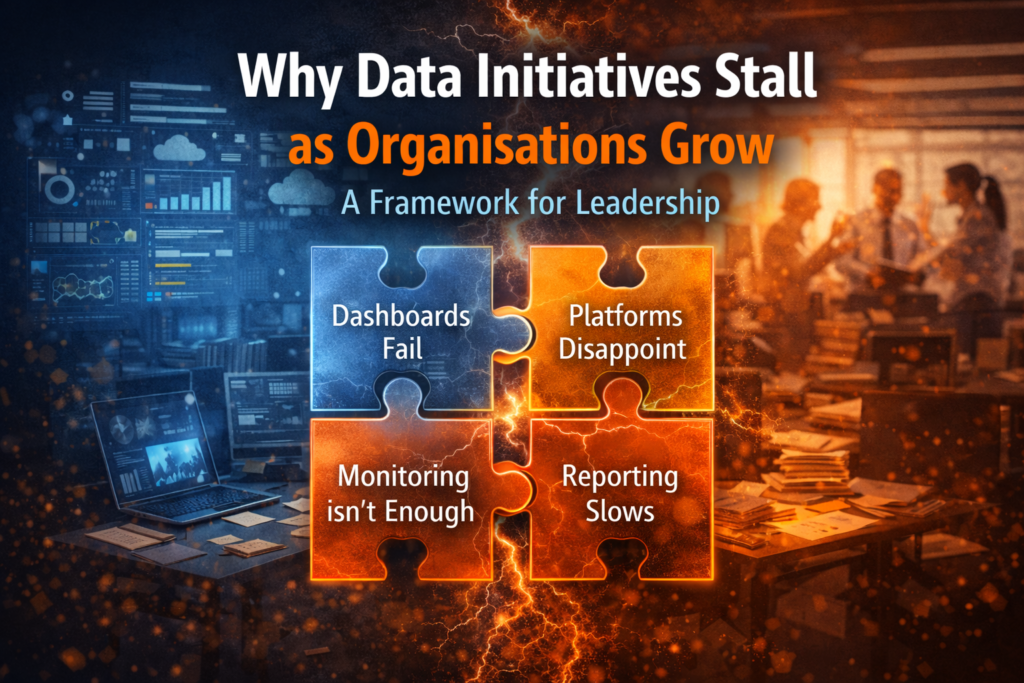
A four-part framework for leaders
Most data initiatives don’t fail loudly.
They stall.
Dashboards exist, but confidence is low.
Platforms are in place, but value feels elusive.
Reporting works, just not quickly enough.
From the outside, it looks like a tooling problem. From the inside, it feels like friction everywhere.
This series exists to explain why that happens, and why so many organisations experience the same problems at the same stage of growth.
The pattern leaders recognise (but rarely name)
Across sectors and sizes, the story is remarkably consistent:
- Early reporting delivers quick wins
- Adoption grows organically
- Complexity creeps in
- Confidence declines
- Momentum slows
Leaders often respond by:
- Building more dashboards
- Investing in new platforms
- Adding layers of monitoring
- Asking for more detail
And yet… things don’t get simpler. They get heavier.
The uncomfortable truth
Most organisations don’t have a data problem. They have an outgrown approach to data.
What worked when the organisation was smaller no longer works at scale, but nothing has replaced it.
This framework is designed to make that visible.
The four questions that explain almost everything
1. Why do dashboards fail?
Dashboards fail not because of bad visuals or poor tools, but because they are built before clarity exists.
Without shared definitions, decision intent, and ownership:
- Trust erodes
- Reports multiply
- Decisions slow
Dashboards become outputs without purpose.
2. Why don’t platforms fix broken data culture?
Modern platforms are powerful—but power amplifies whatever already exists.
If culture is unclear:
- Platforms expose disagreement faster
- Capability outpaces understanding
- Confusion scales with tooling
Technology removes friction.
It does not create alignment.
3. Why isn’t monitoring enough?
Monitoring tells you when something breaks.
It doesn’t tell you why something changed.
As organisations grow, leaders don’t just need alerts—they need confidence:
- Where did this number come from?
- What changed upstream?
- What decisions are affected?
That gap is the difference between monitoring and observability.
4. Why does reporting slow down as organisations grow?
Reporting slows not because teams work less efficiently, but because:
- Alignment doesn’t scale automatically
- Ownership becomes blurred
- Risk sensitivity increases
- Manual work creeps back in
Speed disappears when trust has to be rebuilt every time.
One problem, four symptoms
Taken together, these aren’t separate issues.
They’re different expressions of the same underlying challenge:
Organisations outgrow their original data assumptions—without realising it.
Dashboards fail.
Platforms disappoint.
Monitoring feels insufficient.
Reporting slows.
Not because people aren’t capable—but because clarity hasn’t kept pace with complexity.
Why this matters for leaders
When this pattern goes unaddressed:
- Decisions slow quietly
- Risk increases subtly
- Frustration becomes normalised
Teams work harder.
Leaders wait longer.
Confidence erodes in small, compounding ways.
The danger isn’t broken reporting.
The danger is accepting friction as inevitable.
A better way to think about data maturity
Data maturity isn’t about:
- More dashboards
- New platforms
- Bigger teams
It’s about:
- Clear decision-making
- Agreed definitions
- Explicit ownership
- Designed-for trust
Tools then accelerate progress instead of exposing cracks.
How to read this series
This series is designed to be read in order:
- Why Dashboards Fail
- Why Platforms Don’t Fix Broken Data Culture
- Monitoring vs Observability for Business Leaders
- Why Reporting Slows Down as Organisations Grow
Each article tackles one symptom.
Together, they form a single framework for understanding why data initiatives stall, and what needs to change before technology can help again.
The question that changes everything
Instead of asking:
“What tool should we invest in next?”
A more powerful question is:
“What assumptions about data, decisions, and ownership have we outgrown?”
For most organisations, answering that is the real turning point.
Data Platform Accelerator
News
Berita Teknologi
Berita Olahraga
Sports news
sports
Motivation
football prediction
technology
Berita Technologi
Berita Terkini
Tempat Wisata
News Flash
Football
Gaming
Game News
Gamers
Jasa Artikel
Jasa Backlink
Agen234
Agen234
Agen234
Resep
Cek Ongkir Cargo
Download Film