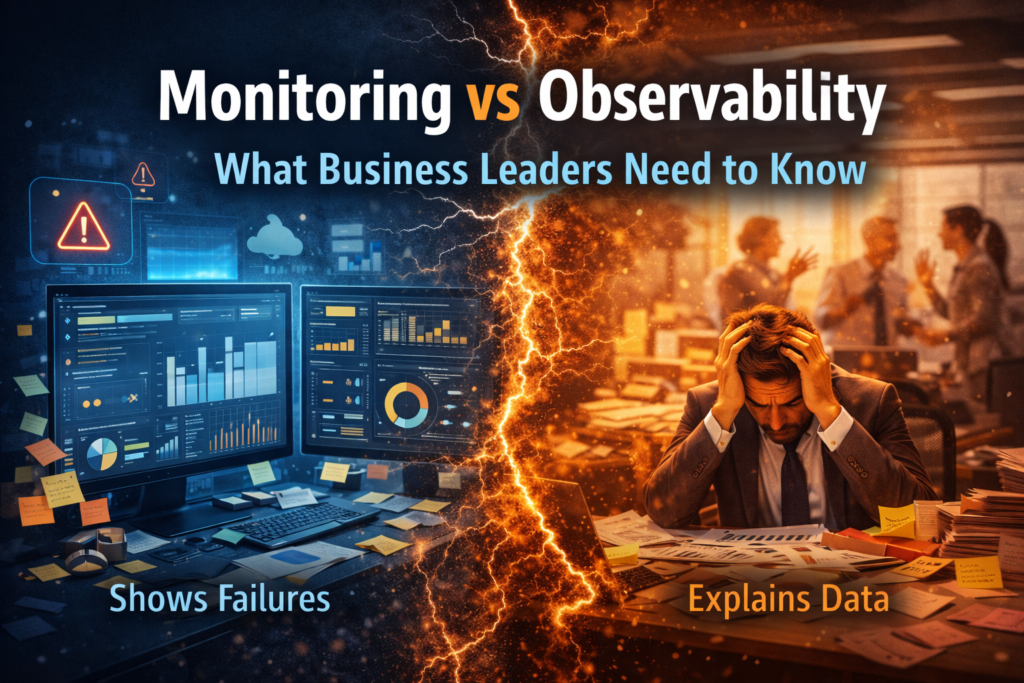
Monitoring vs Observability: What Business Leaders Need to Know
As organisations grow, a familiar frustration emerges.
- Dashboards exist.
- Monitoring is in place.
- Alerts fire.
And yet leaders still ask:
“Why didn’t we see this coming?”
This is where the conversation often turns to observability. It’s a term that sounds technical, but the problem it addresses is not.
Monitoring feels reassuring – until it isn’t
Most organisations already monitor their systems and reporting.
They track:
- System uptime
- Refresh failures
- Data latency
- Pipeline errors
From a distance, everything looks under control.
Until:
- A board pack is challenged
- A number changes unexpectedly
- A critical metric drifts with no obvious cause
At that point, monitoring tells you something is wrong,but not why.
Monitoring answers “Is something broken?”
Monitoring is about known failure states.
It works well when:
- You know what “good” looks like
- You know what can break
- You know the thresholds to watch
Examples:
- Did the report refresh succeed?
- Did the pipeline fail?
- Is the system up or down?
Monitoring is essential, but it’s reactive by design. It tells you after something crosses a line.
Observability answers “Why is this happening?”
Observability starts from a different place.
It assumes:
- The most important problems aren’t always predictable
- Business questions change faster than systems
- Failures are often subtle before they are obvious
Observability is about understanding behaviour, not just detecting failure.
For leaders, that means being able to answer:
- Why did this metric change?
- Where did the data come from?
- What else is affected?
- Can we trust this insight right now?
This isn’t a tooling debate
Monitoring vs observability is often framed as a technical upgrade.
- New tools.
- New dashboards.
- New telemetry.
That misses the point.
Observability is not something you install. It’s something you design for. Without clarity, observability tools simply generate more noise.
Why leaders feel the pain first
As organisations scale:
- Data flows increase
- Dependencies multiply
- Decision cycles shorten
Leaders feel the consequences before teams feel the cause.
Common symptoms:
- Meetings spent debating numbers rather than decisions
- Insight arriving too late to matter
- Increasing reliance on manual explanations
- “Can someone just sanity-check this?”
At that stage, the organisation isn’t lacking monitoring. It’s lacking understanding.
The hidden cost of poor observability
When observability is weak:
- Confidence drops
- Decision speed slows
- Risk increases quietly
Leaders start to:
- Ask for more reports
- Request deeper breakdowns
- Commission parallel analyses
Ironically, this makes the problem worse. More reporting ≠ more insight.
What observability really means for leaders
For business leaders, observability is the ability to:
- Trace a number back to its source
- Understand how a metric is constructed
- See when assumptions change
- Spot drift before it becomes a failure
It’s the difference between:
“The number is wrong”
and
“We know exactly why it changed, and what to do next.”
Why platforms don’t automatically give you observability
Modern platforms make observability possible.
They do not make it inevitable.
Without:
- Clear metric ownership
- Agreed definitions
- Decision-focused design
- Aligned leadership expectations
Observability tooling simply exposes existing confusion faster. This is why organisations often invest heavily, yet still feel blind.
Monitoring tells you when to panic. Observability tells you when to act
Monitoring is about protection.
Observability is about confidence.
Both matter, but they solve different problems.
Leaders don’t need more alerts.
They need fewer surprises.
Why this matters now
As organisations grow, complexity increases faster than understanding.
This is why:
- Reporting slows down
- Insight feels harder to extract
- Trust erodes quietly
The issue isn’t that teams aren’t working hard. It’s that the organisation has outgrown its original approach to insight.
Where this fits in the series
This article follows:
And leads into the next question leaders often ask:
That’s where we’ll go next.
These are also the exact challenges organisations bring into our Data & Analytics Acceleratorusually framed as tooling problems, but rooted in clarity, ownership, and design.
A better leadership question
Instead of asking:
“Do we need better monitoring?”
A more useful question is:
“Do we understand what our data is telling us, and why?”
When leaders can answer that with confidence, technology finally starts working for the business, not against it.
Useful Links
How to Achieve Key Business Goals with Data-Driven Strategies and AI Tools
What If Rejection Was the First Step to Success?
Lessons from Fantasy Premier League: Data, Decisions, and Power BI
News
Berita Teknologi
Berita Olahraga
Sports news
sports
Motivation
football prediction
technology
Berita Technologi
Berita Terkini
Tempat Wisata
News Flash
Football
Gaming
Game News
Gamers
Jasa Artikel
Jasa Backlink
Agen234
Agen234
Agen234
Resep
Cek Ongkir Cargo
Download Film